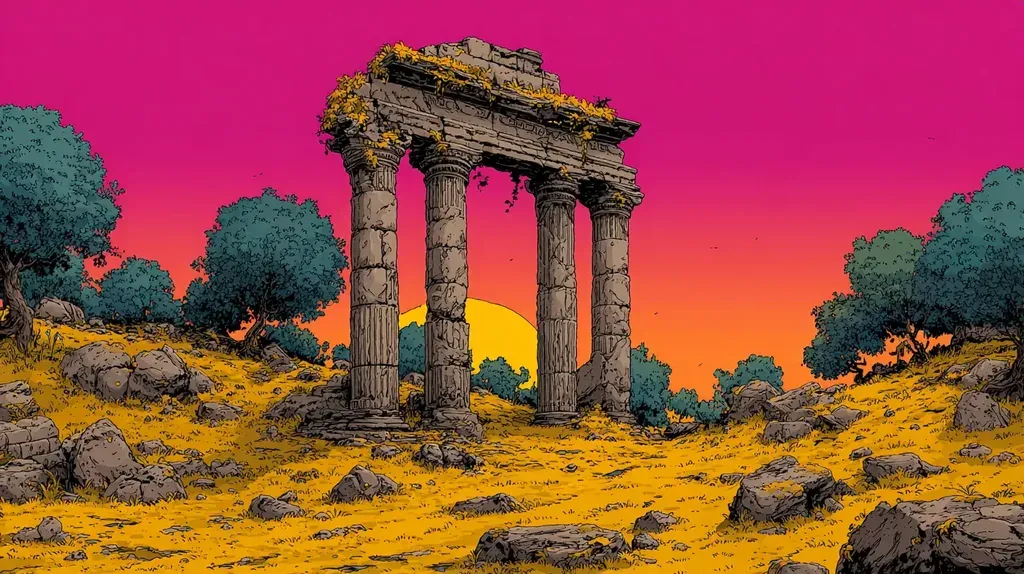
After the destruction of Carthage in 146 BC, Rome turned the territory into a province, Africa (the very name that today designates an entire continent). Refounded under Julius Caesar and then Augustus, Carthage rose again, while wheat and later olive oil turned this land into Rome's granary, without ever erasing its Punic and Berber foundations.
146 BC: how did a destroyed Carthage become Roman Africa?
the certainty that history, here, was never written in a single language
In 146 BC, the Third Punic War ended with the destruction of Carthage. Rome crushed its rival and turned the territory into a province, Africa (Africa vetus). This is the origin of the name that has, ever since, designated an entire continent.
Carthage would have to wait for Julius Caesar to rise again. Taking up a project already championed by Gaius Gracchus, he decided to found Roman colonies in Africa. Carthage was thus refounded as a Roman colony, first under Caesar, then under Augustus: the razed Punic city became a city once more, this time a Roman one.
Why did Africa become Rome’s granary?
If you trace the origin of this wealth, it begins with wheat. According to historian Sophie Bessis (Histoire de la Tunisie, chapter II), the province of Africa was devoted first and foremost to this grain, shipped to Rome to feed the capital of the Empire. From the 2nd century onwards, the provincial economy opened up to another crop, the olive tree, which came to complement wheat without ever replacing it.
Dougga illustrates this agricultural prosperity in its own way. An ancient Numidian city bearing the imprint of Carthage, still visible today in its Libyco-Punic mausoleum, it became, under Rome, a pagus attached to a neighbouring colony. Far from being a Roman creation ex nihilo, Dougga shows how the old Punic and Berber world put itself, lands and know-how included, in the service of Rome's granary.
What survived of the Punic and Berber world beneath the Roman toga?
Under Roman rule, the Punic language did not disappear. In several cities, it remained the official language in the 1st century AD, and Punic inscriptions can still be read as late as the 4th century. It did not fade: the language persisted alongside Roman institutions.
The great urban projects, meanwhile, bear the mark of Rome without erasing this substrate: the amphitheatre of Thysdrus (El Jem), built in the 3rd century, ranks among the largest in the entire Empire after the Colosseum, and is today a UNESCO World Heritage Site.
How did Africa become a land of Christian thinkers, before everything changed?
Before its decline, Roman Africa gave rise to a Christian thought of the first order. Carthage saw the birth, around 155, of Tertullian, the first great Christian writer in Latin, who died around 220. A century later, the bishop of that same city, Cyprian, died a martyr in 258. This same land also lies behind Augustine, born in 354 in Thagaste (today Souk Ahras, in Algeria) to a Christian mother, Monica, and a pagan father; he studied at Madauros and then at Carthage.
Yet this intellectual ferment unfolded across a weakened Africa. In the 3rd century, the Empire’s economic and monetary crisis, worsened by epidemics, brought construction to a halt, notably at Hadrumetum (Sousse). The turning point came the following century: the Vandals of Gaiseric, arriving from Spain, landed in Africa in 429, took Hippo in 431, then Carthage in 439. Seven centuries of Roman presence on this land thus came to an end.
From Carthage reborn to Dougga, which stayed true to its Punic and Berber roots, by way of the columns of the Thysdrus amphitheatre still standing watch over the plain, Roman Africa tells the story of a world which knew how to slip into a toga without ever forgetting what it wore underneath. The grain and then the oil that sailed off to Rome, the Punic inscriptions still legible on the stones, the pagus of Dougga that kept its old customs: it all says the same thing, a province that fed the Empire while remaining, at heart, itself. Perhaps that is what strikes you most when you stand before the tiers of El Jem or the mausoleum of Dougga: the certainty that history, here, was never written in a single language.
Also on La Sultane
The University of Tunis Holds a Symposium: VISUAL ARTS IN TUNISIA
Ennajma Ezzahra: an Architectural Embodiment of Baron d’Erlanger