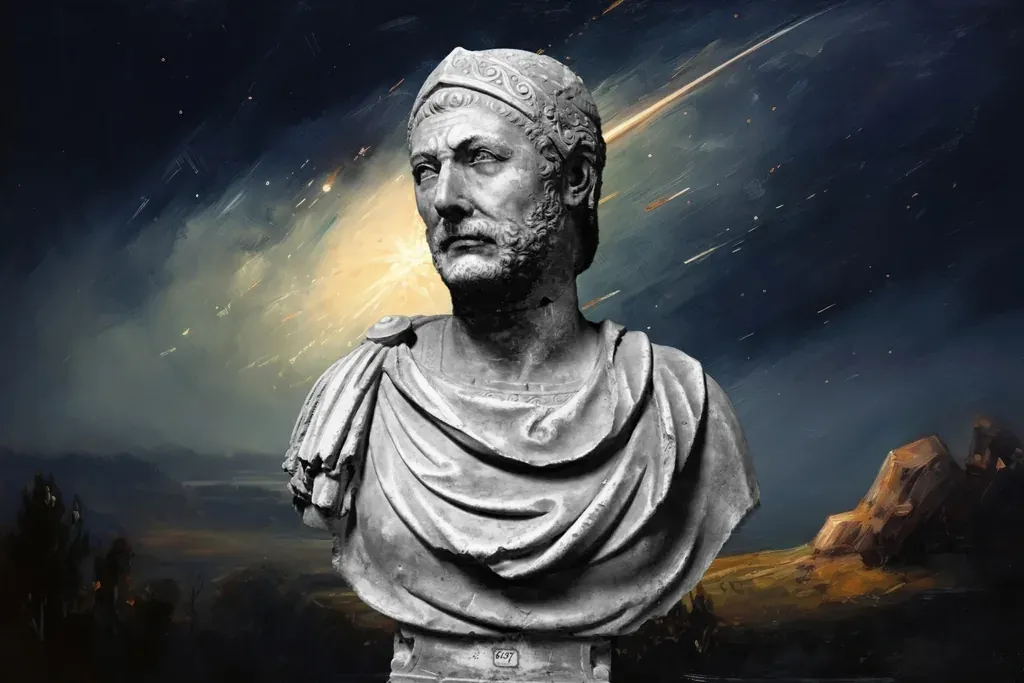
Hannibal Barca, son of Hamilcar, was the Carthaginian general who carried the war into Italy itself during the Second Punic War, a conflict lasting more than twenty years between Rome and Carthage. After the siege of Saguntum, which triggered the war in 219 BC, he crossed the Alps in 218 BC and strung together the victories of the Trebia, Lake Trasimene and then Cannae, where the Roman army was annihilated. Defeated only at Zama, in 202 BC, by Scipio, he remains one of the greatest strategists in History.
Second Punic War: the battles that wrote History
In 219 BC, Rome and Marseille interfered in the affairs of Saguntum and installed in power a faction hostile to the Carthaginians. These new rulers massacred the Saguntine allies of Carthage. The conflict that followed drove Hannibal Barca, son of Hamilcar, to besiege Saguntum until it fell.
Rome seized this opportunity to demand that Carthage hand over the young general, aged 29, accused of having violated the treaty of 226. The Carthaginian senate refused this demand. Saguntum, situated south of the Ebro, had not been an ally of Rome when the agreement was signed. Carthage therefore accepted the Roman declaration of war. The Second Punic War began.
A visionary strategist reveals his genius
The audacious manoeuvre: crossing the Alps
Rome banked on the undeniable superiority of its fleet and planned to land its forces in Spain and Africa. Hannibal then conceived a bold manoeuvre: to carry the war into Italy by land.
He brought over troops from Africa to protect Spain from a possible Roman attack. Then he dispatched numerous emissaries into the Celtic world to invite them to join their forces with his against the Romans.
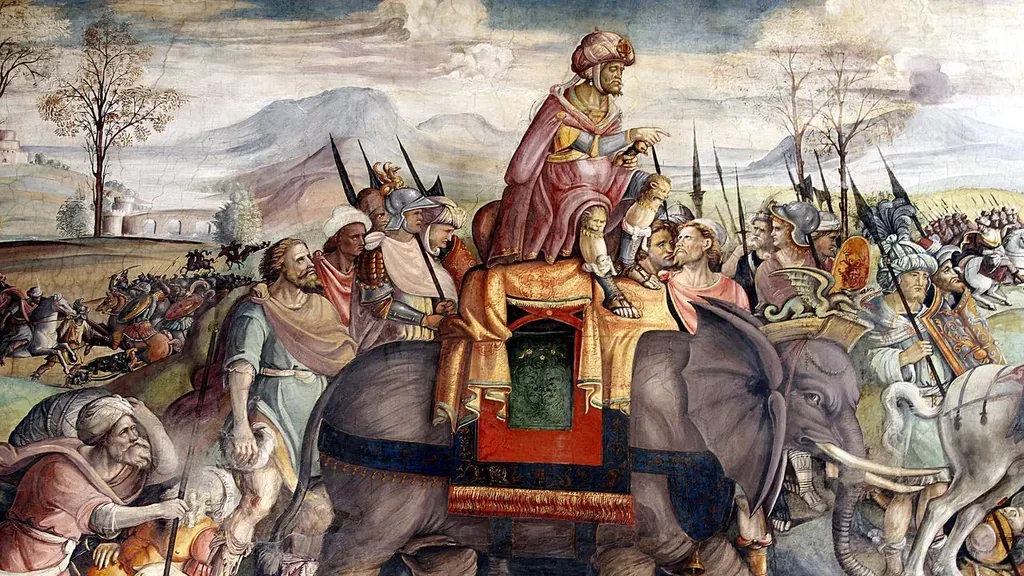
In the spring of 218 BC, he began his legendary march towards northern Italy at the head of an imposing army: 50,000 foot soldiers, 9,000 horsemen and 37 elephants. The crossing of the Alps proved gruelling. Hannibal emerged into the Po Valley in September 218 with an army reduced to 20,000 foot soldiers, 6,000 horsemen and 21 elephants.
The first victories in northern Italy
The Carthaginian general accepted this hardship to carry out his plan: attacking the Roman army in northern Italy, where Rome had not yet consolidated its authority.
The Romans understood the gravity of the situation. They cancelled the African expedition and sent troops to Spain to cut Hannibal off from his reserves and his supplies. They suffered a first defeat west of the Ticinus in December, then on the Trebia, where they lost three quarters of the forces engaged.
Buoyed by these brilliant successes, which he exploited through clever propaganda, Hannibal rallied many Gauls of Cisalpine Gaul. The Second Punic War was being fought on several fronts at once.
The Battle of Lake Trasimene: a deadly trap
The ambush in the mist
The Romans yielded the Po plain to the Carthaginian general and decided to bar him access to central Italy behind the chain of the Apennines. Hannibal had great difficulty crossing this range, where he lost many soldiers and almost all of his elephants. He left the Roman army on his left and headed towards Perugia.
The enemy troops, led by the Roman consul Gaius Flaminius, pursued him relentlessly. They camped in the vale of Lake Trasimene. The next morning, on 21 June 217 BC, the Roman army resumed its marching formation.
Hannibal took advantage of the mist covering the landscape. Positioned high on the flanks of the hills, he launched the assault on the Roman column, attacking it from all sides. Disoriented, the Roman consul and the officers were the first to perish.
A military disaster for Rome
The disorganised soldiers and foot troops tried to flee across the lake, became bogged down in it and remained there. A few managed to escape, but Hannibal quickly caught up with them and took them prisoner. He chained up the Romans and released their allies.
Hannibal was waging war against Rome alone and wanted this to be known. A few fugitives reached Rome and recounted their defeat: 15,000 Romans and their leader Flaminius met their deaths, and another 15,000 were taken prisoner. Hannibal lost nearly 2,000 Gauls on his side. The Roman military elite was decimated.
The great strategist's genius wasn't confined to the battlefield. He knew exactly how to use terrain and natural features to his advantage. He sought to isolate Rome by rallying the peoples subject to it. After each battle, he freed all the Italian prisoners, hoping to draw them away from the Roman cause.
The Battle of Cannae: a tactical masterpiece
The clash of two strategies
Rome adopted a tactic of delay. It harassed the Punic army while avoiding head-on clashes. But in 216, two new consuls were elected.
Lucius Aemilius Paulus, known as Paullus, preferred to pursue this strategy of attrition, while Caius Terentius Varro, known as Varro, preferred confrontation. The conflict was wearing down the common people. According to the historian Polybius, Rome assembled an imposing force of 8 legions to face the Carthaginians.
The Roman army numbered 80,000 men. Hannibal had fewer than 50,000 men. Continuing his raids through southern Italy, he seized grain warehouses meant to supply the Roman troops at Cannae, a small town in Apulia now called Cannes della Battaglia.
The perfect encircling manoeuvre
On 2 August 216, the decisive encounter between the two armies took place. Varro, commanding the Roman army, arranged it in a classic formation. He took command of the left wing along with the allied cavalry and left the right wing to Paullus. The most experienced Roman legions formed the backbone of the centre, flanked on either side by the allied legions.
Hannibal devised a bold strategy reflecting "his determination to fight a battle of encirclement and annihilation", according to Yvan le Bohec. He placed the Gaulish infantry in the centre, facing the Roman legions, and flanked it on either side with the heavy infantry, his African elite, which he commanded in person.
Hannibal placed the cavalry of the Iberians and the Gauls, commanded by Hasdrubal, on the left wing, and the Numidians led by Hanno on the right wing. He advanced the Gaulish infantry, which was quickly pushed back by the Romans as they launched their assault. The cavalry engagements quickly turned to the advantage of the Carthaginians on the wings.
The annihilation of the Roman army
Hasdrubal annihilated the Roman cavalry and brought his reinforcements to Hanno, striking the cavalry of the Italian allies from the rear. The Roman infantry fell into the trap of a vice that closed pitilessly upon it. In the centre, the Gauls fell back without breaking their ranks, allowing the heavy infantry to surround them gradually on the left and the right by a wheeling movement. The horsemen who had beaten the Italian allies prevented any retreat and closed the trap completely. The encirclement was perfect.
Rome lost one of the greatest armies it had ever assembled. The sources differ on the number of survivors, but the losses came to 45,000 dead and 20,000 prisoners for the Roman army. Only 15,000 men managed to escape. The bloodletting struck the high magistrates and Roman senators, many military tribunes and former consuls. Paullus perished there. Varro managed to escape, as did a young soldier, Scipio, who had not yet earned his surname of Africanus. Triumphant, Hannibal had lost fewer than 6,000 men, the majority of them Gauls.
J. Carcopino describes this battle thus in his work "Profils de conquérants" (Profiles of Conquerors): "The result was exactly what Hannibal had foreseen: by relentlessly attacking the Gauls, the Romans had let themselves be enveloped by the Africans. Trapped between the flaps of the snare that the Carthaginian had insidiously prepared for them, the legionaries could no longer fight except in disjointed groups."
The missed opportunity
In the aftermath of Cannae, Maharbal, one of Hannibal's lieutenants, suggested that he march on Rome. Following the general's refusal, according to Livy, he reproached him thus: "The gods have not given everything to the same man! You know how to win, Hannibal, but you do not know how to exploit your victory."
Some historians believe Hannibal had valid reasons not to attempt to deal Rome its death blow. He was not equipped for a long siege and his army was in a completely hostile region. His successes crowned him with glory and many cities rallied to him. Only the Carthaginian reinforcements were slow to arrive.
The inferiority of the Punic fleet and the incompetence of admiral Bomilcar prevented fresh troops from Carthage and from its ally Philip V of Macedon from reaching Italy. Carthaginian influence in Sicily came to an end. Rome launched two decisive operations: P. Cornelius Scipio set off to conquer Spain, where Hasdrubal met his death as he was returning to his brother's aid. Then, while Hannibal's army was harassed on all sides, the Romans carried the war into Africa. Carthage recalled its general, forcing him to leave Italy for good.
The Battle of Zama: the fall of a genius
Hannibal's final tactical dispositions
On 19 October 202 BC, the Battle of Zama put an end to the Second Punic War and to more than 20 years of conflict. Hannibal placed 20 elephants in the front line, the Gaulish and Ligurian mercenaries in the second line, and the Carthaginian and African infantry in the third line. The mercenaries recruited during the Italian campaign were to serve as reserves. He arranged his cavalry on the two wings: the Carthaginians on the right and the Numidians on the left.
For Hannibal, the elephants were to charge first, while the first assault, meant to weaken the Romans, would be led by the Gaulish and Ligurian mercenaries. He would then bring in the line of the Carthaginians and finally the veterans to secure victory.
Scipio's brilliant response
Scipio took steps to neutralise the Carthaginian general's plan. Breaking with the compact quincunx formation of the infantry, P. Cornelius Scipio left free passages between the tactical units of the legion and placed light infantry soldiers there who could move easily and disorient the elephants. He placed the Italian cavalry on the left wing and the Numidian cavalry led by Massinissa on the right wing.
The charge of the elephants marked the beginning of the fighting, in accordance with Hannibal's plan. But this charge quickly turned into a disaster. Panicked by the din of the Roman horns, the elephants panicked and turned against their own ranks.
The final collapse of Carthage
Scipio's plan then showed all its effectiveness. The mahouts drove their beasts into the passages left open, and the velites were able to hurl their javelins at the flanks of the animals, exposed on both sides at once. The two wings of Hannibal's army, the Carthaginian and Numidian cavalries, suffered from the stampede of the elephants.
When the two infantries clashed, the forces were already unequal. The Gaulish and Ligurian auxiliaries could not hold out for long, as Hannibal had foreseen, and fell back towards the third line, that of the Carthaginians and the Africans. The latter refused to make room for them in their ranks and fought to push back both their mercenaries and the Romans.
Scipio employed the same tactic used by Hannibal at Cannae: the second and third lines of the legionaries set off to attack the wings and began a wheeling movement. The Carthaginians still fighting against the first line found themselves encircled. The Numidian cavalry led by Massinissa returned and took the Carthaginian infantry from the rear.
The reckoning of a titanic war
The reckoning is beyond appeal: 20,000 Carthaginians perished and 10,000 were taken prisoner. The Roman army mourned the loss of fewer than 2,000 men.
After returning to Carthage, Hannibal declared to his fellow citizens that they had just lost not a battle, but the war. Carthage signed a treaty that marked the end of its Mediterranean power and enshrined Roman hegemony.
Thus ends the epic of Hannibal, one of the greatest strategists in History. His military genius held Roman power in check for nearly two decades. His crossing of the Alps and his tactical victories remain references studied in every military academy in the world.
Chronology of the Second Punic War
| Date | Battle | Result |
|---|---|---|
| 219 BC | Siege of Saguntum | Fall of Carthage's allied city; triggers the Second Punic War |
| December 218 BC | Ticinus then Trebia | Rome suffers two successive defeats; three quarters of the forces engaged lost at the Trebia |
| 21 June 217 BC | Lake Trasimene | 15,000 Romans killed (including the consul Flaminius) and 15,000 taken prisoner; Hannibal loses about 2,000 Gauls |
| 2 August 216 BC | Cannae | Total encirclement: 45,000 dead and 20,000 Roman prisoners out of 80,000 men engaged; Hannibal loses fewer than 6,000 men |
| 19 October 202 BC | Zama | Scipio's victory: 20,000 Carthaginians killed, 10,000 taken prisoner; Rome loses fewer than 2,000 men; end of the Second Punic War |
An important note: a history to be reassessed?
The Roman version called into question
It's worth making clear that the account presented here reflects the traditional version of these events, as handed down by the ancient Roman historians, chiefly Polybius and Livy. For some years now, archaeological research and the work of Tunisian historians have seriously called into question this official version.
The paradox of the Carthaginian military harbour
Several troubling elements fuel these academic debates. The dating of the circular military harbour of Carthage by the American and British archaeological missions in 1993 revealed that its construction took place just after the Second Punic War. Yet, according to the peace treaty, Carthage had no right to a war navy. Historians have never explained this major paradox.
The enigma of the location of Zama
Concerning the Battle of Zama specifically, the thousand-year-old uncertainty hanging over its location is striking. How is it that Rome, which occupied North Africa for five centuries and erected monuments to celebrate its victories, left no trace of what would have been "the most important victory in its entire history"? Despite excavations in the supposed region of Zama Regia, no obvious trace of a large-scale battlefield has been discovered.
Troubling historical anomalies
Some researchers also raise anomalies in the post-battle destinies. The supposed victor, Scipio, was accused of corruption and ended his life in obscurity. Whereas the vanquished, Hannibal, remained at the head of the Carthaginian armies and developed the country.
Contemporary research
The Tunisian writer Abdelaziz Belkhodja, drawing on the work of the German historian Theodor Mommsen and the American professor Yozan D. Mosig, even speaks of "the lie of Zama". This research suggests that history as it has been reported to us may have been largely rewritten after the destruction of Carthage in 146 BC.
This critical reassessment is a reminder of the importance of comparing ancient written sources with modern archaeological discoveries for a more nuanced understanding of these major historical events.