Thanks to the new economic direction taken by its empire, Carthage asserts itself once again on the Mediterranean political stage. Taking advantage of the rifts between the Greek cities, it regains control of a large part of Sicily, and does so in spite of the hostility of Dionysius of Syracuse and his successors.
Carthage steps up its trade with the new Eastern states
At the end of the 4th century BC, Carthage stepped up its trade with the new Eastern states born of the conquests of Alexander the Great. Above all with Ptolemy, king of Egypt, who had based his currency on the Phoenician standard, giving him greater economic power. At the end of the 4th century, Carthage would be troubled by Agathocles, a Syracusan tyrant described by most ancient sources as a particularly cruel figure, one who did not hesitate to massacre the inhabitants of cities seeking to escape his control. A man whose ambition had a Mediterranean scope, he sought to imitate Alexander the Great. Eager to fight the barbarians, he encroached on Carthage’s Sicilian territory.
Also read: The Periplus Of Hanno
Carthage drives Agathocles back
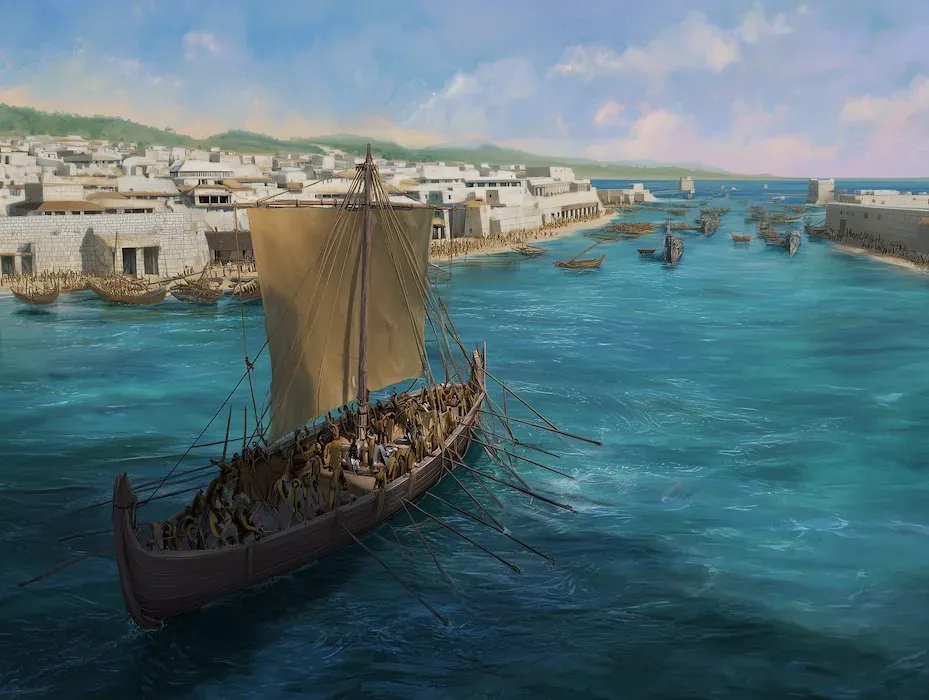
At the cost of a considerable military effort, Carthage drove Agathocles back towards Syracuse, which it then besieged. It was at this point that the Syracusan tyrant undertook an unprecedented manoeuvre: at the head of 14,000 men, he slipped past the Carthaginians and carried the conflict onto their own soil, landing at Cap Bon in 310 BC. He burned his fleet to force his soldiers to fight without mercy. After a few initial victories, his African campaign ran into difficulties, and Agathocles had to come to terms with Carthage before returning to Sicily in 306.
Consolidating its grip on Sicily
The Carthaginians waited for the death of Agathocles in 289 to consolidate their grip on Sicily, taking advantage of the constant discord between the Greek cities. In 278, they blockaded Syracuse, which was relieved by Pyrrhus, king of Epirus. He succeeded in reconquering almost the whole of Carthage’s Sicilian province.
The birth of a new power
But the Greek cities grew openly hostile, seeing in him a tyrant in the making; when even some of them chose Carthage over him, he left the island in 276. From then on, the Phoenician empire extended its hold over Sicily — territory it could have taken outright with the right military commitment. Carthage never made that commitment. And when it settled at Messina, it would have to confront a new Mediterranean power: Rome.
The revival of Carthage at a glance
| Date | Event |
|---|---|
| End of the 4th century BC | Carthage steps up its trade with the Eastern states born of Alexander’s conquests, notably Ptolemaic Egypt. |
| End of the 4th century BC | Agathocles, tyrant of Syracuse, encroaches on Carthage’s Sicilian territory. |
| 310 BC | Agathocles lands at Cap Bon at the head of 14,000 men and burns his fleet. |
| 306 BC | Agathocles returns to Sicily after coming to terms with Carthage. |
| 289 BC | Death of Agathocles; Carthage consolidates its grip on Sicily. |
| 278 BC | Carthage blockades Syracuse, which is relieved by Pyrrhus, king of Epirus. |
| 276 BC | Pyrrhus leaves Sicily; Carthage extends its hold over the island. |
| — | Carthage settles at Messina and confronts a new Mediterranean power: Rome. |