Tunisia lived apart from the Mediterranean civilisations when the first Phoenicians approached its shores in the 12th century BC and founded Utica in 1101, before the Christian era. For these great merchant navigators, North Africa was no more than a stop on the way to the Iberian peninsula, famed for its abundance of copper and tin, whose shipment to the East made the fortune of the Phoenicians. Since the site of Utica lay halfway between their point of departure and their destination, it caught the interest of these traders. And so it all began.
How the Phoenicians Paved the Way for the Founding of Carthage
Setting out in search of a prestigious continent lying to the west — one the Greeks called Hesperia, a name that meant Italy from the Greek point of view and the Iberian peninsula from the Italian one — the Phoenicians criss-crossed the western Mediterranean and reached the south of those lands the Romans would later name Hispania.
There lay the kingdom of Tartessos (the name the Greeks gave to the first civilisation they discovered in the West), rich in copper and silver mines and in the flecks of gold carried along by the waters of the Guadalquivir.
The coasts of that kingdom were held by daring sailors who went as far as Cornwall (the English county at the south-western tip of the island of Great Britain) in search of tin. The Phoenicians founded the trading post of Gades (today's city of Cádiz), near the estuary of the Guadalquivir, in order to trade with this kingdom.
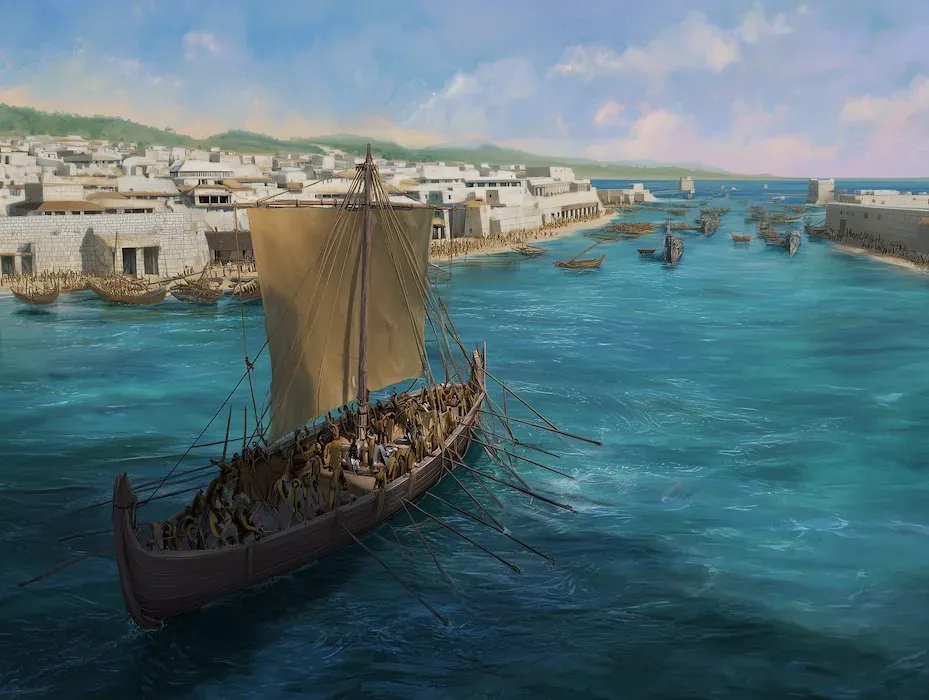
In the same period they sailed towards Morocco and settled at Lixus, in the 12th century before our era, at the mouth of the Oued Loukkos opposite present-day Larache. It would later be said that the gold of Sudan reached Lixus by mysterious routes. To protect their sea road, the Phoenicians had to dominate the western basin of the Mediterranean. They established themselves in Sicily, Malta, Sardinia and the Balearics. On the North African coast they also created the trading posts of Utica, Hadrumetum (Sousse), Carthage (around 814 BC) and later Rsaddir (Melilla) and Tingi (Tangier). For another great historical tale born of this same sea, head to our article on Barbarossa.
Before turning to the story of its founding, here are the chronological landmarks of the period:
| Landmark | Event |
|---|---|
| 12th century BC | The Phoenicians reach North Africa and Morocco, where they found their first trading posts |
| 1101 BC | Founding of Utica |
| Around 814 BC | Founding of Carthage, according to the historical sources |
| 753 BC (21 April, according to legend) | Legendary founding of Rome by Romulus |
The Legend of the Founding of Carthage
Carthage was founded long after Utica and Hadrumetum, since the various historical sources agree that it was created in 814 BC. It is older than Rome, which legend says was founded on 21 April 753 BC by Romulus.
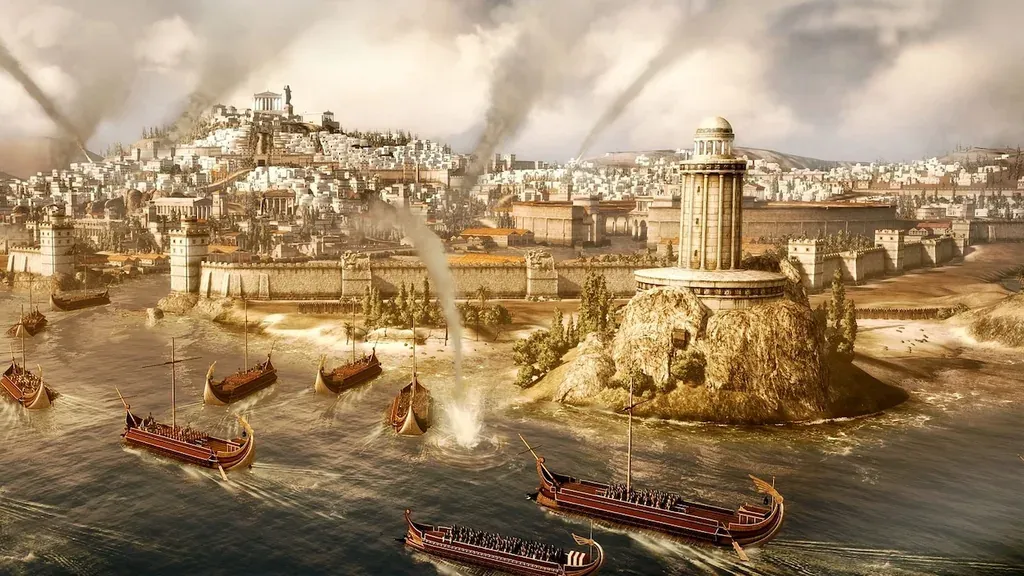
Carthage stands on a gulf that opens onto the strait joining the two basins of the Mediterranean, eastern and western. Hence the whole interest of its position. Lagoons separated it from the mainland and so guaranteed its safety against attacks by land.
Several ancient texts recount the birth of Carthage. Legend, however, blurs into reality. It is said that the king of Tyre designated two heirs to succeed him: his son Pygmalion and his daughter Elissa. Pushed aside from the throne in favour of her brother, she married Acherbas, the priest of Melqart, the god who reigned over the city of Tyre.
The priest was not only very rich, he was the most powerful man after the monarch. Pygmalion, consumed by greed, resolved to lay hands on Acherbas's fortune and ordered his murder.
It was then that Elissa decided to flee, in the company of powerful citizens who had no love for Pygmalion. To throw her brother off the scent, she announced that she wished to move into the royal palace, on the pretext that she could no longer bear the house of her late husband.
She used the ruse to gather all her possessions, load them aboard and put out to sea with everyone who wished to leave. After a long voyage, the Phoenicians reached the site of Carthage and struck up good relations with the local population.
They learned that local custom forbade foreigners from owning a piece of land larger than an ox hide. To get around the restrictions of this law, Elissa cut the hide into strips so fine that they encircled a vast expanse.
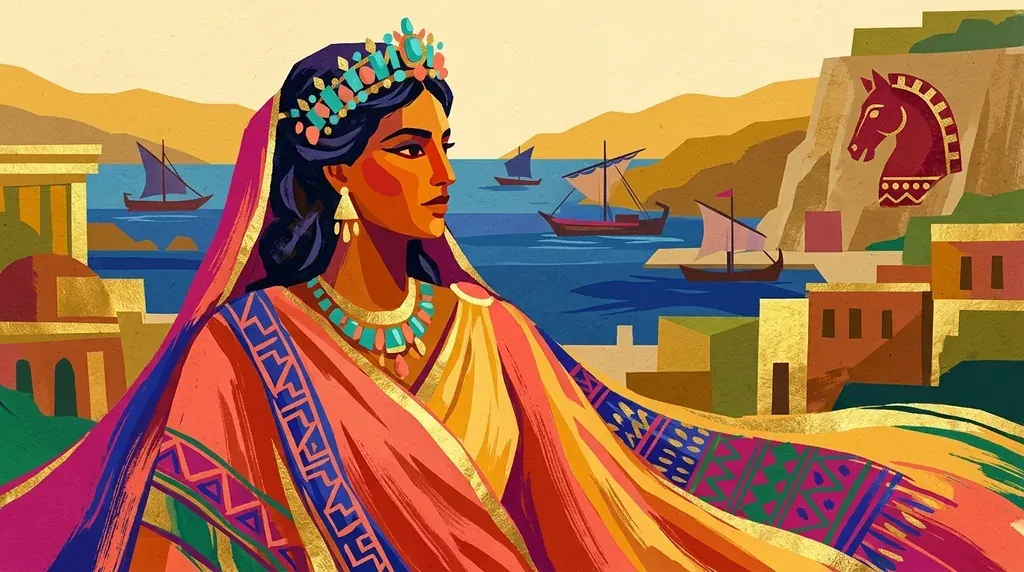
In ancient belief, the founding act of a city weighs upon its destiny. And so, to decide where their city would stand, the Phoenicians dug into the earth and found the head of an ox, an omen of a life of toil and servitude that neither Elissa nor her companions wanted. They dug into the ground further along and came upon the head of a horse, symbol of a powerful and warlike destiny. It was there that the Phoenicians would raise their city.
"The Phoenicians dug into the earth and found the head of an ox, an omen of a life of toil and servitude. They dug into the ground further along and came upon the head of a horse, symbol of a powerful and warlike destiny."
Hiarbas, the local king, dazzled by Elissa's intelligence and beauty, resolved to marry her, on pain of declaring war on the newly founded city. Torn between her wish to stay faithful to the memory of her late husband and her duty towards her young homeland, Elissa accepted the king's proposal. She ordered her men to prepare the wedding ceremony. She had a pyre built and, after sacrificing many victims, threw herself into the fire, declaring that she was going to join her husband. For this act, Elissa would be honoured as a deity.
Virgil would make Elissa a heroine of his epic the Aeneid and link her to Aeneas. He gives her the name Dido, which in the Punic language seems to mean "manly woman", or indeed "slayer of Baal", "protecting spirit of good", or "she who gives". Virgil thus places the founding of Carthage at a date earlier than 814 BC, so that the two figures behind the two cities that would fight over the Mediterranean could meet and fall in love.
The Reality Behind the Legend
The account of the founding of Carthage appears to come from a Greek or Hellenised Carthaginian cultural milieu. The ruse of the ox hide probably rests on a loose translation of the word Byrsa. In Greek it meant ox hide, whereas for the Phoenicians it would seem to have meant fortress.
The presence of a horse's head on Carthaginian coins appears to be the source of the episode of the horse's head unearthed at the founding of the city. Yet for all its legendary character, the account holds a certain number of historical truths, such as the importance of the cult of Melqart at Tyre and the Tyrian origin of the Carthaginian aristocracy. Whatever the case, Carthage was founded by Phoenicians who came from Tyre. Nothing allows us to confirm with certainty that Elissa, sister of Pygmalion, lay behind its founding.
This city with its prestigious name — Qart Hadasht, "new capital" — had modest beginnings. Like the other Phoenician trading posts, it long remained under the tutelage of Tyre. Tunisian heritage, for its part, goes on telling its story well beyond antiquity: head to our article on Chéchia and Sefseri, the Tunisian dress heritage that has crossed the centuries.