In the tenth century, the physician Ibn al-Jazzar saw his patients at home, far from princely courts, and wrote the Zad al-musafir, a manual later translated into Latin as the Viaticum. Taught at Salerno, the text circulated there thanks to Constantine the African, though the name of its Kairouan author was not always remembered.
Kairouan in the tenth century: how did the city become a centre of medical learning?
without one, the other would have had nothing to pass on
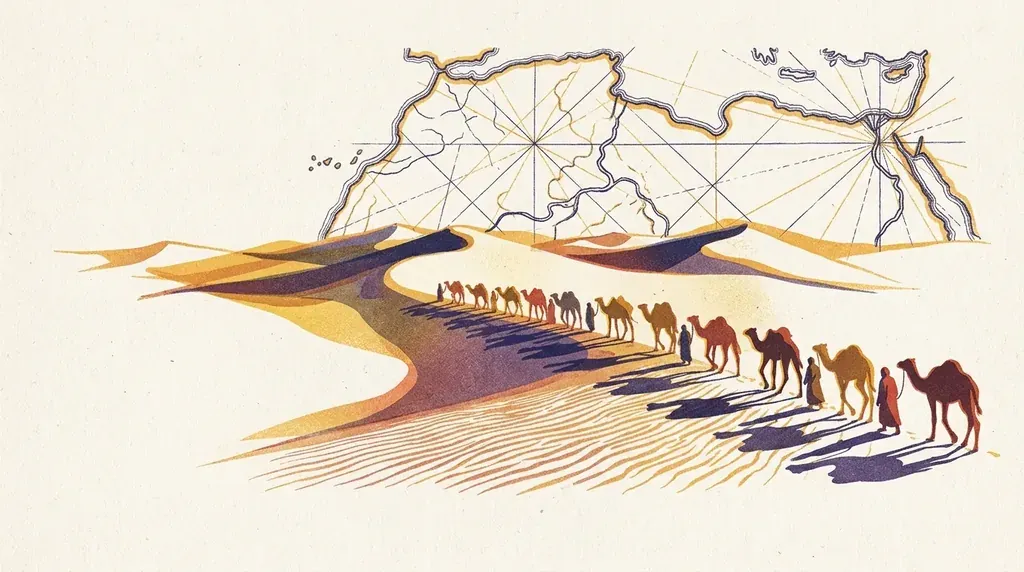
In the tenth century, Kairouan lived in an Ifriqiya that kept changing hands. In 909, the Fatimids, a Shia dynasty, overthrew the Aghlabids and settled in the region. They founded Mahdia in 921, before Caliph al-Mu’izz left Ifriqiya in 973. Yet the city remained a recognised centre of learning.
According to the Histoire générale de la Tunisie, Kairouan had its own school of medicine at the time, embodied notably by Ishaq ibn Imran and Ziyad ibn Khalfun. It was in this city that Abu Ja'far Ahmad ibn Ibrahim ibn Abi Khalid, known as Ibn al-Jazzar, born around 898 and died around 980, spent his entire life. He trained there under Ishaq ibn Sulayman al-Isra'ili, a Jewish physician born in Egypt, who had come to serve first the Aghlabid court and then the Fatimid court.
Who was Ibn al-Jazzar, the physician who saw patients at home and turned down the princely courts?
Ibn al-Jazzar had no taste for courtly honours. He saw his patients at home, where an assistant prepared remedies in the entrance hall before he himself prescribed them. Tradition holds that he refused to enter the service of princes, preferring this direct, almost intimate practice, in which the physician remained accessible to anyone who came knocking at his door.
His major work, the Zad al-musafir wa qut al-hadir (“Provisions for the Traveller and Sustenance for the Settled”), is a manual of practical medicine. The text soon travelled beyond the Arabic-speaking world: translated into Greek as the Ephodia, into Hebrew, and then into Latin as the Viaticum peregrinantis, it was taught at Salerno, the first school of medicine in Christian Europe.
Who was Constantine the African, and how did his path take him from Carthage to Monte Cassino?
Constantine the African was born in Carthage, on the outskirts of Tunis, around 1020. A merchant or a travelling scholar, depending on which account survives, he eventually boarded a ship and reached southern Italy, at Salerno, around 1077. His beginnings were nothing like a triumphant arrival: you can easily picture him living, at first, in poverty.
Constantine did not linger in Salerno, however. He left the city for the monastery of Monte Cassino, where Abbot Desiderius welcomed him warmly. It was within these walls that the physician from Ifriqiya became a monk. He remained there until his death, in 1087.
What did Europe learn from the Viaticum, and what remains of this legacy today?
Constantine the African published several of these translations under his own name, never once crediting the Arab authors who had written them: the Viaticum is none other than Ibn al-Jazzar’s Zad al-musafir.
Thanks to these pages, the school of Salerno, the first school of medicine in Christian Europe, received the medicine of Galen and Hippocrates as Arab physicians had already gathered and enriched it.
Ibn al-Jazzar’s name has not, however, faded into oblivion: a prize today bears it at the Ibn El Jazzar Faculty of Medicine in Sousse, a tribute to a school of medicine in Kairouan whose influence had, in its time, reached as far as Europe through its translations.
Here, the history of medicine did not travel in only one direction.
From Kairouan to Salerno, by way of the silence of Monte Cassino, Ibn al-Jazzar's name was lost behind that of his translator. The physician who saw his patients at home and the monk who carried his work to Italy never shared the same glory, but you now know this much: without one, the other would have had nothing to pass on. The Zad al-musafir, become the Viaticum, nourished generations of physicians who knew nothing of Kairouan. It is up to us, today, to know better.
Also on La Sultane
The University of Tunis Holds a Conference: THE VISUAL ARTS IN TUNISIA
Ennajma Ezzahra: The Architectural Embodiment of Baron d’Erlanger