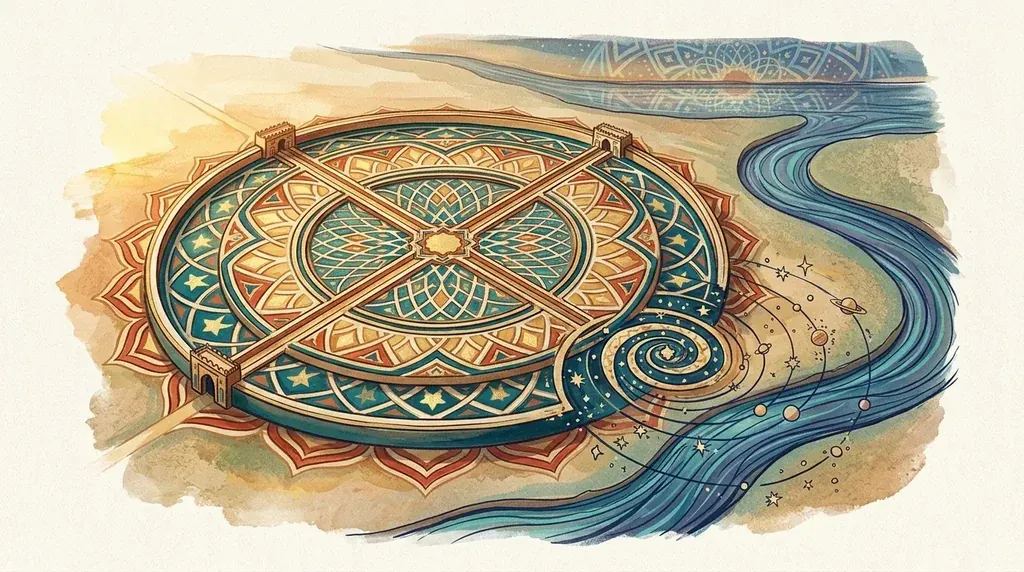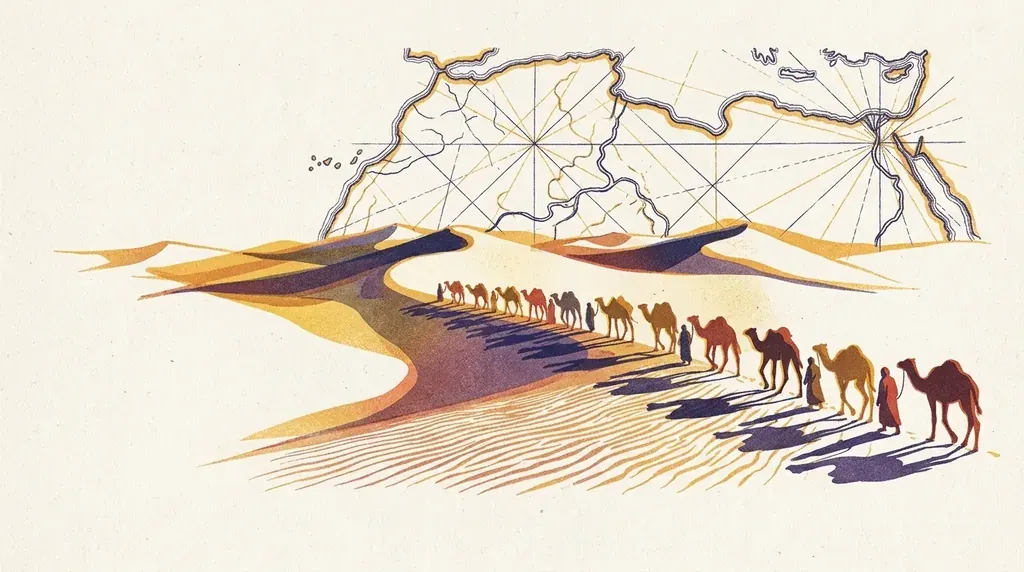
Born in Basra and trained in Baghdad, Ibn al-Haytham settled in Fatimid Cairo, where the caliph al-Hakim summoned him to tame the Nile floods. The expedition failed, but in the seclusion that followed, he wrote the Kitab al-Manazir, the Book of Optics, in seven volumes. In it, he founded the experimental method in the sciences of vision.
Who was Ibn al-Haytham, the child of Basra?
he never simply asserts, he verifies through experiment, which makes him a forerunner of the experimental scientific method
Ibn al-Haytham was born around 965 in Basra, in present-day Iraq. Nothing about the city where he grew up hints at the curious mind taking shape there: a child who watches, who questions. It was in Basra that he received his first education.
To further his studies, he left Basra for Baghdad, where he completed his education. The city of his childhood then lived under the authority of the Buyid dynasty. He would die in Cairo around 1040.
Why did the caliph of Cairo summon him?
The Fatimid caliph al-Hakim, who ruled from Cairo, wanted to tame the Nile floods, and it was for this project that he called on Ibn al-Haytham. The scholar set out on an expedition up the river, before facing the facts: taming the Nile was beyond the means of the age, and the project proved impossible.
The Cairo that welcomed him had not sprung from nowhere. The Fatimid caliphate had been born in Ifriqiya, present-day Tunisia, where its founders had built Mahdia before conquering Egypt and establishing their throne there.
What did he really discover about light and vision?
His masterwork bears a name that already says much: the Kitab al-Manazir, the Book of Optics, written in Cairo in seven volumes. With both warmth and rigour, he establishes a central point: vision occurs through light entering the eye. From the outset, he takes care to distinguish what belongs to the conditions of vision from what belongs to the propagation of light itself.
What is particularly striking is his method: he never simply asserts, he verifies through experiment. To observe the behaviour of light, he often turns to the camera obscura. His treatise blends geometrical optics with physiological optics.
What legacy did he leave to today’s science?
Ibn al-Haytham's body of work is considerable: biographers credit him with nearly two hundred works, of which only around sixty have survived, mathematics accounting for nearly half. His Book of Optics was translated into Latin in the Middle Ages under the title De aspectibus or Perspectiva. Read and discussed in Europe for centuries, it circulated there under his Latinised name, Alhazen. His work influenced scholars such as Bacon and Kepler.
This legacy still reaches into today’s scientific vocabulary: a famous geometry problem, Alhazen’s problem, still bears his name. It consists of finding, on a spherical mirror, the precise point where a ray from a given point reflects towards another given point.
From Basra to Baghdad, and on to Fatimid Cairo, where history links him, without his having chosen it, to the legacy of Ifriqiya, Ibn al-Haytham never stopped testing what he observed through experiment. His camera obscura and his Book of Optics remain the trace of a mind that preferred experiment to ready-made certainty: translated into Latin under the title De aspectibus, the work was read and discussed in Europe for centuries.
Also worth reading on La Sultane
The University of Tunis Holds a Conference: THE VISUAL ARTS IN TUNISIA
Ennajma Ezzahra: The Architectural Embodiment of Baron d’Erlanger