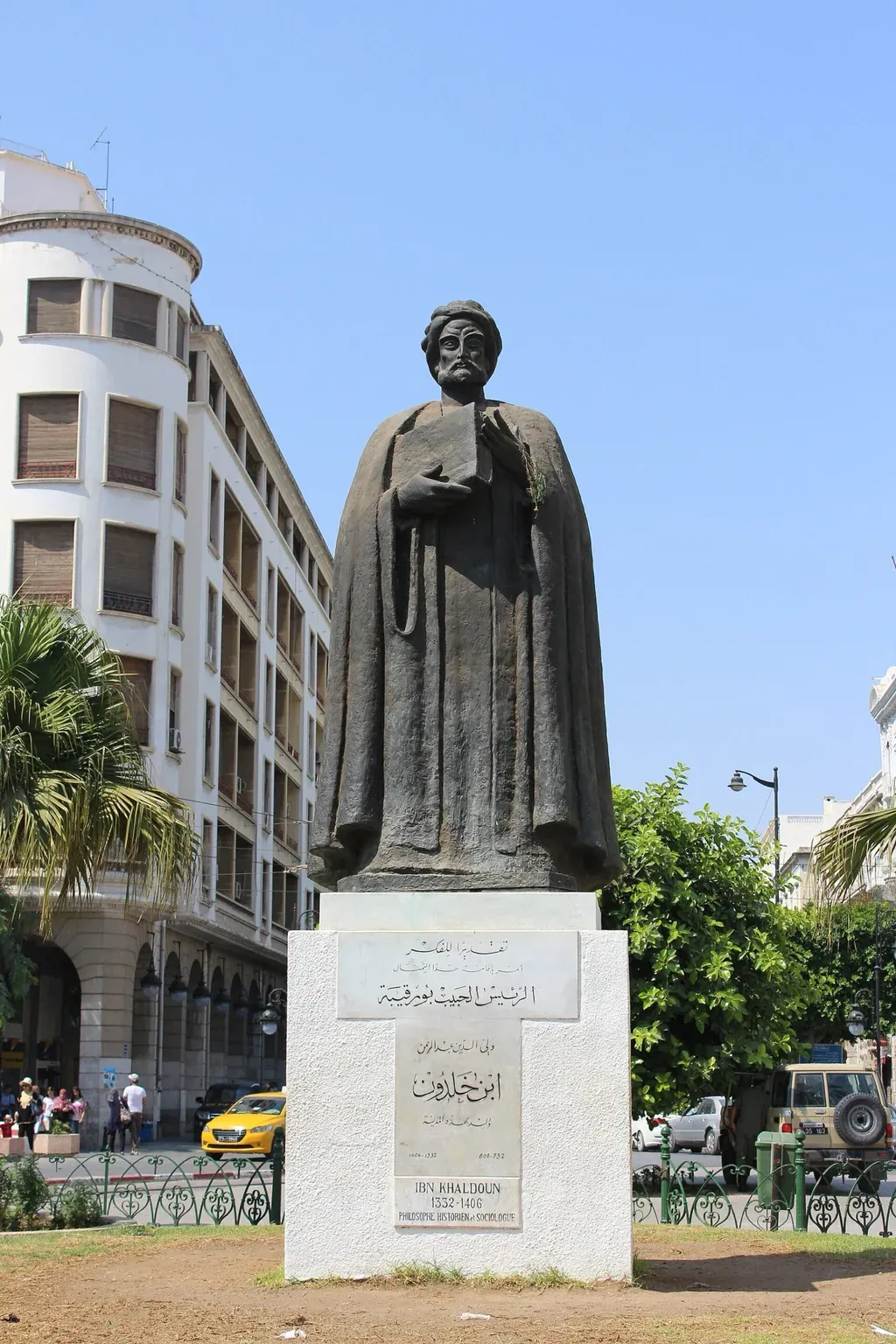
Born in Tunis in 1332, Ibn Khaldun lost both parents to the plague of 1348, then withdrew to Qalaat Ibn Salama between 1375 and 1378. There, in 1377, he wrote the Muqaddima, setting out asabiyya (group cohesion) and the cycle of dynasties, a body of thought the West would later rediscover as a forerunner of sociology.
Who was Ibn Khaldun, the child of Tunis?
For Ibn Khaldun, this is the force that carries a dynasty to power, only to fade along with it and clear the way for a new cycle.
Abd al-Rahman Ibn Khaldun was born in Tunis in 1332, in the medina, a stone's throw from the Zitouna. He grew up in a family of scholars of Andalusian descent, where books and learned conversation were part of daily life.
But this Tunis childhood was shattered abruptly: in 1348, the Black Death struck the city and claimed both his parents. For the young boy, it was an early break from the family circle that had shaped his love of letters.
What Maghreb did he grow up in, and why did he travel so much?
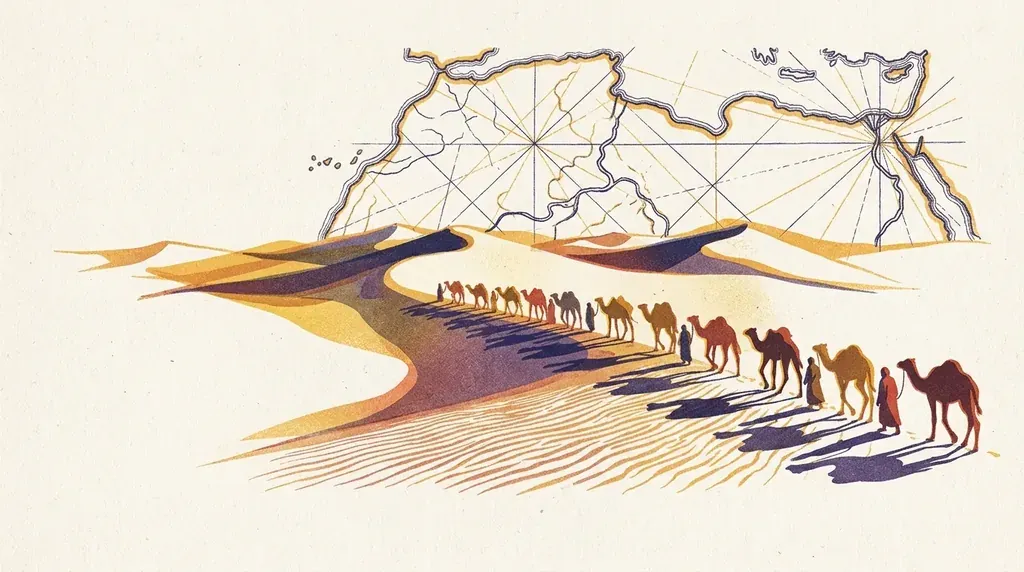
In the fourteenth century, the Maghreb was no single bloc. Three rival dynasties divided it between them: the Hafsids in Tunis, the Zayyanids (or Abdalwadids) in Tlemcen, the Marinids in Fez. Further off, across the Mediterranean, the Nasrid emirate of Granada still held on.
It was in this fragmented landscape that Ibn Khaldun built his career, never settling for long at any one court: he served, in turn, the Hafsids of Tunis, the Marinids of Fez, then the Nasrids of Granada. This political instability, far more than any taste for travel, explains his road from one capital to the next, until his retreat to Qalaat Ibn Salama, in present-day Algeria, where he completed the Muqaddima.
What did he write in his retreat, and what is asabiyya?
Between 1375 and 1378, Ibn Khaldun withdrew to Qalaat Ibn Salama, a fortress near Tiaret in present-day Algeria, under the protection of the Banu Arif tribe. It was there that he wrote the Muqaddima in 1377: the introduction to his great Discourse on Universal History, the Kitab al-'Ibar. Translated into French as Les Prolégomènes from De Slane's translation onward, it is, for some modern thinkers, the first text to lay the foundations of the philosophy of history, if not of sociology itself.
His key concept, asabiyya, denotes the cohesion, the group spirit that binds a community together. For Ibn Khaldun, this is the force that carries a dynasty to power, only to fade along with it and clear the way for a new cycle.
How did his ideas come to endure across the centuries?
In January 1401, outside Damascus as it lay besieged by Tamerlane, Ibn Khaldun had himself lowered from the ramparts on a rope to meet the conqueror. The two men talked at length. He died in Cairo in March 1406, where he was buried.
Europe rediscovered him only belatedly, in the nineteenth century. Between 1862 and 1868, William Mac Guckin de Slane translated the Muqaddima into French as Prolégomènes. European scholars of the day then grasped the work's importance and ranked Ibn Khaldun among the greatest philosophers of the Middle Ages.
From Tunis to Qalaat Ibn Salama, from Fez to Granada, Ibn Khaldun's journey is that of a mind who drew from the political instability of his age a universal lesson about the life of societies. To read the Muqaddima today is to find, in the words of a man born in the medina of Tunis, a view of startling relevance on how human groups form, rise to dominance, and then run out of steam.
More to read on La Sultane
The University of Tunis Hosts a Symposium: THE VISUAL ARTS IN TUNISIA
Ennajma Ezzahra: The Baron d’Erlanger’s Architectural Legacy