The Arab conquest of Byzantine Africa ran from 647 to 705: a first incursion at Sbeïtla, the founding of Kairouan far from Carthage, alliance and then rupture with Koceila, chief of the Awraba, and the resistance of the Kahena, queen of the Aurès, before the birth of Ifriqiya.
How did Byzantine Africa change hands in the seventh century?
the old Roman Africa, as Bessis writes, “Islamised quickly and Arabised slowly.”
In the seventh century, Africa was a province of the Byzantine Empire, governed from Carthage by an exarch. In 646, the exarch Grégoire broke away and proclaimed himself emperor, asserting this Africa's independence from central power.
It was against this backdrop that the first incursion from Egypt came in 647: governor Abdallah ibn Saad defeated the patrician Grégoire at Sbeïtla, where he lost his life, and the region was then plundered. For nearly twenty years, the crisis convulsing the caliphate halted these expeditions, until a fresh plundering campaign struck Byzacène around 666–667.
Why did Kairouan turn its back on Carthage?
Appointed governor of Ifriqiya by the Umayyad caliph in Damascus, Oqba ibn Nafi founded Kairouan in 670, a garrison town set in the heart of the country. The choice of site already signalled an intention: to build a brand-new capital, far from Carthage, rather than settle into the old urban order.
Removed from office in 674, Oqba gave way to Abu al-Muhajir Dinar, who changed tack. Facing the Berbers, he favoured conciliation over confrontation: he defeated Koceila, chief of the Awraba, then won him over. In Kairouan, the new city embodied both alliance and conquest.
The understanding did not last. Back in power in 681, Oqba humiliated Koceila during his great ride towards the western Maghreb; on the way back, in August 683, he fell into an ambush laid by Koceila at Tahuda, near Biskra, and was killed. The Arabs evacuated Kairouan, where Koceila settled at the head of a broad Berber confederation, until his defeat and death in 688–689, between Kairouan and Sbeïtla, at the hands of Zuhayr ibn Qays, Oqba's former lieutenant.
Who was the Kahena, queen of the Aurès?
Her true name remains uncertain. The Arabs called her Al Kahina ("the soothsayer"); Berber genealogists and chroniclers favour Dihya instead, or one of its variants (Daya, Dehiya, Dahya, Damya, Dihia, Tihya), so much has oral transmission blurred the spelling. Ibn Khaldoun, having reconstructed her genealogy, settles on Dihya. This uncertainty also stems from the absence of indigenous sources for the period: everything known about her comes from Arab chronicles written long after the events.
What is known with more certainty is her standing: widow of the king of the Jerawa, a Butr Berber tribe of the eastern Aurès, she is said to have taken over its leadership. When Hassan marched on the Aurès after seizing Carthage, she came down from her mountain stronghold, destroyed Baghaya and crushed the Arab troops near Meskiana, a victory that made her, for a time, the last Berber bulwark against the conquest.
Nor did the victory hold. The Kahena forced Hassan to fall back as far as Cyrenaica, but her troops plundered Byzacena, the settled populations turned away from her, and around 700 (701 according to Boularès, between 700 and 704 according to Bessis) she was defeated and killed in the Aurès in a final battle. According to the Histoire générale de la Tunisie (volume II, p. 39), Hassan then formed two auxiliary corps from the Berber hostages and handed their command to the queen's own sons.
What did this half-century change, and what still remains today?
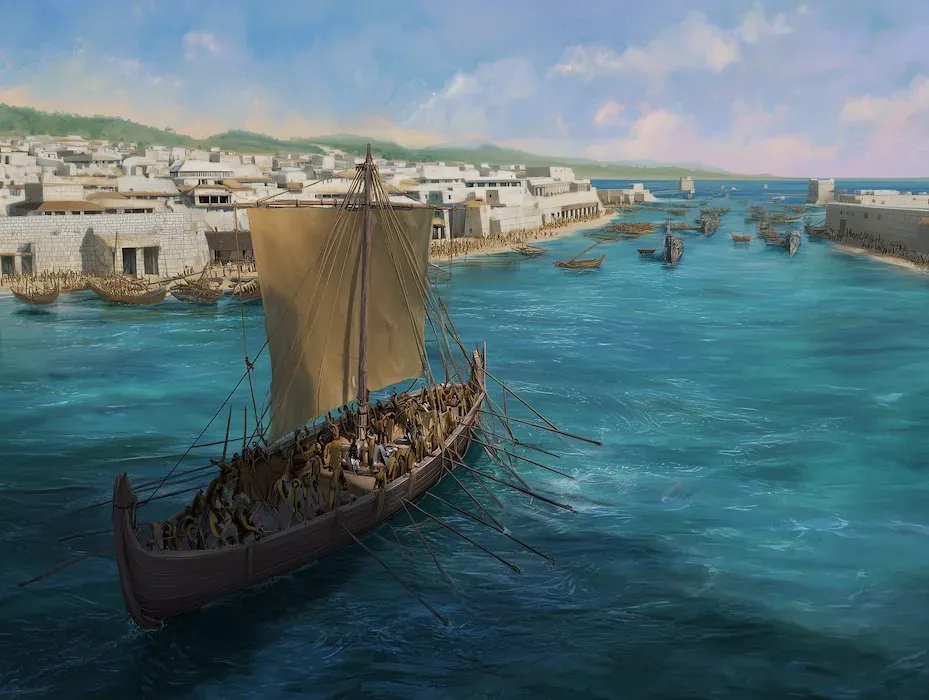
Around 693–695, caliph Abd al-Malik charged Hassan ibn Nu'man with completing the conquest. He returned to Ifriqiya around 699 and retook Carthage, but the old city (a Punic, then Roman, then Vandal and finally Byzantine capital for over a thousand years) never regained that standing: its role shifted to Tunis, rising alongside it. In 703 or 704, Ifriqiya became a province of the Umayyad empire, placed under governor Musa ibn Nusayr.
From this half-century, between 647 and 705, what stands out above all is a contrast in pace: the old Roman Africa, as Bessis writes, "Islamised quickly and Arabised slowly." Power changed its name and its centre, but the fabric of the country, its towns and its countryside, kept transforming at its own pace, long after the new order had settled in.
From Sbeïtla to Tunis, half a century was enough to redraw the map. Carthage faded, Kairouan rose, and Ifriqiya took the place of the old Byzantine Africa. But this shift also tells a story of resistance: Koceila and the Kahena, the humiliated ally and the queen of the Aurès, are a reminder that the land resisted before it transformed. Islamisation moved fast, Arabisation took its time, and the two memories, that of the conquerors and that of the Berbers, keep answering each other rather than erasing one another.
Also on La Sultane
The University of Tunis hosts a conference: THE VISUAL ARTS IN TUNISIA
Summer 2026 festivals: Tunisia relights its Roman amphitheatres
Ennajma Ezzahra: the architectural legacy of Baron d’Erlanger