Who was Mariam al-Astrulabi? A single line, in a catalogue compiled in Baghdad in 987, tells us she made astrolabes in Aleppo, at the court of Emir Sayf al-Dawla. Her first name is unknown to us, given to her only later. The portrait of a woman of science nearly forgotten.
Who was Mariam al-Astrulabi, according to the only written trace that survives?
the very sky she once studied now carries her memory
Everything history has kept of her fits into a few lines. The only ancient source that mentions her is the Fihrist, the great catalogue of books and scholars compiled in Baghdad in 987 by the bookseller Ibn al-Nadim. It is he who names her al-Ijliya. You will find no other written trace from her own era: a single line in a catalogue, and that is all that remains of her.
The first name you may know her by, Mariam, does not appear in that catalogue: it was given to her later, by modern publications. That is how she is referred to today, as Mariam al-Astrulabi or Mariam al-Ijliya, so that she might finally carry a first name, even one borrowed from the present rather than from her own century.
In what world did she practise her craft?
In the tenth century, Aleppo came under the authority of the Hamdanids, a Shia Arab dynasty first established in Mosul. In 944, Emir Sayf al-Dawla (916-967) seized the city and made it the capital of his emirate, which he contested with neighbouring powers.
Around him formed one of the most brilliant courts of the tenth century. The poet al-Mutanabbi stayed there and composed his most celebrated panegyrics, and the philosopher al-Farabi also found his place there. It was in this hub of letters and sciences that the astrolabe maker practised her craft.
What does making an astrolabe demand, scientifically speaking?
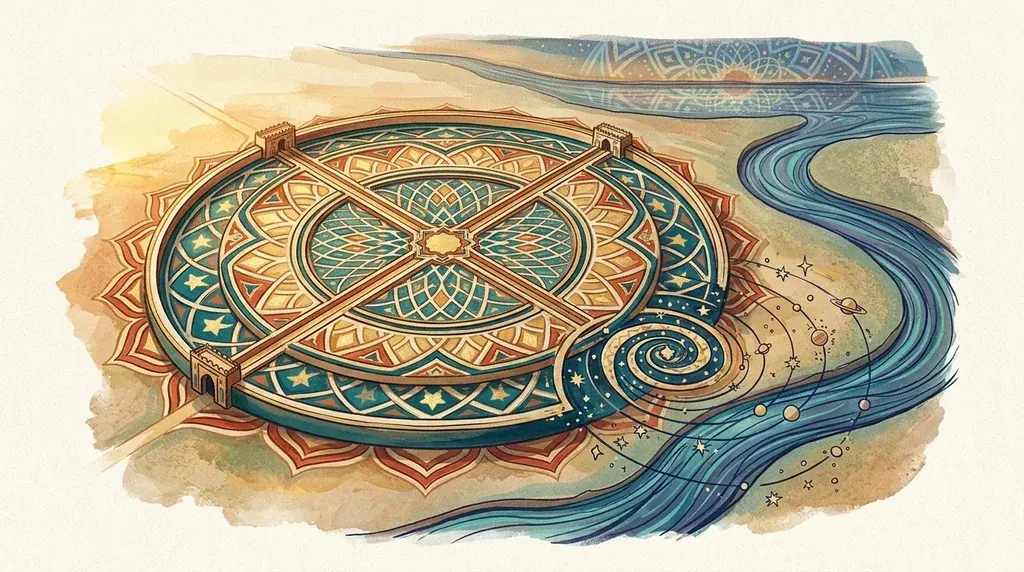
The astrolabe is an astronomical instrument born in the Greek world, which scholars of the Muslim world refined from the eighth century onwards. In practice, it is a brass disc fitted with a rotating piece, used to read the position of the stars and the sun. An object of metal, conceived as a calculation.
Making one requires mastering stereographic projection, the technique of mapping the celestial sphere onto a flat plane, then calculating the exact coordinates of the stars before engraving them into the brass. You can imagine the sheer range of knowledge this demands: geometry, astronomy, and the steady hand of a goldsmith.
What remains of her today?
Almost nothing remains of her, save for a single line in a catalogue, and yet her name has travelled through the centuries all the way to the sky. In 1990, at the Palomar Observatory in California, an asteroid was discovered and named in her honour: (7060) Al-'Ijliya. For a maker of instruments that measured the course of the stars, the tribute feels fitting: the very sky she once studied now carries her memory.
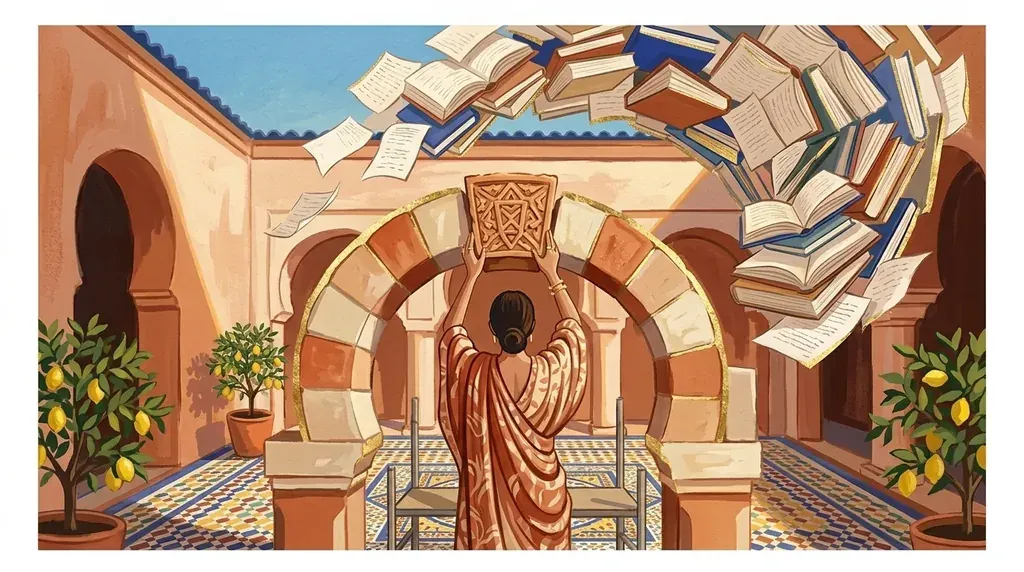
Mariam al-Astrulabi thus joins, in this series, two other figures you already know. Fatima al-Fihri, who founded the Qarawiyyin mosque-university in Fez in 859. And Lubna of Cordoba, scribe and mathematician. Three women, three crafts of precision (knowledge, writing, instrument-making), and one same truth: their work outlasted their names by far.
Of Mariam al-Astrulabi, then, only a line in a catalogue remains, and a piece of sky that bears her name. It is little, and yet it is immense: proof that a woman, working as both goldsmith and scholar, knew how to read the sky with a precision few mastered at the time. You need no full biography to measure what she achieved: the very silence of history about her life speaks, by its absence, to the place she had carved out for herself in a craft that allows no amateurs.
Also on La Sultane
Sonya Ben Behi, Bookstagrammer and Serial Reader
Dr. Leila Lakhoua Houimli: Consistency, Elegance & Competence