The voyage of Hanno remains one of the most fascinating maritime expeditions of antiquity. Only a fragment of this legendary journey has come down to us, through a Greek translation of the inscription engraved on bronze tablets. These tablets hung in the great temple of the god Baal at Carthage. As a result, we have the transcription of the account written by the leader of the expedition himself.
The text, however, is certainly incomplete. After crossing the Strait of Gibraltar, the Carthaginian sailors followed the western coast of Africa. Yet the question of how far they went remains hotly disputed.
Hanno's Expedition: An Impressive Armada
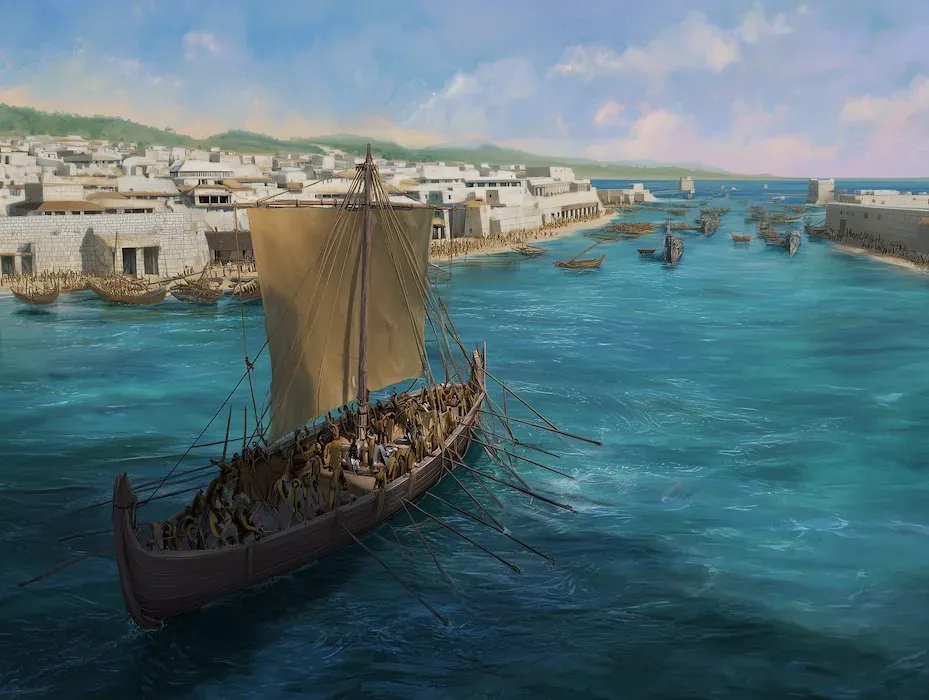
Hanno, suffete (chief magistrate) of Carthage, led a large-scale expedition of 60 fifty-oared ships. This fleet carried 30,000 people, including men, women, colonists and sailors. With the help of the sailors of Gades and Lixus, Hanno founded the first Carthaginian colony on the Atlantic coast of Morocco.
The expedition then reached Cape Soloeis, probably present-day Cape Cantin. There, Hanno raised a temple to honour the Phoenician god of the sea, whose name remains unknown today.
The Island of Cerne: A Geographical Mystery of Hanno's Voyage
The voyage continued southward, where merchants were put ashore on an island named Cerne. This island is said to have been the terminus of the gold route from Sudan. The ancients, moreover, placed this island at the western edge of the world.
Modern historians and archaeologists have tried to identify this mysterious island. They have put forward several hypotheses: the island of Arguin on the Mauritanian coast, the island of Herné in the Bay of Dakhla, the island of Gorée, or even Madeira.
These leads, however, seem unlikely given the limited presence of Carthaginian artefacts along the southern Moroccan coast. Today, scholars tend to identify the island of Cerne with the Purpuraires Islands, lying off present-day Essaouira. Indeed, in the 8th century BC the Phoenicians founded there a trading post for the murex trade with the local populations. This mollusc yielded the purple dye so prized throughout the Mediterranean basin for colouring precious fabrics.
The Direct Testimony of the Carthaginian Navigator
The Voyage of Hanno records:
Thereafter, the expedition probably advanced as far as the depths of the Gulf of Guinea, marking one of the boldest explorations of antiquity.
Trade and Strategy: Hanno's Commercial Legacy
Historians still study this account with great interest. They believe it contains many truths, but also that Hanno deliberately muddied the waters. He probably invented certain details to mislead foreign sailors and impress his contemporaries.
The Greek Herodotus describes the silent gold trade with the peoples of the Atlantic coasts. The Carthaginians would unload their goods on the shore, then go back aboard their ships. They would then light fires to signal their arrival.
The local populations came to examine the goods without touching them. They would set down a certain quantity of gold and withdraw. The Carthaginians took it only if they judged they had received a quantity of gold equal to the price of their goods. Herodotus concludes: "Neither side dealt dishonestly."
Lands Forbidden to the Greeks: The Strategy of Secrecy
The Carthaginians, and the Phoenicians before them, dreaded competition from other navigators in their daring explorations. They particularly feared their Greek rivals, enterprising and cunning.
To discourage them, they spread extraordinary and terrifying tales in foreign ports. Traces of these tales can even be found in Homer's poem The Odyssey, which recounts the adventures of Ulysses. What is more, they did not hesitate to sink any ship that came too close to their trading posts.
Hanno's expedition thus represents far more than a simple voyage of exploration. It illustrates Carthaginian mastery of the sea and reveals the sophisticated commercial strategies of this ancient civilisation.
The Stages of Hanno's Voyage
The ancient text gives no precise dates. Here, in the order the account reports them, are the main stages of the journey.
| Stage | Geographical landmark | What the account reports |
|---|---|---|
| 1 | Strait of Gibraltar | The Carthaginian sailors cross the strait before following the western coast of Africa. |
| 2 | Atlantic coast of Morocco | Founding of the first Carthaginian colony, with the help of the sailors of Gades and Lixus. |
| 3 | Cape Soloeis (probably present-day Cape Cantin) | A temple is raised in honour of the Phoenician god of the sea, whose name remains unknown. |
| 4 | Island of Cerne (probably the Purpuraires Islands, off Essaouira) | Merchants are put ashore on an island regarded as the terminus of the gold route from Sudan. |
| 5 | Gulf of Guinea (probably) | The farthest point probably reached by the expedition, according to historians. |