Chakras open the door to another branch of Eastern medicine: Ayurveda, or traditional Indian medicine. According to Ayurveda (the science of life), chakras are energy centers located at key points in the body. There are seven major ones. Invisible and intangible, they are said to play a central role nonetheless: when one of them is disturbed, it's said to throw off the body's entire physical, mental, and emotional balance.
The Invisible Wheels of Well-Being
Ayurvedic medicine, backed by 5,000 years of tradition, is said to identify more than 88,000 chakras spread across the body — an ancient but practical science, since balancing the seven main chakras is said to be enough for the rest of the energy network to follow suit.
The 7 major chakras are aligned vertically along the spine. Colorless, odorless, intangible, and tasteless, they are said to belong to the 'subtle body' — the sum of the invisible energies of the human body, commonly known as the 'vital breath.' A disturbed chakra manifests either by closing (blocked energy) or, conversely, by being too open (scattered energy), resulting in emotional and/or physical imbalances. Knowing your chakras and their characteristics is thus said to lead to a better understanding of your body and more balanced emotions.
The 7 Major Chakras
| Chakra | Location | Qualities When Balanced | Color / Stones |
|---|---|---|---|
| 1. Muladhara (root) | Base of the spine, tailbone | Stability, self-confidence, courage | Vivid red — black tourmaline, bloodstone, smoky quartz |
| 2. Swadhistana (sacral) | Navel | Sexuality, vitality, creativity | Bright orange — citrine, tiger's eye, yellow topaz |
| 3. Manipura (solar plexus) | Pit of the stomach | Balance, spontaneity | Bright yellow — green aventurine, malachite |
| 4. Anahata (heart) | Center of the chest | Love and harmony | Bright green — rose quartz, kunzite |
| 5. Vishuda (throat) | Hollow of the throat | Communication, expressiveness | Electric blue — blue agate, turquoise, celestite |
| 6. Ajana (third eye) | Between the eyebrows | Imagination, intuition, wisdom | Indigo blue — amethyst, sugilite |
| 7. Sahasrara (crown) | Top of the head | Spirituality, self-realization | Violet — clear quartz, selenite |
The root chakra (Muladhara) governs the adrenal glands, the rectum, and the small intestine; when unbalanced, it is said to show up as circulatory trouble, sciatica, or anemia physically, and as selfishness or a loss of self-confidence psychologically. The sacral chakra (Swadhistana), linked to the digestive and reproductive systems, is said to be tied to feelings and desires — when disturbed, it is said to express itself through anger or jealousy. The solar plexus chakra (Manipura), the entry point for vital energy (prana), is said to encourage good deeds and joy when balanced, and selfishness and resentment when it isn't.
The heart chakra (Anahata) symbolizes love and also governs breathing; meditating on it is said to build self-control and inner peace. The throat chakra (Vishuda) governs the thyroid and symbolizes communication and truthfulness. The third eye chakra (Ajana), the seat of perception and knowledge, is said to feed on light. The crown chakra (Sahasrara), finally, symbolizes white light and is said to be the chakra of meditation and the path to nirvana — when balanced, it is said to lead to lasting bliss; when unbalanced, to lethargy and confusion.
How to Balance Your Chakras
According to Ayurveda, a harmonious life depends on healthy living habits and on balanced chakras. Here are a few ways to get there.
Yoga
This gentle practice lets you focus on one or several chakras at a time, following a sequence of breathing movements and a set of postures (asanas), at a given pace.
Ayurvedic Massage
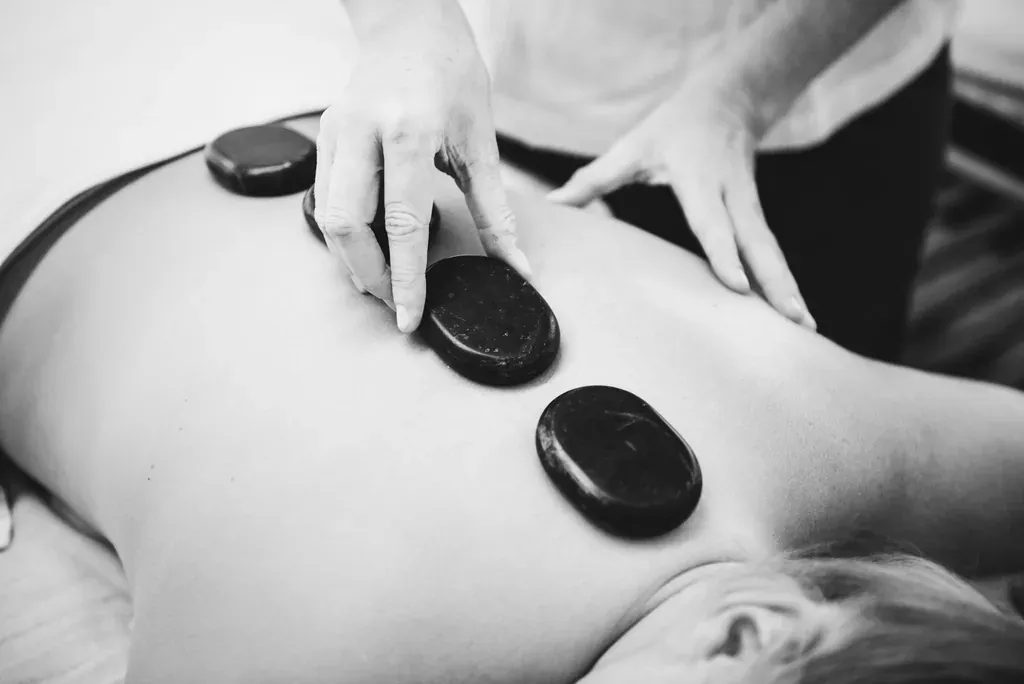
A long massage similar to lymphatic drainage, using energizing oil, made up mainly of light strokes and pressure applied over the chakras. Extremely relaxing, it's preceded by a questionnaire to pinpoint the imbalance.
Music Therapy
This involves listening to meditation music using specific wavelengths (such as 432 Hz or 528 Hz), said to act directly on the nerves and the flow of energy. This restorative music is highly valued by some meditators.
Seven chakras, seven colors, seven families of stones: Ayurvedic medicine assigns each one a precise role in physical, emotional, and spiritual balance.