How do you stand before the Great Pyramid of Giza, the Colosseum or the Great Wall of China and not marvel? How were those blocks of stone cut, moved, then hauled so far and so high, with so little to work with? The structures we are about to visit are exceptional on every count — architectural, technical, social — and each one carries a little extra mystery that makes all the difference.
A guided tour across the ages, to the four corners of the world. Off we go.
The Pantheon, Rome
You probably know it already, but did you know it remains the largest unreinforced concrete dome in the world? And it went up at the very start of the 2nd century, under the emperor Hadrian. Since July 2023, entry is no longer free: a €5 ticket is now required to visit — a novelty after nearly two thousand years of open access to this temple turned church.
Sacsayhuamán, the Inca fortress of Peru
This Inca fortress is built from stones so vast that nobody, even today, quite believes human hands brought them there: the Spanish chronicler Sancho Pedro de la Hoz was already marvelling at them in 1533. How the blocks were carried and then cut remains unknown, since no mortar holds them together. Almost five centuries on, the mystery holds.
Chand Baori, the stepwell of Abhaneri, India
Stepwells, or bâolis, belong to the landscape of western India. Often conceived as sacred places, they pair a water-harvesting system with a staircase leading down to it. The one at Abhaneri, known as Chand Baori, counts no fewer than 3,500 steps.
Chogha Zanbil, the Iranian ziggurat
Another stepped structure: Chogha Zanbil is one of the only ziggurats — those Mesopotamian religious buildings — whose ruins have survived to us. Built around 1250 BC, it became the first Iranian site inscribed on the UNESCO World Heritage list.
Göbekli Tepe, the oldest temple in the world
On this Turkish archaeological site, the oldest sections go back to the 10th millennium BC: this is the earliest monumental stone temple ever brought to light. More unsettling still, it was deliberately buried around 8,000 years BC, for reasons that remain unclear — every hill covering it is man-made. Göbekli Tepe has been on the UNESCO World Heritage list since 2018.
The Leshan Giant Buddha, China
Carved straight into the cliff face of Mount Lingyun, the Leshan Giant Buddha depicts Maitreya, the Buddha of the future, the one who will succeed the Buddha Shakyamuni. It is the largest Buddha in the world, standing 71 metres tall and 28 metres wide.
The Marib dam, Yemen
Keeping a desert kingdom watered is no small matter. This genuine feat of ancient engineering, built in the 8th century BC, is the oldest known hydraulic dam in the world. It held for more than 1,000 years before its final collapse around 570 AD, which drove the 50,000 people living nearby into exile. Yemen has been torn apart by civil war since 2015, and the Marib region — one of the main fronts of the conflict between 2021 and 2022 — remains hard for visitors to reach today.
The Church of Saint George (Bet Giyorgis), Ethiopia
One of the oldest Christian communities in the world raised remarkable churches here. Built on a cruciform plan — that of a Greek cross — Bet Giyorgis was carved entirely out of red volcanic rock: sculpting it meant excavating 3,400 m3 of stone. In 2021, at the height of the Tigray war, the town of Lalibela was briefly occupied by armed forces before being retaken. The site remains accessible today, though the Ethiopian authorities are still looking to replace the metal shelters installed in 2008 to protect the churches from erosion.
The Ħal Saflieni Hypogeum, Malta
This underground cemetery originally held the remains of 7,000 individuals: the Ħal Saflieni Hypogeum is a monument like no other, of exceptional value. It is the only known example in Europe of an underground labyrinth, dated to roughly 4,000 to 2,500 BC. For the quality of its architecture and its remarkable state of preservation, it remains an essential monument of prehistory — one to discover on a flight to Malta, the smallest country in Europe.
The underground city of Derinkuyu, Turkey
A refuge for the first Greek Christians facing persecution by the Roman Empire, Derinkuyu sheltered several civilisations over the centuries and could house as many as 20,000 people underground at the same time.
Puma Punku, Bolivia
This imposing structure, raised around 600 BC, has the distinction of having been assembled from prefabricated, interlocking pieces. And all of it with stones weighing more than 100 tonnes.
Petra, Jordan
Founded in antiquity, towards the end of the 7th century BC, Petra raises giant façades cut straight into the rock, in a monumental ensemble without equal. Forgotten in the modern era, it was rediscovered in 1812 by the Swiss explorer Jean-Louis Burckhardt and has been on the UNESCO World Heritage list ever since.
Newgrange, Ireland
One of Ireland’s most famous archaeological sites, north of Dublin: this prehistoric mound, a tomb built around 3,200 BC — 600 years before the great pyramid of Giza, in Egypt, and 1,000 years before Stonehenge — is aligned so precisely that every year, on the winter solstice (21 December) at 9.17am, the sun reaches straight into the central chamber and stays there for 15 minutes.
The Nazca geoglyphs, Peru
Mysterious figures litter the floor of the Nazca desert, whose parched microclimate — barely 30 mm of rain a year — preserved them. Dated between 800 and 300 BC, these giant geometric lines, clearly visible from the air, still guard their purpose: shamanic rituals, astronomical calendar or the UFO theory, everyone reads them their own way. In 2024, a team from Yamagata University and IBM Research used artificial intelligence to spot more than 300 new geoglyphs in the desert, all but doubling the number of figures recorded since the site was found.
The megalithic spheres of Costa Rica
These spheres are thought to have been carved between 1,500 and 200 BC; several hundred of the stone balls have turned up in southern Costa Rica. The largest known stone reaches 2.15 m across, with an estimated weight of 16 tonnes.
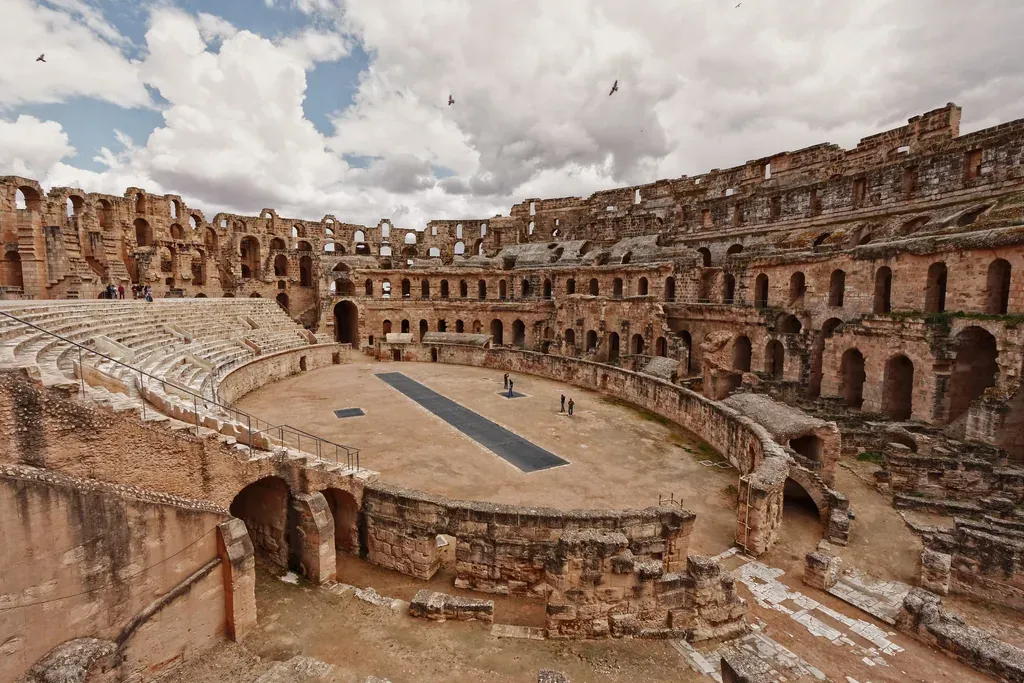
Want that same vertigo of civilisations closer to home? Tunisia has its own sites on the UNESCO World Heritage list, and offers a journey into Roman antiquity with nothing to envy these distant wonders.