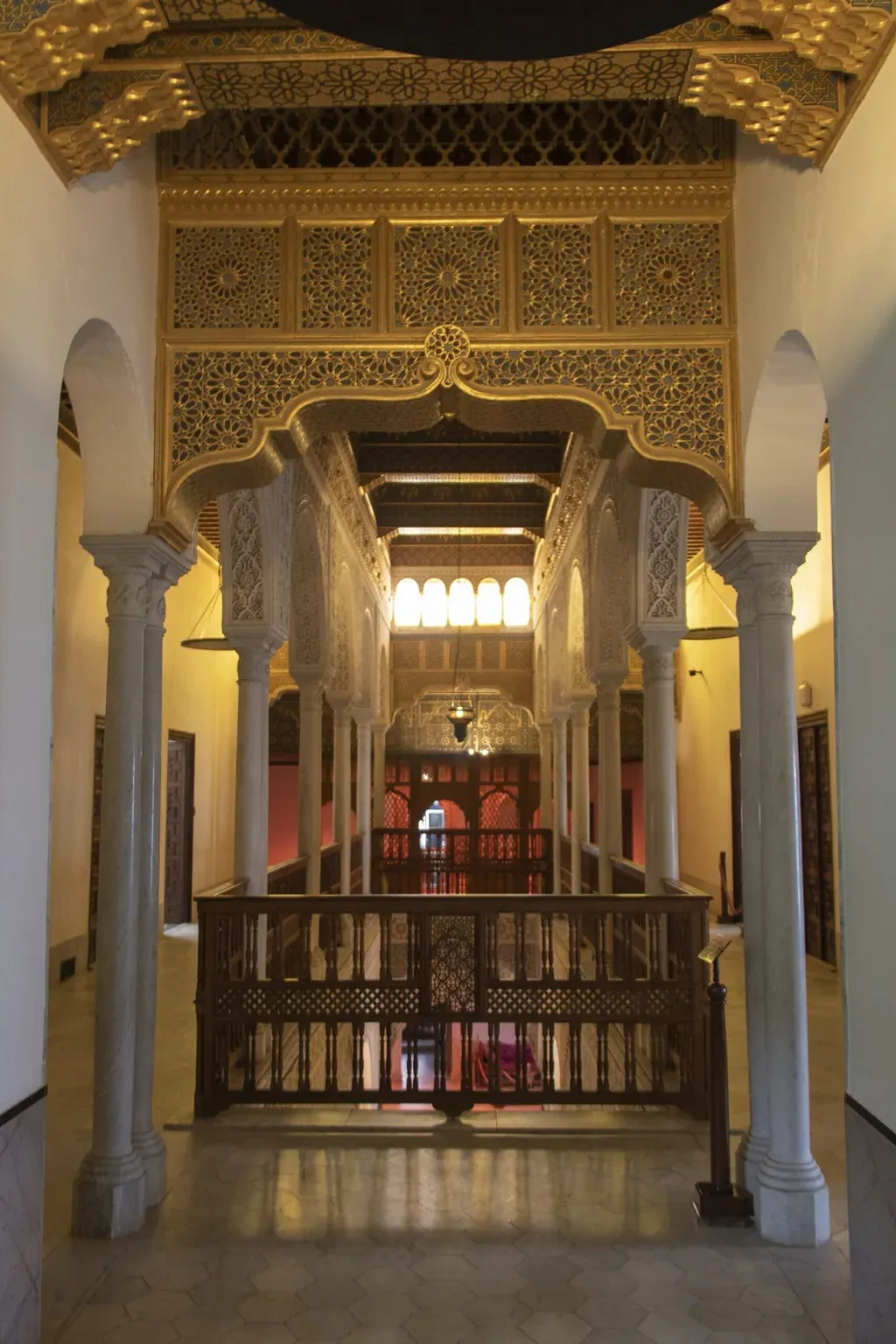
In the very heart of the Tunis medina, an 18th-century palace has passed through regimes and uses without ever losing its soul. Dar Sfar, also known as Le palais de la Médina, has been a beylical residence, the home of a great family and the first bar-restaurant in Tunisia. Today it is a café, an art gallery and a function hall under the Zahmoul family, who have made it one of the meeting places of the capital’s artists.
An 18th-century palace in the heart of the medina
Nobody in Tunis is unaware of Le palais de la Médina. The imposing space stands in the very heart of the Tunis medina, a UNESCO World Heritage site, and was built during the 18th century. Its architects came, according to the oral tradition told around the place, from Persian Khorassan — the Khorassanids having left their artistic mark on the history of Tunisia. The building counts among the most important of its era: meetings were regularly held there on politics, and on the arts and culture too. The architecture, its colours and ornaments above all, did a great deal for that exchange of ideas, carried by the skill of Tunisian craft trades.
Striking architecture, prestigious owners
During the Husseinite era, the property was one of the bey’s favourite residences, before passing to the Sfar family, originally from Mahdia. After independence, Wassila Bourguiba became its owner and turned the place into a bar-restaurant: the first of its kind in Tunisia. Dar Sfar then became the favourite haunt of artists and singers such as Ali Riahi, Hédi Jouini, Hédi Kallel and Hédi Semlell. Zohra Lambouba even danced there. Many political figures passed through its doors, Tunisian and foreign alike.
From the Sfar family to the Zahmoul family: a rebirth since 2017
In 2017 the place became the property of the Zahmoul family, who turned it into a café, an art gallery, a meeting point for artists, art lovers and critics, and a function hall known across the capital. It has brought tradition and modernity together ever since, faithful to the ambition its owner set out when he took it over.
A heritage to visit and to live in: Khorassanid architecture, the memory of the artists who built the Tunisian cultural scene, and an artistic life very much alive today. Worth discovering without delay, for anyone who has not yet pushed open its door.