Scholar, patron, painter, musicologist: Baron Rodolphe d'Erlanger was all of these at once, and the author of a work that became a reference, La musique arabe, published by Paul Geuthner in Paris. At djebel al-Manar — the “mount of the lighthouse”, on the Carthage headland — he found the place he had long dreamed of, where he could live his passion for Arab culture to the full. There, at Sidi Bou Saïd, he had the palace of Ennajma Ezzahra built: today a museum and a hub of Tunisian music, an architectural jewel that remains a mystery even to the villagers.
Who was Baron d'Erlanger?
Rodolphe François, baron d'Erlanger, born on 7 June 1872 at Boulogne-Billancourt and died on 29 October 1932 in Tunis, was a Franco-British orientalist of German-American descent. Born in France, he settled in England, then adopted British nationality in 1894. His grandfather, baron Raphaël d'Erlanger, had founded the bank “Erlanger et fils” in Frankfurt am Main in 1848; his father, baron Frédéric Émile d'Erlanger, developed the Paris branch until it became an independent bank in its own right, with worldwide reach.
Rodolphe had three brothers: the eldest, baron Raphaël Slidell d'Erlanger, was a scientist and a professor; the second, baron Émile Beaumont d'Erlanger, banker and patron of the arts, chaired the Compagnie des chemins de fer du Nord and financed the Channel Tunnel Company, intended to bore the tunnel under the Channel; the third, baron Frédéric A. d'Erlanger, became a composer of renown. Rodolphe was also the cousin of the explorer and ornithologist Carlo von Erlanger, and one of his great-nieces married Winston Churchill Junior, grandson of the British Prime Minister.
Why did he settle at Sidi Bou Saïd?
Legend has it that the baron, in fragile health, came to the hill seeking a cure in the Tunisian climate. Another part of the truth lies in his passion as a painter, formed in Paris then nourished by travels in Italy, in England, in Egypt and in Tunisia — a country where the family bank had interests of its own: the Husseinite dynasty had borrowed millions of francs from European creditors, the Erlangers among them. Because of a bronchial disease, the baron stayed in Tunisia from April 1909 and acquired a plot of land at Sidi Bou Saïd, some twenty kilometres north of Tunis, on a rock overlooking Carthage.
How was the palace built?
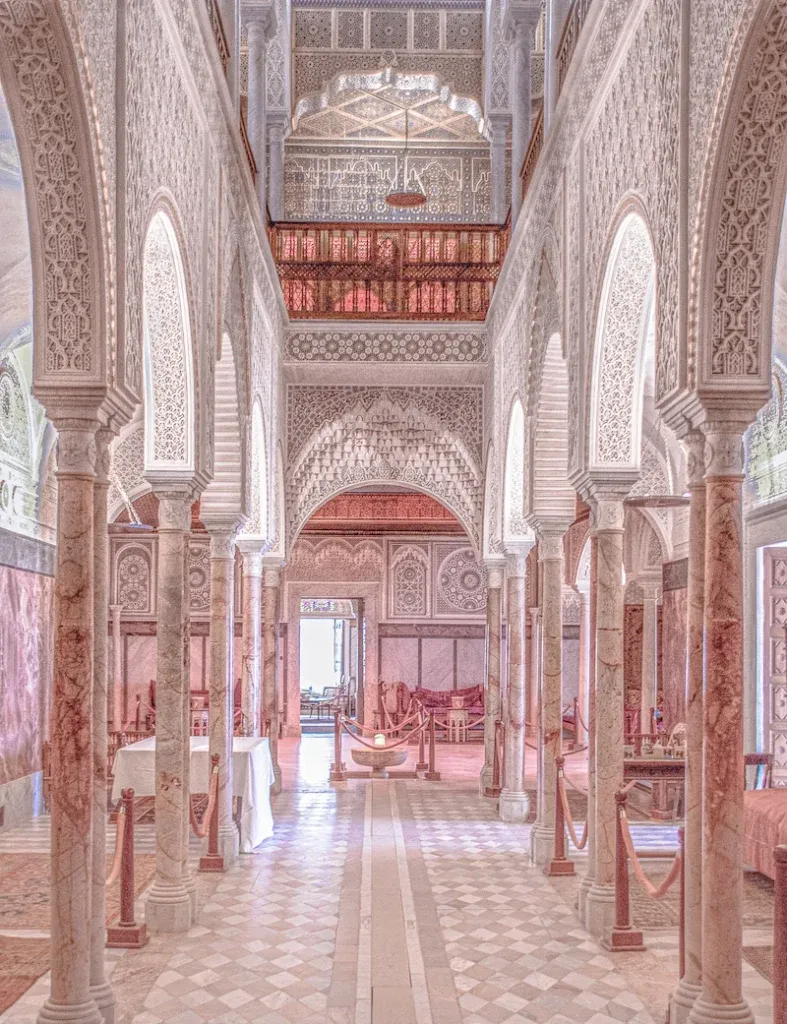
In September 1910, the baron moved into his property with his wife. The following year he began building a 2,000 m² palace with a five-hectare terraced garden, following the principles of Andalusian architecture. This large and beautiful residence would soon become a favoured meeting place for the musicians, people of letters and painters of Tunisia and elsewhere, its broad façade dominating an immense park. Built over some ten years, from 1911 to 1922, Ennajma Ezzahra recreates a passionately dreamed Orient: refined interior decoration mingling Arab-Andalusian, Spanish and Italian art, in a spirit that imitates the palace of the Alhambra at Granada. By decree of 28 August 1915, the baron also secured protection for the entire village of Sidi Bou Saïd — mandating blue and white and forbidding any unregulated building on the promontory.
What is to be discovered inside?
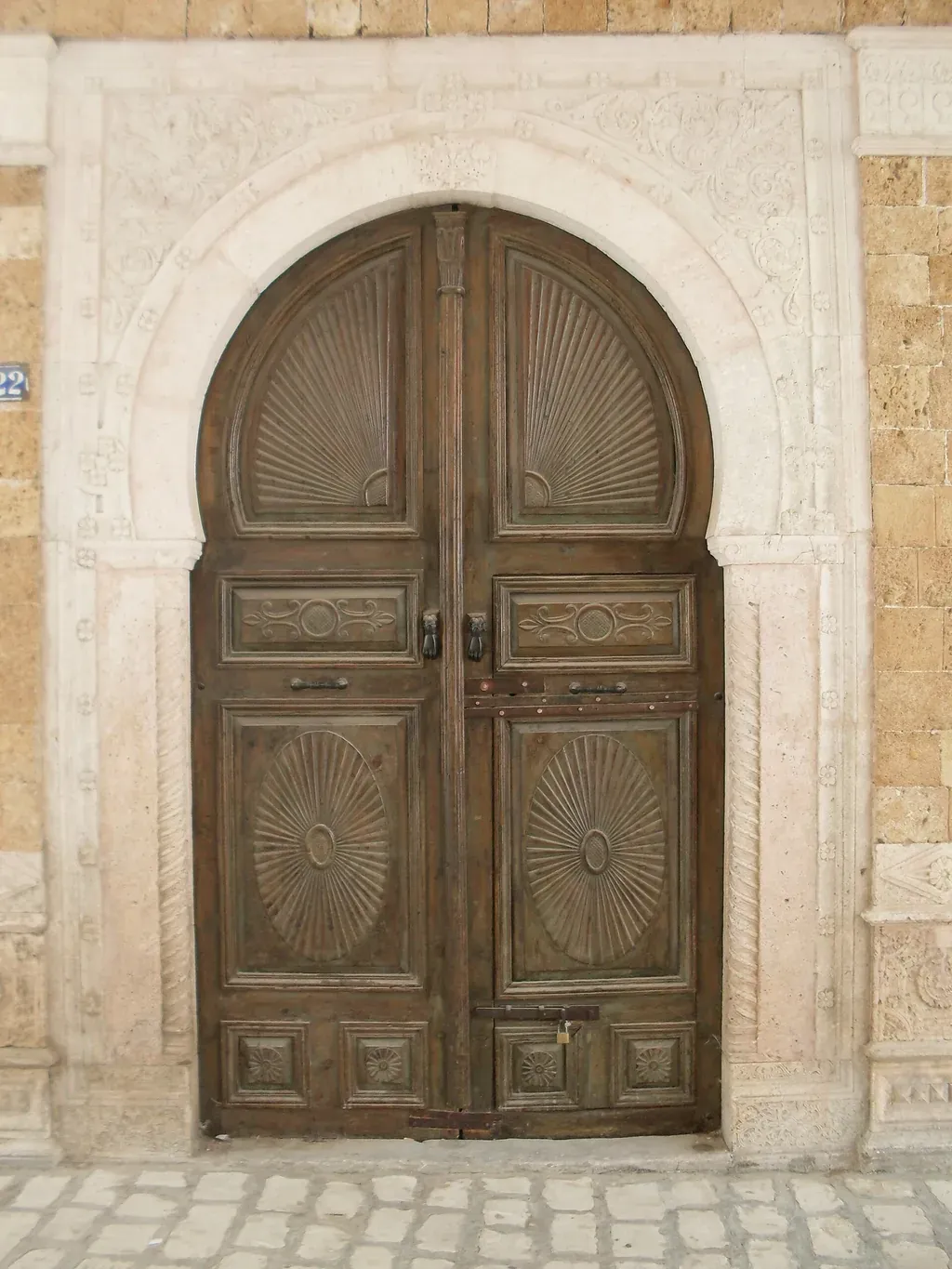
You enter through a tall door with heavy wooden leaves, painted yellow and studded with black in the Andalusian manner, then follow a flower-lined path that embraces the hill up to the palace — positioned to make the most of its view over the sea. The central gallery of the salon of honour — with its row of round arches on twinned columns, its delicately chiselled plaster and the richness of its marbles — betrays a marked taste for pageantry inspired by the beylical palaces. It leads to a peristyle patio, an oust-dar of Tunisian tradition, where musical performances and cultural press events are still held today — oriental music, jazz, classical music, opera.
The palace also comprises a music room of Tunisian tradition organised around a majless, a library of Moroccan inspiration bringing together old books and manuscripts gathered by the baron, and a large gilded chamber with a marble floor covered with Turkish and Persian carpets, opening onto a Persian garden with delicate faience.
What has become of the palace today?
Occupied and looted by German soldiers during the Second World War, then damaged by the billeting of Allied soldiers, Ennajma Ezzahra was sold to the Tunisian State by baroness Edwina d'Erlanger, widow of the baron's son, a few years after his death. It is today preserved as a museum, with a large part of its original furniture, paintings by Rodolphe d'Erlanger and a treasure chest supposed to have belonged to Suleiman the Magnificent. The palace has also served as a setting for several film shoots, among them the film Justine, adapted from the novel by Lawrence Durrell.
Since 1992 it has housed the Centre for Arab and Mediterranean Music, which uses it as a regular concert venue and displays a historical collection of musical instruments there. It is also home to the Tunisian National Sound Archive, charged with collecting, preserving and disseminating the country's musical heritage, as well as an instrument-making workshop dedicated to restoring instruments and researching organology — a place that, so they say, has not yet unveiled all its secrets, like other listed sites of Tunisian heritage and the neighbouring village of La Marsa.