Craving a getaway? Tunisia is full of wonderful little spots for a solo escape (to recharge), a family trip, or a romantic getaway. Here are three cities to run away to.
Hammamet
At the turn of the last century, many traveling writers, drawn to the exotic and the picturesque, fell under Hammamet's spell and helped build the town's fame, turning it into a highly prized winter resort. During his stay in Hammamet, the painter Paul Klee was dazzled by its light, its colors and its shapes.
“It was in discovering this small fishing village that I understood art does not reproduce the visible, but makes it visible.”Paul Klee
August Macke, Gustave Flaubert, Guy de Maupassant, André Gide and Oscar Wilde would also fall for the town. The Romanian billionaire Georges Sébastien added to its glory when he settled there and built a palace, which today houses the Hammamet International Cultural Centre. This residence now hosts the Hammamet International Festival, in the open-air theatre added to the villa's gardens by the Tunisian state in 1964. Other famous figures succumbed to Hammamet's beauty: Jean Cocteau, Wallis Simpson, the Duke of Windsor, Winston Churchill, Generals Von Arnim, Montgomery and Eisenhower, and even King George VI.
Mahdia
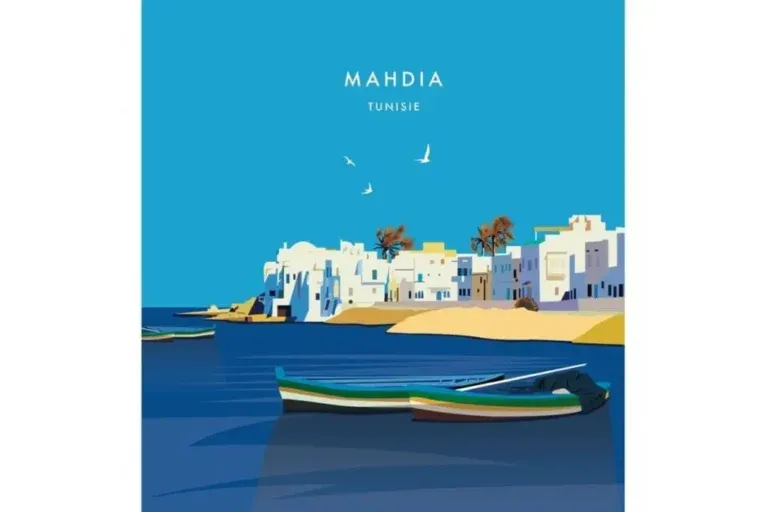
The city of Mahdia began as a Phoenician trading post, later Roman, under the name Aphrodisium. It was known successively as Jemma, Aphrodisium and Cap Africa. Originally built on a peninsula 1,400 metres long and 500 metres wide, it is home to one of the leading fishing ports in all of Tunisia. Although its historic centre sits on the peninsula, the city has gradually spread inland, notably with the Zouila district.
Its strategic geographic position and its fortifications allowed it to play a key role in the Mediterranean basin until the 16th century. The city has many sites of interest, including the Skifa Kahla, or Bab Zouila: a fortified gate first built in the 10th century and restored in the 16th. To this day it remains one of the entry points to the city's historic centre and one of the few surviving structures of the old ramparts.
Djerba
This is the largest island off the coast of North Africa; its main town is Houmt Souk. The Carthaginians founded several trading posts there, while the Romans built several towns and developed agriculture and port trade. The island passed successively under the Vandals, the Byzantines, then the Arabs. It is marked by the survival of one of the last Tunisian Berber dialects, by part of its Muslim population's adherence to Ibadism, and by the presence of a Jewish community said to date back to the destruction of Solomon's Temple. The island is also known for the Ghriba synagogue.
Since antiquity, historians have identified Djerba as the island where Homer has Ulysses and his companions run aground. Having tasted the lotus, described as a “fruit as sweet as honey, which plunges all who taste it into the delights of a blissful oblivion that erases every worry of existence,” Ulysses struggles to leave the island of the Lotus-Eaters, that imaginary people mentioned in the Odyssey. It is in fact a real, endemic plant that grows along the coast, known today as sedra: modern pharmacology has identified two of its active compounds, lotusine A and D, with narcotic properties, which may explain Ulysses' difficulty in leaving the island. Some see in this a symbol of the particular danger lying in wait for every adventurer and explorer: a land so hospitable, its welcome so warm and kind, that leaving becomes unthinkable.