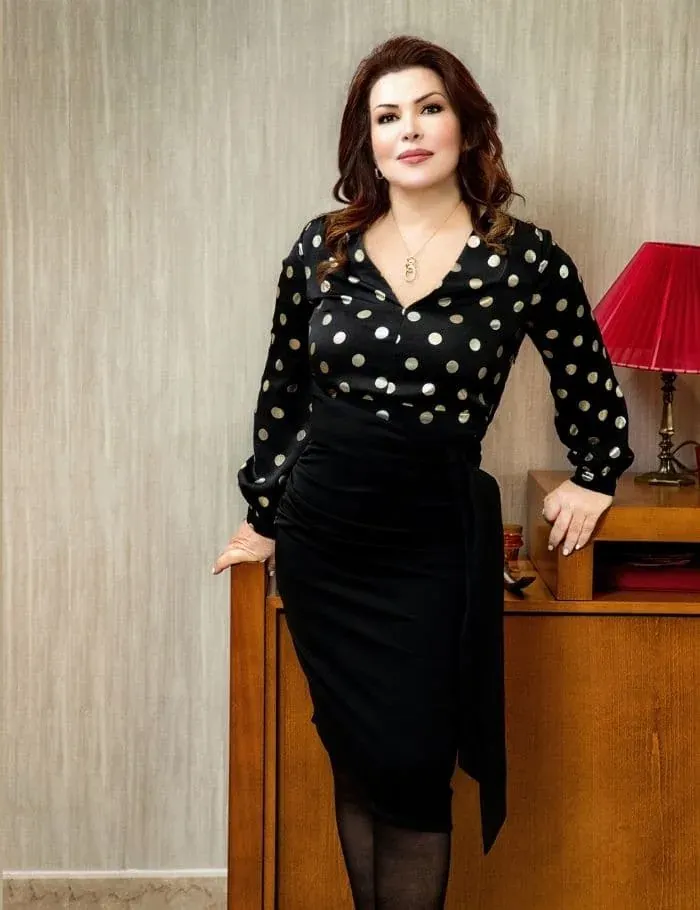
A Tunisian obstetrician-gynaecologist trained in Montpellier and then in Tunis, Lilia Bouraoui looks back in this interview on the calling passed on by her father, a hospital administrator; her years at the public hospital alongside Doctor Mohamed Chelli; her resignation to devote herself to her daughter; and her charitable commitment — including the 2011 humanitarian mission to Libyan refugees at Ras Jedir. A portrait of a woman doctor carried by one conviction: “Life is love.”
| Stage | Landmark |
|---|---|
| Training | Montpellier, then Tunis |
| Specialty | Obstetrics and gynaecology |
| Hospital beginnings | Public hospital, alongside Doctor Mohamed Chelli |
| Charitable commitment | The “L’enfant d’abord” association; humanitarian mission at Ras Jedir (2011) |
| Family life | A daughter in finance, a son studying medicine |
Lilia Bouraoui: A Calling in the Service of Life
For Lilia Bouraoui, becoming a doctor was self-evident. Her father, Tayeb Bouraoui, worked in hospital administration and notably headed the Charles Nicole University Hospital. He rubbed shoulders daily with doctors and admired their dedication. He wished for his beloved daughter to join their ranks and in turn carry out a noble mission.
From an early age, Lilia showed a particular sensitivity to human suffering. She naturally embraced her father’s wishes and committed herself to this path with determination.
Training and Early Inspirations
The Montpellier Years
After her baccalaureate, Lilia left for Montpellier to pursue her medical studies. The first year proved difficult for someone who had always been cherished by her parents. She had to adjust to being separated from her family while devoting all her energy to her studies.
She found respite only on Sundays, when Professor Jean Fourcade invited her to join his family for the Sunday meal. This head of department at the Montpellier hospital, and a close friend of her uncle, left a deep impression on the young student.
“He was extremely kind. A humble, very simple man of a kind rarely seen these days,” Lilia recalls with affection. Jean Fourcade showed her that success does not go hand in hand with arrogance. One must always show compassion.
“He was my friend, my professor, my Master. A human being I loved deeply.”
The Influence of Professor Ghachem
Jean Fourcade reinforced the idea Lilia had of the doctor’s role. This vision was already embodied in Professor Abdel Aziz Ghachem, a forensic pathologist and dean of the Tunis faculty of medicine.
The man she calls “my uncle” became a kind of spiritual father: “He was the ideal doctor, Dad’s great friend. He made a deep impression on me and I wanted to be like him.”
Excellence Through Sacrifice
The young student slept only 2 or 3 hours a night and studied constantly. She refused to disappoint her father, who believed firmly in her: “For me, I had to succeed on the first try. I owed it to my dad.”
Lilia Bouraoui succeeded brilliantly, finishing among the top of her class.
Return to Tunisia and a Confirmed Calling
After two years of study in Montpellier, she returned to Tunis to continue her training. She joined a team of wonderful doctors, keen to help ensure the durability of a fair health system accessible to all.
“We gave a great deal of ourselves. We worked out of dedication, because we felt entrusted with a mission,” she explains.
Choosing Obstetrics and Gynaecology
The surgery placement was her delight. After hesitating between cosmetic surgery and general surgery, Lilia opted for a quintessentially feminine discipline. She became an obstetrician-gynaecologist, caring for both women and their children.
Contemporary Medical Realities
Regarding the rise in caesarean sections, Lilia Bouraoui qualifies received ideas. Doctors do not choose this operation for mercenary reasons. Sometimes, mothers-to-be request it to preserve their perineum. In general, vaginal delivery remains the preferred option.
Several factors explain this trend: a lack of physical exercise, an increase in birth weight, the wish to avoid obstetric complications, and the growing incidence of gestational diabetes and pregnancy-induced hypertension.
“We doctors have the responsibility to assess the situation and make our decisions as early as possible,” she notes.
An Exemplary Hospital Career
Alongside Doctor Chelli
Lilia Bouraoui began her practice at the public hospital and quickly became deputy to her head of department, Doctor Mohamed Chelli. This extraordinary doctor had an impressive capacity for work. He would arrive at 6 in the morning to begin his rounds.
Humble, clear-sighted and intelligent, he did not hesitate to question himself, even in front of the youngest. He worked until the very last day of his life.
“I owe him a great deal. I was his student, I was his daughter. He taught me so much and I adored him for it.”
The Challenges of the Public Service
The mother of a little three-year-old girl, Lilia Bouraoui found herself alone in having to fill the role of head of department. She trained the younger doctors and worked by night as by day, because the department was already short of staff.
She reported her difficulties to the ministry and asked for the recruitment of new doctors. Unsurprisingly, her messages went unanswered. Lilia Bouraoui then handed in her resignation.
“I no longer had any time to devote to my daughter; I barely found the time to shower; I worked day and night. After a while I was worn out. In fact, I gave myself three months to rest before opening my practice.”
Humanitarian Commitment and Dreams for the Future
The “L’enfant d’abord” Association
Lilia Bouraoui is actively involved in the “L’enfant d’abord” association, which takes her to the four corners of Tunisia. One of her memorable experiences unfolds in Ain Drahem, where she sees more than 80 people on the first day.
“I gave each of them their prescription… But it was of no use. Not one of them could afford to buy what they needed. The next time, I brought the medicines and handed them directly to the patients.”
Revolutionary Solidarity
In 2011, doctors organised spontaneously to bring aid to Libyan refugees in the camps at Ras Jedir. Lilia Bouraoui spent three intense days there, a testament to the humanitarian commitment of Tunisian practitioners.
“One must not call into question the dedication of our doctors or their human commitment,” she insists.
A Philanthropic Dream
If she had the means, Lilia would fulfil her dream: to create a home for the elderly. She has even thought of transforming her own house, inspired by the experience of a friend who reorganised her home to take in residents with Alzheimer’s.
“If there is one cause dear to my heart, it is that of the elderly or of single mothers. These two groups are often mistreated and ostracised. The idea would be to help them rebuild themselves.”
Family-Career Balance
A Mother’s Choice
Beyond the physical exhaustion, it was love for her child that led Lilia to leave the public hospital. The father worked a great deal and was seldom present.
“One of the parents really had to be there. You don’t have children only to leave the cleaning lady to look after them. They need us, our attention, our affection. We are their anchor and we must prepare them to learn about life.”
She is proud of her eldest daughter, who works in finance, and of her son studying medicine. “Our children are a treasure. They are the most beautiful thing we have.”
Life Philosophy and a Message of Hope
Passion and Fulfilment
“I did what I loved to do. Always acted with passion, making the most of my circumstances. I have always been convinced by my choices, because I adore my profession,” she confides.
If she had to change one thing in her journey, it would be to stay longer in the public service. “But once you leave your hospital, you can no longer return to it.”
The Magic of Birth
Lilia Bouraoui’s passion shines through in every one of her words when she speaks of her profession:
“The magic happens the moment I tell a woman she is pregnant. When I see her joy, I feel I have taken part directly in that life. One of the most beautiful things I witness is that first look a mother gives her child, after having carried it for nine months in her womb.”
A Universal Message
“The Tunisian woman is a fighter… We also have a dynamic and promising youth. I encourage them to move forward. One can only be fulfilled by being passionate about what one does.”
For Lilia Bouraoui, life is worth living. Being the first person to receive life at births is a privilege of which she never tires.
“It is a moment charged with emotion that reminds us of the meaning of life. Life is love.”