Tunisian cuisine wins hearts! Say Tunisia and you inevitably say Mediterranean and jasmine, calm seas and golden wheat fields… All these features of the land of Hannibal are found quite naturally on the plates of Tunisians, who possess one of the richest and most varied culinary heritages in the world.
Where does the richness of Tunisian cuisine come from?
It is quite simple: there is not one discerning food lover, whether from the country or from elsewhere, who does not let slip an “mmmmmm, this is good!” at the very first mouthful of a dish of kafteji, of lablabi or of chakchouka… before plunging the fork straight back in. The dozens of dishes on record are so many festivals of the senses and of colour, shaped by the various civilisations that settled on this land over the millennia — all of which left their imprint on the country’s cooking.
Whether Capsian, Amazigh, Punic, Roman, Vandal, Byzantine, Arab, Andalusian, Turkish or European, each civilisation brought an ingredient, a technique, a knowledge that the majority of Tunisians quickly took into their cooking. A genuine synthesis eventually came about between these civilisations, visible in genetics, culture and cuisine alike. Tunisian cuisine is thus at once Eastern, African and European, and varies from region to region. It remains rich in vegetables, spices and aromatic herbs, but also in cereals and olive oil, and stands out for its nutritional qualities.
Why does olive oil hold such a central place?
Many elderly Tunisians, some of whom hold high office today, astonish with their alert minds, their good health and their readiness to smile — even though they have lived through periods of intense stress. One of them, asked about the secret of his good form, would answer: “as a boy, on our family farm, at every opportunity I would plunge a big piece of bread into a bucket filled with olive oil and swallow it in one go. That is the key to well-being.” Olive oil, whose health benefits are well recognised, is a flagship ingredient — arguably the central one — on the Tunisian table.
The cultivation of the olive tree on Tunisian soil goes back to the 8th century BCE. It is thanks to this tree, which can live a very long time (the country’s oldest olive tree, at Echraf in the north, is said to be 2,500 years old), that the south of the country was able to develop. Phoenicians, Greeks and Romans already made use of this precious fruit, whose oil went into culinary, cosmetic or medical preparations. Since then, its “green gold” has confirmed that reputation: for the 2025-2026 season, Tunisia is on course to become the world’s second-largest producer of olive oil, just behind Spain and ahead of Greece and Italy, with a harvest estimated at between 380,000 and 400,000 tonnes.
International awards have kept pace. In 2017, two Tunisian olive oils, “Olivko” and “Triomphe de Tuccabor”, had already won gold medals in New York and in London. Since then, the distinctions have multiplied: 211 medals won at 33 international competitions in 2023, 26 medals — including an equal number in gold — at the International and European Extra Virgin Olive Oil Competition in Geneva in 2024, then 46 gold medals at the Al-Ahram international competition in Cairo in 2025. To carry the tour of Tunisian culinary heritage further, our exploration of the Tunisian summer table and how it is handed down revisits those gestures inherited from grandmothers.
Kafteji, madfouna: where do the emblematic dishes come from?
Take the case of kafteji, the popular dish par excellence. Many think it is Tunisian, but it is nothing of the sort: it is said to have been originally a Turkish dish. Kafteji is thought to come from the Turkish “Kofteci”, which means a seller of kefta (“kofta” in Turkish), or more generally the one who fries. The dish reached Tunisia through the beylical families, who at the time prepared it without potato — it looked more like what is today called “tastira”.
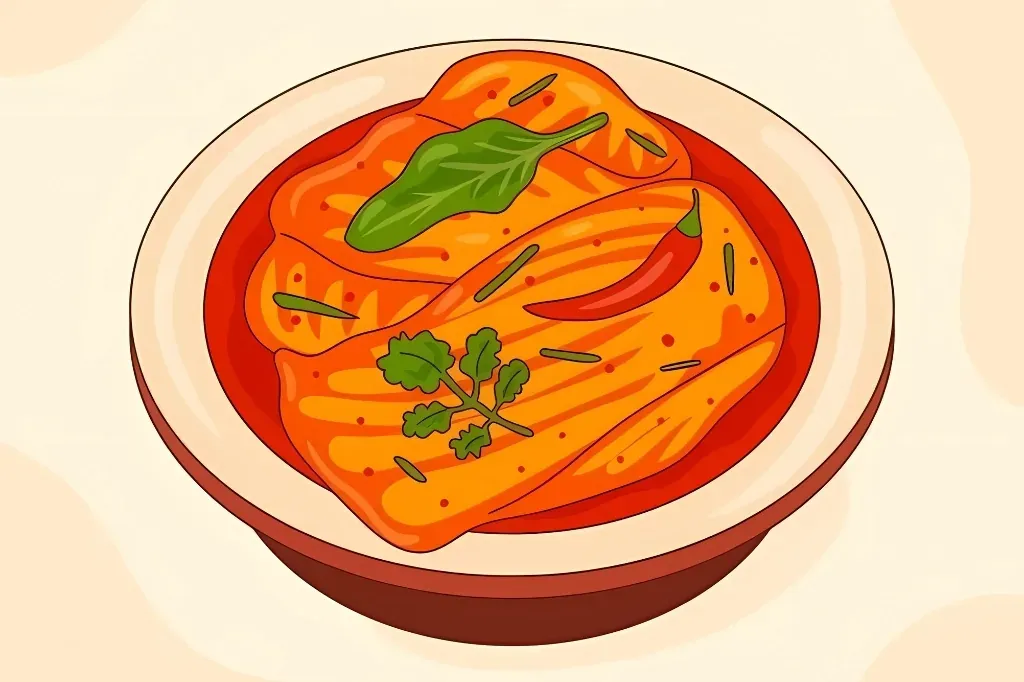
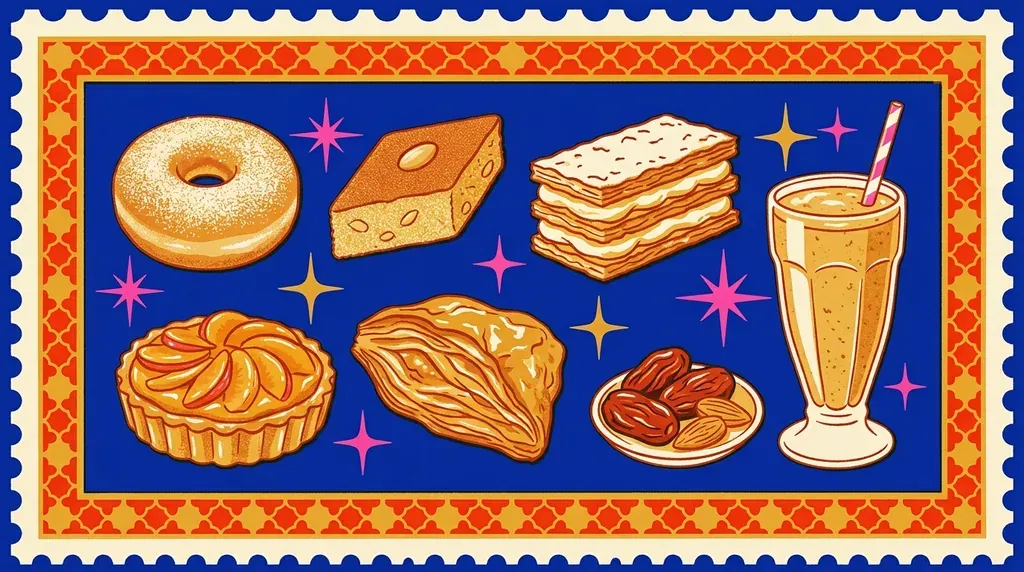
Kafteji later became a speciality of Kairouan. Revisited several times over, it is today prepared in a number of ways: sometimes with simply peppers and eggs, sometimes with squash, pumpkin or potatoes. Other dishes are likewise of Turkish origin, such as lablabi, chorba, baklawa or halva chamia. Madfouna, for its part, is a Tunisian dish of Jewish origin once called “t’fina”, a name designating a dish long simmered under cover, which can cover different recipes such as bkaila, wheat harissa, the red-bean stew dafina or nikitouche with eggs. It was reportedly the Italian Jews passing through Tunisia during the last century who handed the recipe on to Tunisian Jews. These exchanges continue today, as with the rise of Korean kimchi on Tunisian plates.
Cereals and fish, pillars of the Tunisian table
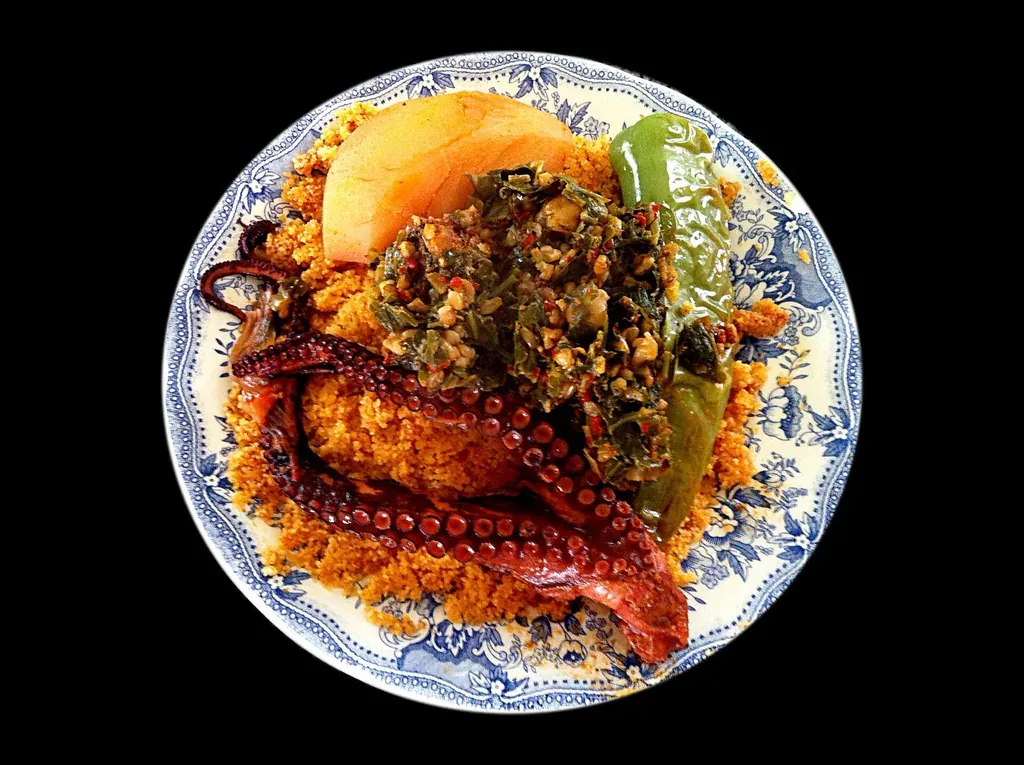
Tunisian cuisine gives pride of place to cereals, cooked every which way: the “couscous Borzguen” of Le Kef, the “Ftét” of Béja, the “Kaak warka” of Zaghouan, the “couscous Mayou” of Hammamet, the “sweet couscous with quadid” of Nabeul, or “El Bazine” of Sfax. For a long time, cereal production was intended for every social class, while that of fruit and vegetables remained reserved for a better-off population. But everyone was fond of Berber bread, a vital component of the Tunisian table: leavened or as a flatbread made from barley, wheat and cereals, it was much appreciated.
In antiquity already, fish, when it was not cooked in water or in a broth, was generally cooked in a sauce or fried in olive oil. For preservation, drying was used, or steeping in vinegar and salt, or even garum, a condiment used in Rome and in ancient Greece: fish flesh or intestines fermented at length in a large quantity of salt to prevent any rotting. These ancestral techniques find an echo in the methods of food preservation still used today.
Harissa, tea and coffee: the everyday essentials
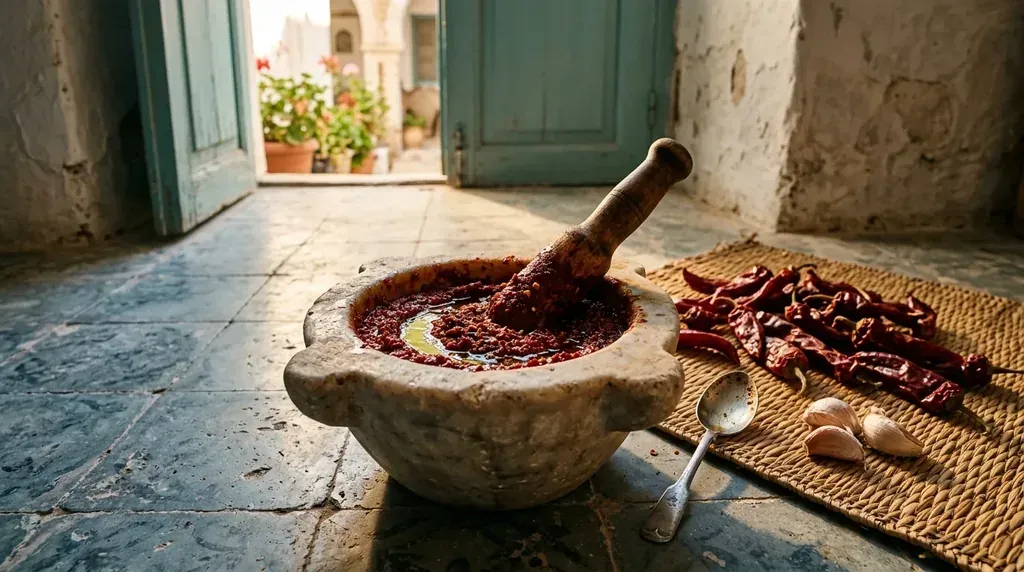
Harissa is the most widely used condiment in Tunisian cuisine. Tunisians put it in most starters and season many cooked dishes with it. Its hot taste pleasantly flavours the food, and it has been scientifically demonstrated that harissa, like any chilli-based sauce, is beneficial to health — which would partly explain the longevity of the inhabitants of the Mediterranean basin.
Tea is an integral part of Tunisian culture: it is drunk anywhere and at any time. Energising, it is flavoured with mint and served with Syrian pine nuts or grilled almonds, sometimes with peanuts — and behind this enthusiasm one finds the benefits of mint. Tunisians also drink black tea flavoured with geranium leaves. The traditional coffee is Turkish coffee, often scented with a few drops of orange blossom. Not to mention the many juices (orange, strawberry…) and lemonades much enjoyed in summer, between Italian ice creams and Turkish-style ice creams.
Alcohol in Tunisia: boukha and thibarine
The history of alcohol in Tunisia goes back to the dawn of time: its consumption enjoyed a certain prosperity under Punic Carthage, when men such as Magon theorised the fermentation of barley. Boukha, much appreciated by enthusiasts, is a fig eau-de-vie distilled since the end of the 19th century on the initiative of a Tunisian Jew, Abraham Bokobsa, in his artisanal workshops at La Soukra. Its name means “alcohol vapour” in the Judeo-Berber dialect; it is obtained by natural distillation of figs, mainly from Tunisia and Turkey.
Kosher, boukha can serve as the base for many cocktails, flavour fruit salads or be drunk as a digestif or an aperitif; it was also drunk in Libya. Not forgetting thibarine, made from alcohol, sugar and aromatic plants, often presented as a date liqueur without this appearing on the label. This digestif is originally produced by the White Fathers of Thibar, in Tunisia.
A gastronomy under strain: the weight of the high cost of living
For several years now, Tunisian gastronomy has suffered from the high cost of living: meat and fish have become a luxury for many households, which fall back on chicken — itself also hit by rising prices. That strain has not eased: according to the Institut national de la statistique (INS), food inflation still reached 8.2% year on year in May 2026, driven by sheep meat (+21.8%), poultry (+15.6%), beef (+14.1%) and fresh fish (+11.9%). Paella, the famous Spanish rice dish based on meat and seafood, peasant fare par excellence to begin with, has thus become a bourgeois dish, reserved for the best-off households. All in all, Tunisian cuisine remains in the image of the Tunisian people: a true mosaic of tastes, of sensibilities and of colours, which is holding firm despite the economic strains.