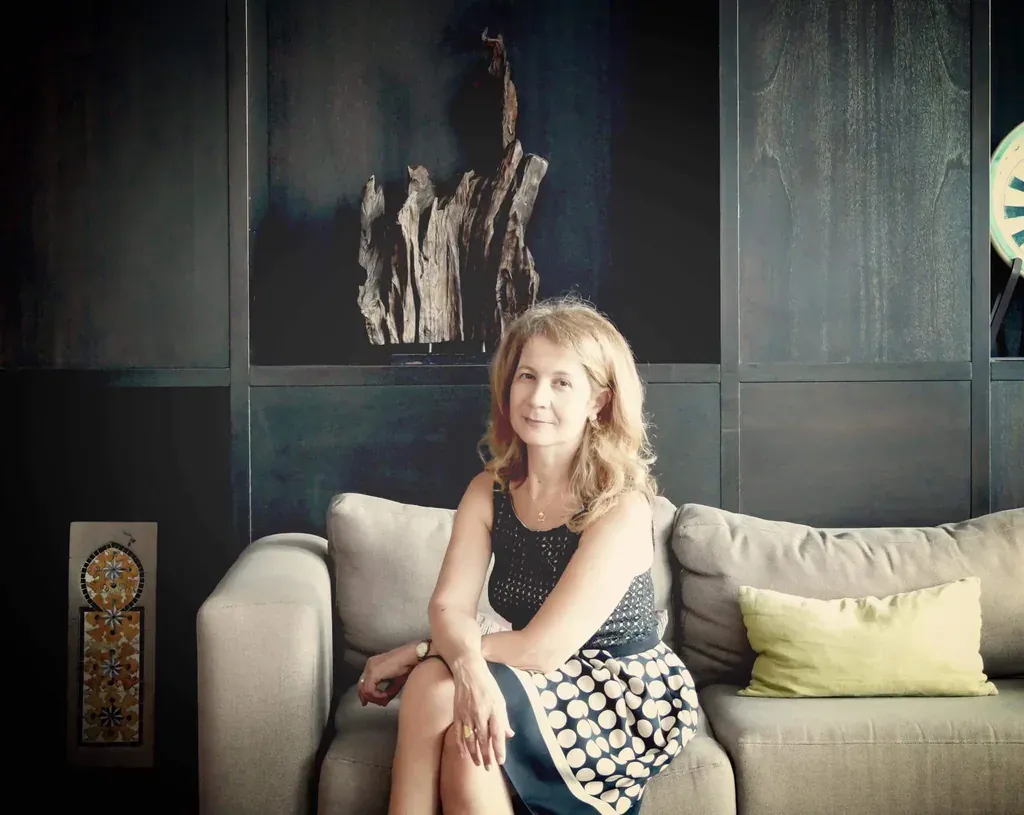
Amel has been a political activist since 2011. She is the only person in my circle who has not thrown in the towel. Despite the difficulties and all the ugliness we witness, she remains convinced that she must be present on the ground to change things. I do not always share her positions, and I tell her of my reservations or my disapproval. She receives the criticisms I make with strength, kindness and humility. They have never shaken her convictions, nor rattled our friendship.
Amel Belkhiria: Perseverance in the service of the democratic ideal
Amel Belkhiria has been my friend for an eternity. That is to warn you from the outset of the affection I feel for her. She has agreed to answer my questions and to take part in this rather unusual series of interviews. To begin with, I will not tell you about her courage or her determination. I will say nothing of the immensity of her heart of gold. I will also keep quiet about what makes her someone you can trust.
Tell us who you are, about your path, tell us about the reasons that drove you to get involved
Amel Belkhiria: That is the most complex question anyone can answer. Who are you?
I am quite simply a Tunisian woman who glimpsed a glimmer of hope in the change brought about by the events of 14 January 2011.
| Milestone | Detail |
|---|---|
| Education | Pharmacy studies, Faculty of Monastir |
| 14 January 2011 | Demonstrates on the avenue facing the Ministry of the Interior, the day of the revolution |
| 2011 | Candidate for the Constituent Assembly, Tunis 2 list, Modernist Democratic Pole (Pôle Démocrate Moderniste), running mate to the late Ahmed Brahim |
| 2011-2014 | Active within the Joumhouri, alongside Maya Jeribi |
| Early 2014 | Withdrawal from active political life |
| Four years later | Returns to political engagement alongside Selim Azzabi and the "companions of 2011" |
| — | A spell in the office of the Minister of Development, Investment and International Cooperation |
The family foundations
I am the product of an ordinary Tunisian family. More precisely, of an ordinary Tunisian woman. Having lost my father very young, it was my mother who watched over our upbringing, my sister's and mine. My childhood and adolescence revolved around two fundamental values. There is nothing you cannot achieve with perseverance and knowledge. And there is nothing you cannot accomplish because you are a woman!
A late political awakening
Until 2011, I never felt the slightest interest in public affairs. Public debate having been a taboo known to all, political life in Tunisia never interested me. And yet I took a keen interest in the history of Tunisia and of the region.
I had finished my pharmacy studies and begun my career in the private sector when the events of December 2010 broke out, stirring a repressed sense of belonging that, until then, had only fully expressed itself when I was abroad. On the morning of 14 January 2011, I found myself on the avenue facing the Ministry of the Interior, chanting for the departure of the regime in place.
The birth of a commitment
I admit that, at that moment, I had no precise idea of what needed to be done the next day. But I had the conviction that we had to take the step towards a democratic and social opening that would allow Tunisian potential to flourish. On the evening of 14 January, I had that refreshing feeling. Everything was possible for our Tunisia! The opportunities were countless, and we had only to make use of the freedom we had won to unleash all the potential repressed under the yoke of silence... Ten years on, I acknowledge that this was a rather naive line of thought.
Entering politics
During the months that followed, I set out in search of a "project" that answered my aspirations: to defend a free and plural society. A society that sees diversity as a source of richness. That shares the values of mutual respect, integrity, work and the rule of law. It was with a group of young people driven by the same motivations that I decided to take action.
Seven months later, I was a candidate for the Constituent Assembly on the Tunis 2 electoral list of the Modernist Democratic Pole, as running mate to the great activist, the late Ahmed Brahim. Defending the project of a progressive constitution. Pleading for a modern, democratic state that would guarantee individual freedoms and equality between men and women. Condemning any form of racial or religious discrimination. A state founded on citizenship and equal opportunity for all. It was a beautiful experience of hope and dreams. But on the evening of 23 October 2011, the awakening was harsh...
The Joumhouri experience
For three years, in a quest to bring together a progressive, centrist family, I went through the experience of the Joumhouri. I had the honour of seeing the great Maya Jeribi at work. A big-hearted activist who left no one indifferent. Those three years were deeply enriching.
I had the pleasure of mixing with most of the figures of the struggle against the dictatorship and with most of those who entered the political scene after 2011. I undeniably learned a great deal. I lived through unforgettable moments of joy and human sharing. But I also experienced distress and disappointment. The distress of seeing blood spilled after the assassinations of the late Chokri Belaid and the late Mohamed Brahmi, and the disappointment of seeing ego wars and the aftershocks of the quarrels of the 1970s and 1980s compromise the future of an entire nation that nonetheless had so many opportunities within reach.
The pause and the return
In early 2014, I decided to take a break. I was no longer able to reconcile my ideals and the meaning I give to the practice of politics with the turn events were taking and the solutions chosen to get around the deadlocks that marked the Constituent Assembly's term. I was not convinced that "ousting the Islamists" alone was a political platform sufficient to build a lasting, solid project.
Four years passed without any real engagement. I watched with great bitterness the decay of values, the absence of an innovative, unifying national project. And the glaring lack of ethics in political practice. But one day, I received a phone call inviting me to a meeting with Selim Azzabi, former director of the presidential cabinet and, above all, an old friend and comrade from the Republican Party.
My decision was quickly made. I was rejoining the action alongside the companions of 2011, with the aim of reviving the project so dear to my heart: a society that is free and freed from the yokes of corruption. Valuing difference and diversity. Encouraging innovation and free initiative. Founded on the values of work, respect for the law, integrity and fairness.
An unshakeable ideal
I have certainly gained in experience, in maturity, in pragmatism and in realism. But while keeping the essential in mind:
"That from these honored dead we take increased devotion to that cause for which they gave the last full measure of devotion… That these dead shall not have died in vain, that this nation, shall have a new birth of freedom, and that government of the people, by the people, for the people, shall not perish from the earth." Abraham Lincoln
Abraham Lincoln spoke these words at Gettysburg to mark the end of the civil war. 155 years later, they remain a great inspiration for Tunisia.
Very many of us deplore the lack of fair representation for women, in politics — and not only there. Do you envisage the possibility of moving to greater visibility?
Amel Belkhiria: I have always thought that the representation of women depended first and foremost on the will of "women". And although we still live in a rather patriarchal society, I think Tunisian women have spaces for action that they sometimes desert.
The feminine paradox
I sometimes tend to believe that women are the first brake on their own representation. The remarks I received from some women in the field during the election campaign (as a candidate) left me... perplexed.
That said, I do not conceive of women's representation solely in the "shop window" of power. There are very influential positions, even if they are in the shadows. What should be promoted is women's participation in public life, in political parties, in civil society, and so on.
Tunisian feminine excellence
My time in the office of the Minister of Development, Investment and International Cooperation allowed me to realise the value of the work Tunisian women do within the public administration. And the quality of the female executives and senior executives with which the country abounds.
I also think the cause of women would gain ground with the rejuvenation of the political scene. The heavy "cultural" legacy would be softened by a new, open-minded generation. And above all one carried by dynamic, motivated young women, who prove themselves wherever they go and give Tunisia a brilliant image.
So, to come back to your question, whether I envisage moving to greater visibility depends on several factors. First of all, the relevance of the thing. And above all my conviction of the "added value" I could bring to a given position, whatever its degree of exposure.
"The situation of women is left to feminists alone. It only comes back into politicians' discussions in the run-up to elections." What do you think of this statement?
Amel Belkhiria: I quite agree. There is one aspect relating to the application of the law: the legal arsenal is fairly well stocked when it comes to protecting women. What remains is to apply the law and to embed it in the social subconscious (the law banning violence against women, for example). This largely comes down to the workings of the rule of law, whose institutions are responsible for applying the law.
The role of education
But there is another aspect, relating to the evolution of society. And here it is the role of the intellectual and political elite and of civil society, which has the task of planting the pillars of a model of society that incorporates equality between men and women.
Here, once again, our education system stands on the front line of the battle. It is in state schools that collective consciousness begins to be shaped. Recently, a news item shared on social media caught my attention and, above all, alarmed me. The headmaster of a state secondary school issued a notice obliging "girl" pupils to wear a smock, on pain of being refused entry to the school. Anatomical "specifications" were even laid down for the famous smock.
An educational scandal
I was scandalised, on more than one count. Although it turns out that the document dates from 2018, that changes nothing about the seriousness of the decision, or the entrenchment of this backward mentality in the minds of several members of the teaching staff.
With this simple scrap of paper, in three lines, they managed the unfortunate feat of objectifying little girls. Of planting the first seeds of discrimination against women in the heads of their classmates. Of flouting the precepts of the Tunisian constitution, and of destroying any notion of equality in the application of the law.
Yet it is at school that one is supposed to understand one's first rights and duties as a citizen. It is at school that one is supposed to learn to respect the law. It is at school that one is supposed to learn that a society that respects itself is a society governed by blind laws. Blind to gender, to colour and to social classifications!
The overhaul of state education remains the central issue for Tunisia's future. Whether on the economic, social or political level.
Tunisia faces many challenges today. We often hear of the need to carry out reforms — give us your own vision.
Amel Belkhiria: The need to carry out reforms! Yes, absolutely and without delay. It is no longer a choice but a vital obligation. But I think that would not be enough, so deep must the changes be!
A transformative vision
I would say that Tunisia needs a societal overhaul, one that starts with drafting a new social contract. A redefinition of the role of the state and a thorough revision of its education system.
It is time for Tunisia to move from the protective, guardian state towards a facilitating state whose primary mission would be to guarantee equal opportunity to all citizens — to secure access to basic education and create the conditions for autonomous citizens to succeed and flourish, citizens capable of taking on the social role of supporting the most vulnerable groups.
The educational imperative
Rethinking our education system is therefore an imperative. Not only in the sense of adapting it to the labour market and revaluing vocational training courses. But above all with a view to promoting the fundamental values of a creative and autonomous society, based on citizenship and free initiative within respect for the law.
Who are the people you most admire?
Amel Belkhiria: That is quite a difficult question. It is not easy to pin down all those who can leave their mark on us over a lifetime. Being someone who rejects the cult of personality, I tend not to have an idol "at all".
Inspiring figures
I admire the clear-sightedness and insight of Habib Bourguiba. The tenacity and perseverance of Winston Churchill. The wisdom and tolerance of Mahatma Gandhi. The resolve and will of Margaret Thatcher. The courage and determination of Benazir Bhutto. The eloquence and charisma of Barack Obama. The humility and empathy of Jacinda Ardern.
I admire the headmaster of my primary school, "École Rue de Pologne". The late Si Sadok Negra. He was the first person to teach me the value of a job well done. He knew how to reconcile uprightness, sternness and compassion — Allah yarhmou (may God rest his soul), a great gentleman.
The deepest admiration
But more than anyone, I admire my mother. It is quite a predictable answer, I know, but it is the truth.
I admire her courage, her determination and her strength of character which, without any feminist or other ideological baggage, allowed her to override the precepts of a conservative society — one that tends to confine women to their most rudimentary domestic role — in order to instil in my sister and me the values of freedom and self-determination. To the point where we could not imagine that women's rights could ever be called into question. Nor that it might be necessary to fight to establish women's role in society... The adult world took charge of that lesson, and I must admit that the awakening was sometimes difficult :)
What are the events that made you the person you are?
Amel Belkhiria: Two events strike me as the most relevant:
The founding ordeal
The loss of my father at the age of 4 shaped the way I interact with the world. With hindsight, I think it made me more tenacious and, above all, more demanding of myself. Being worthy of his memory has always been one of the main factors in the major decisions I make.
The revolutionary turning point
14 January 2011 is a key date. An innumerable array of opportunities opened up before us. From then on, we have the chance to change ourselves and to take part in changing things. Before, it was personal successes that mattered. Today, it is collective success that counts most.
This is a question I always ask, because it strikes me as especially important. What is your favourite book? The one that marked you most? The one you loved reading this year? The one you would recommend to those around you, without the slightest hesitation?
Amel Belkhiria: I could not say what my favourite book is. A book is like a perfume: to each season its scent, and to each phase of life or state of mind there is a book (or books) that touches us most.
Books that left their mark
Benazir Bhutto's autobiography "Daughter of the East" marked me deeply. Her struggle as a woman asserting herself in a fundamentally masculine society, the distressing contradiction between the gardens and lecture halls of Harvard and the arid landscape of Sukkur prison, her determination and her courage were a great inspiration.
This year I loved rereading "Le Bon Grain de l'Ivraie" (The Wheat from the Chaff) by the late Béji Caïd Sebsi. It was interesting to dive back into BCE's book after his time at Carthage. It gave me another perspective on his term, and — I must admit — it somewhat depressed me: the references and the calibre are no longer the same!!
An essential recommendation
If I had to recommend one read, it would be, without the slightest hesitation, the letter from the late Ahmed Tlili to the late Habib Bourguiba: a timeless diagnosis that remains as relevant as ever. I warmly recommend it to all leaders of political parties, to all members of parliament and to all those who hold high responsibility in the executive!
Finally, what is the question you would have liked me to ask you, and that I did not think of?
Amel Belkhiria: If I had one decision to change in my life, which would it be?
Very well. So, if you had one decision to change, what would it be?
Amel Belkhiria: I would have chosen a different field for my higher education. I would have opted for law or political science.
The academic regret
I loved studying pharmacy. My years at university in Monastir were among the finest of my life. I loved what I was doing, until the day I decided to change path and career.
And I admit that I find immense pleasure in "Public Service", in its broadest definition, and I would have liked to be better equipped academically.
That said, making up for it is a thought that has been working on me for some months. I hope I will have the courage to take the plunge.
Amel Belkhiria, THANK YOU.