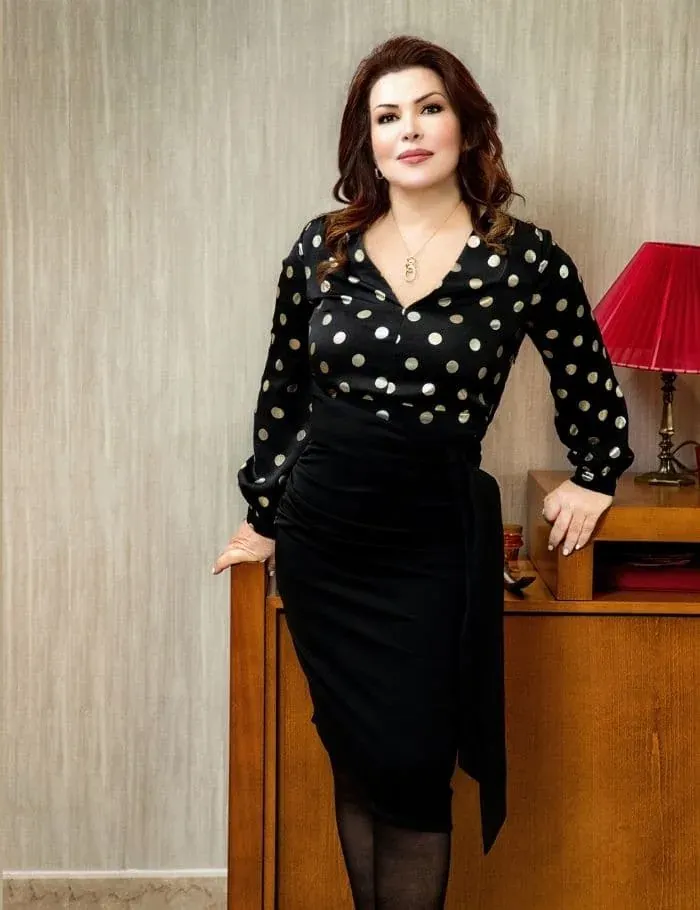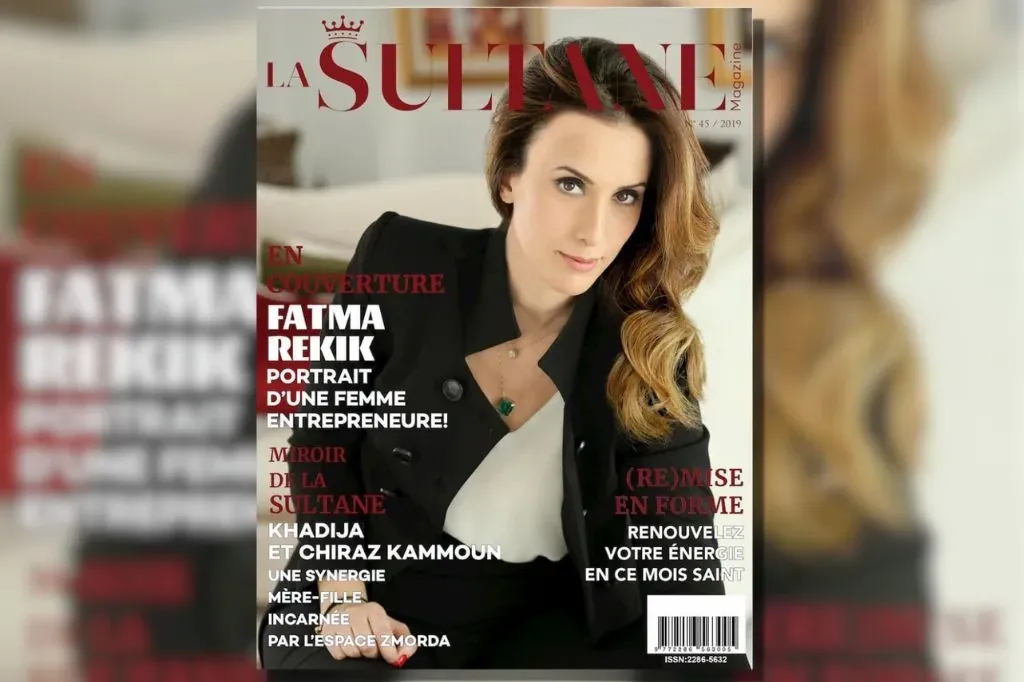
Rim Abdennadher is a clinical psychologist, an entrepreneur and a committed figure in Tunisian civil society. Trained in California and then in Tunis, she has given her career to family therapy, to preventing radicalisation and to standing beside the most vulnerable. On the cover of issue 50 of La Sultane, she tells us about her path, the causes she has fought for and the maxim that guides her life: do everything with love.
Who is Rim Abdennadher? A path from Sfax to California to Tunis
Proud to be a Tunisian woman “schooled through the state system”, Rim Abdennadher took a maths baccalauréat, then left for California and a double major in molecular biology and neuropsychology. In the summer of 2006 she settled in Tunis for a DEA in clinical psychology and applied psychopathology, at the faculty of humanities and social sciences in Tunis, on the 9 April campus. Then came 7 years of volunteering at the Razi hospital.
An executive MBA at MSB university came next, to carry her responsibilities inside the family group Abdennadher — then listed on the stock exchange and chaired by her father — and, as she puts it, to grow her profile as a woman entrepreneur through CSR (corporate social responsibility). She wanted to help through that commitment, she says, the group having always stood by its employees and chosen a social policy. She rounded out her training with a second master’s, in systemic family therapy, in partnership with the University of Savoie Mont-Blanc.
A psychologist committed to families, and against radicalisation
With Dr Abdessalem Yahiaoui and a group of therapists from the first systemic therapy cohort, she founded the Société Tunisienne de Recherche et de Thérapie de Famille et de Couple, which went on to organise the first international conference on couple and family therapy held in Tunisia. The team ran many field studies across the poorest regions, and Rim Abdennadher published a paper on the suicide rate, “remarkably high” since the revolution, particularly in Kairouan.
The country at the time was living through deep insecurity, marked by frequent terrorist attacks. Rim Abdennadher watched young girls being indoctrinated ahead of their departure for Syria, and spoke twice on the subject at the United Nations in New York. Because of that work, several of them threw away the phones that carried their instructions, turned down large sums of money, stayed in school and went on to build settled families — “a source of personal satisfaction”, she says, on a question that runs into the wider ground of the adolescent crisis and of supporting families against recruitment.
Association work turned towards the most vulnerable
Her mother started her on association work at 13, in Sfax, and it carried on through her university years in the United States. In 2020 she sits on the executive of Afrimalife BPW Jasmin, chaired by senator Leila Mabrouk Khayat — also vice-president of CABW, chaired by Cheikha Hissa Saad El Abdallah Salem Al Sabbah, of Kuwait. She is also vice-president of the Amicale Franco-Tuniso-Libyenne and honorary president of the APFNPS in Bizerte, chaired by Fatma Lassoued, whose executive members worked towards the opening of a shelter for older people with no home and no one to turn to.
After a malignant thyroid cancer diagnosed in 2010, she worked until 2018 with women who had breast cancer, before and after their operations. She also followed 70 boarding pupils at the primary school in Mateur, to keep them from dropping out. And through her brother’s contribution and her own, the Abdennadher group renovated the sanitary blocks of more than 100 schools and sports centres.
A familiar presence on Tunisian screens and airwaves
By 2020, Rim Abdennadher is a known voice in the Tunisian media landscape. She has appeared on television alongside the Moroccan journalist Zeineb Saber Berrich, on M24, in 2014, then with Samira Balbouli for Twensa In on Hannibal, on Ahlan Tunis on El Wataniyya and Hkeyet Tounsiya on Elhiwar. She writes a column alongside Afef Gharbi in El Weekend, on Attessia, and appears on the Lebanese channel Télé Lumière, on the programme Aal Mawiid. Her regular radio work covers Mosaïque FM, Radio 6, Express FM, Shems FM, Diwan FM, Radio de Sfax, Hashtag FM, IFM and Radio MED.
One dream: preparing the next generations to face life
Rim Abdennadher’s dream is to prepare young people to face their problems rather than run from them into alcohol or drugs. She argues for learning to love yourself in order to love others better, a form of emotional hygiene she would like taught from nursery school on. Further out, she dreams of a free virtual university for Africa’s poorest children.
Fighting racism: a cause close to her heart
3 years ago, Gemima, Kris and Sarah, three young Congolese students, were attacked. Rim Abdennadher volunteered to help them through the post-traumatic stress, went with them to the investigating magistrate and arranged a meeting with the minister for women to reassure them. Her message: “you are our children, our dear sub-Saharan students. Tunisians are tolerant and we are not going to accept impunity for racism.” Accepting the other and respecting a different view are, for her, principles to teach from nursery school on, so as to raise citizens of the world.
“Do everything with love”: Rim Abdennadher’s philosophy of life
We never stop learning from the people around us, she says — parents, teachers, friends, fellow volunteers, children. The quality of our relationships says a great deal about our own inner balance: working on yourself is, to her mind, an absolute precondition to practising as a psychologist. Disappointment, and betrayal by people you trusted, sharpen the senses and keep you alert, and they push you to take new risks after a failure.
She borrows the maxim from the philosopher Omraam Mikhaël Aïvanhov: whatever is done without love tires you, she says, and ends by wearing you out. Giving time and energy to every strand of a life — family, marriage, work — can complicate the search for happiness, she admits; finding the balance between spirituality, work and family is, to her, the real success in a complicated world, and everything becomes possible with love, persistence and organisation.
Look at the world kindly and you love more, and make more of your life: that is what she wants to believe. She likes to quote her hairdresser, Halim: “the perfect kills the beautiful.” A fulfilled person, in her view, looks for balance rather than perfection, and does not try to impress others at her own expense. To savour life is to live it fully, with dignity and honesty.
Rim Abdennadher today: a wider practice
In February 2021, the Tunisian magazine Femmes et Réalités still presents her as a clinical psychologist and psychotherapist in private practice, working in a systemic, behavioural and psychoanalytic approach now enriched by music therapy and art therapy, and serving in particular children who have suffered trauma and families in difficulty. She also says there that she has founded an educational project inspired by the Reggio Emilia approach, the American International Academy of Tunis.