From Tunis to Kyoto, calligraphy transcends mere writing to become meditation, prayer or even an esoteric science. In Tunisia and beyond, learned women have turned the brushstroke into a quest for meaning, while illumination—surviving the age of printing—keeps alive a legacy where pigments and philosophy intertwine. Discover how these ancient arts elevate the written word to the realm of the sacred.
Why is calligraphy so much more than just beautiful writing?
After all, writing has never stopped being an act of resistance—and of beauty.
Calligraphy, etymologically the “art of forming beautiful characters,” goes far beyond aesthetics. Though its name—from the Greek *kállos* (beauty) and *grapheîn* (to write)—suggests a pursuit of the perfect line, it embodies something deeper. Across many civilisations, it rises to the level of spiritual practice, where the brushstroke becomes meditation and every curve a search for meaning.
In the East, some traditions treat it as an occult science, where thought, tool and philosophy merge. The Japanese term *shodo* (“the way of writing”) captures this: it’s no longer about beauty, but a journey, a transcendence of the divide between form and substance. For Buddhist monks, calligraphy isn’t an artistic act—it’s an ascetic discipline, where the stroke itself becomes prayer.
How did illumination survive the age of printing?
The invention of the printing press marked a turning point: illuminated manuscripts, once handcrafted, gave way to mass-produced books. Yet a few printed works continued to be adorned with painted decorations, preserving a tradition where sketching, pigment blending and layered colouring remained precious acts. Illumination, often confused with miniature painting, wasn’t just about illustrating text—it could break free, creating independent motifs or merging seamlessly with the words.
Today, illuminators keep this craft alive, mixing pigments with animal glue to embellish contemporary stories and documents. Though printing made it less essential, illumination endures as an art in its own right, where every stroke reminds us that writing was once a manual craft, elevated to sacred status by skilled hands.
What secrets lie within the styles of Arabic calligraphy?
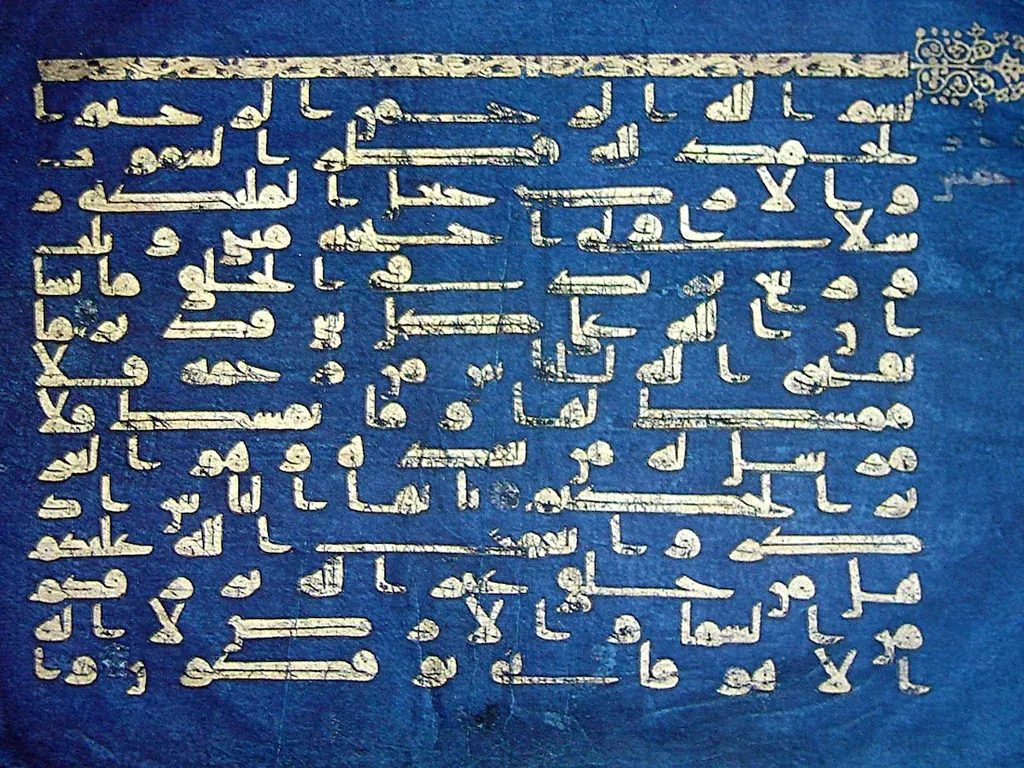
Kufic script, with its geometric, angular lines, is one of the oldest forms of Arabic calligraphy. Born with the earliest Qur’ans, it embodies a near-sacred rigour, each stroke seemingly carved in stone. Its straight, pared-down characters evoke the austerity of Islam’s early days, yet carry a timeless elegance. Often used in monumental inscriptions, this style has endured through the centuries without losing its majesty.
In contrast, naskh script—more fluid and cursive—emerged to meet the practical needs of everyday writing. Quick and legible, it became the go-to for daily texts while retaining a quiet grace. Less solemn than Kufic, it’s nonetheless its natural counterpart, proving that Arabic calligraphy can balance discipline with fluidity, the sacred with the utilitarian.
Where can you experience these arts in Algeria and beyond today?
In Algiers, the National Museum of Illumination, Miniature and Calligraphy (MNEMC) is housed in the 18th-century gem of Mustapha Pasha Palace, nestled in the lower Casbah. This space doesn’t just display works—it hosts international festivals, like the 2009 events dedicated to calligraphy and miniature, and welcomes contemporary artists. In 2010, calligrapher Mahmoud Taleb showcased his creations here, blending Arabic tradition with Persian influences. The museum’s programming turns it into a living laboratory for these arts.
Between 2009 and 2012, Algiers also became a stage for cultural festivals where the MNEMC’s collections travelled, offering a global showcase for these crafts. These events, along with the museum’s permanent exhibitions, reveal how Algeria preserves and reimagines these disciplines while sharing them with the world.
What if the best way to preserve these ancient arts is to reinvent them? Today, Tunisian calligraphers blend Chinese ink with natural pigments from our lands, while illuminators reinterpret Andalusian motifs on travel journals and modern stationery. You don’t need to be a scholar to give it a try: a beginner’s workshop, a blank notebook and a brush are enough to spark that alchemy where the gesture becomes prayer and the letter, poetry. After all, writing has never stopped being an act of resistance—and of beauty.