Calligraphy, from the Greek roots kállos (beautiful) and grapheîn (to write), is “the art of forming writing characters well”.
Calligraphy at a Glance
It is an art that has developed in almost every civilisation that practises writing. In some of these cultures, however, and depending on particular historical or philosophical contexts, calligraphy has been elevated to a special status. In Japan, the word calligraphy is used to define the art of the line: Shodo 書道, the way of the written word. Rooted in a Buddhist lineage, it transcends the very idea of Beauty and Ugliness.
Calligraphy occupies a different place in Western and Eastern traditions.
Eastern Calligraphy
Learning the art of the line is part of the basic training of classical painters in Asia. Asians do not separate the word from the image, the letter from the drawing. And several Eastern civilisations placed calligraphy within the realm of the occult sciences.
In the Far East, tradition holds that the Chinese characters were invented by Cang Jie (~2650), based on his observations of nature. Another tradition traces the invention of the characters back to Fuxi, the legendary first emperor. In Chinese civilisation, the calligrapher is a scholar with a deep knowledge of spiritual and literary texts. His “four treasures” — the ink stick, the inkstone, paper and the brush — are all extensions of the Master’s body and mind.
Latin Calligraphy
In the West, by contrast, it was a purely aesthetic pursuit. Its main aim was to serve the glory of patrons, sovereigns and aristocrats, and it was the art of the copyist monks. Before the invention of printing, Latin calligraphy was associated almost systematically with illumination. It is traditionally linked to the copying of religious manuscripts by Christian monks. This activity, which demanded great concentration and a sureness of hand born of long practice, was at once a form of prayer and an ascetic discipline.
Arabic Calligraphy
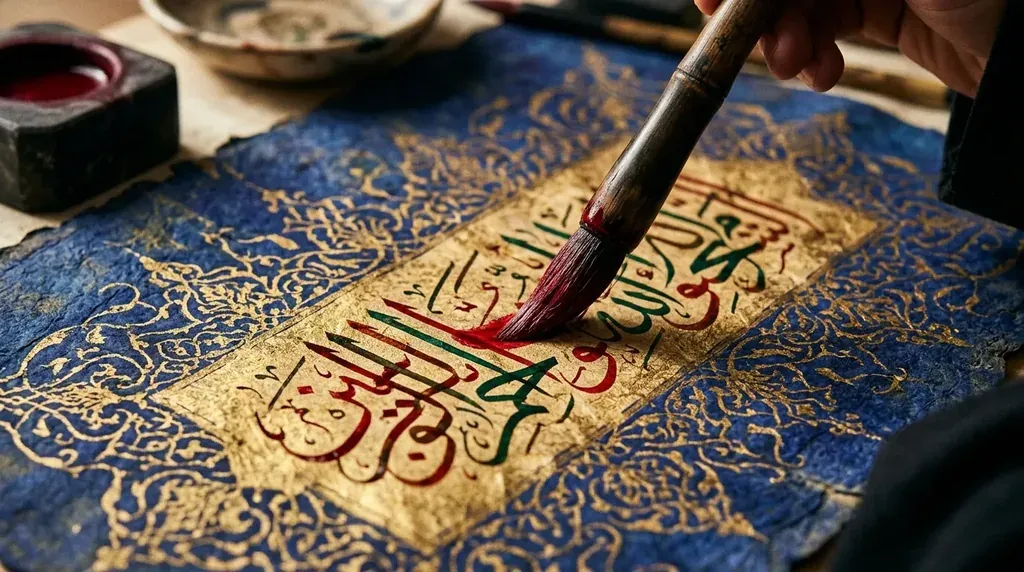
Arabic calligraphy, for its part, was born with the rapid spread of the Arabic language during the Muslim conquests. As the religious message spread through copies of the Qur’an, it quickly took on a religious, utilitarian and ornamental function. Depending on the surface used (wax, papyrus, parchment and paper), it is practised with a stylus, a reed pen, a quill (a bird’s feather, then a metal nib) or the flat or pointed brush. The shape of the letters changes according to the intended use of the text, whether contracts, poetry or official correspondence.
The style also changes according to the countries and cultures, which gradually shape the letters to make them a marker of identity.
Arabic calligraphy comprises several styles, generally grouped into two broad categories:
The first is the Kufic (or Coufic), an angular script that emerged at the same time as the Hijazi of the earliest Qur’ans. One of its finest examples is the Blue Qur’an, written in gold on indigo-dyed vellum and dating from the 10th century. The Museum of Islamic Art in Raqqada, Tunisia, holds a few of its leaves.
The second is the cursive style — more flowing — which includes six main styles:
- the naskhî is one of the first to develop. Fast and legible, it is widely used across the Arab world. One of its variants, the maghribî, was used in Andalusia and the Maghreb;
- the Muhaqqaq, favoured by the Mamluks, leaned to the left;
- the thuluth, also widely used in the Mamluk period in Egypt, is characterised by the height of its ascenders;
- the riqâ’ and the tawqî’, close to the thuluth, are used solely in administrative documents;
- the rayhânî.
Despite this range, a certain unity remains, making Arabic script a symbol of the Arab-Islamic identity.
| Style | Category | Distinctive feature |
|---|---|---|
| Kufic (Coufic) | angular | An angular script, born with the Hijazi of the earliest Qur’ans |
| Naskhî | cursive | One of the first styles developed; fast and legible, widely used across the Arab world |
| Maghribî | cursive (variant of naskhî) | Used in Andalusia and the Maghreb |
| Muhaqqaq | cursive | Favoured by the Mamluks; leaned to the left |
| Thuluth | cursive | Widely used in the Mamluk period in Egypt; tall ascenders |
| Riqâ’ and tawqî’ | cursive | Close to the thuluth; used solely in administrative documents |
| Rayhânî | cursive | Sixth cursive style |