Every July, women's magazines start to look alike. Swimsuit edits, routines for a “summer body,” tip sheets on tanning safely. The faces illustrating these pages nearly all share the same fair complexion, the same body shape, the same ease at undressing. The readership, though, is far broader.
Some Maghrebi women spend the summer covered by choice, others swim in bikinis, many have the dark skin that sunscreen adverts rarely show, and almost all of them are working with a budget these magazines never mention. This gap between the women shown and the women who actually exist isn't an aesthetic footnote. It's a question of representation, and it deserves more than a page of trends.
Why dark skin is missing from its own shelves
Let's start with a simple fact. On the shelves of Tunisian and Moroccan pharmacies, high-protection sunscreens are almost all European brands, and their packaging shows fair skin. The woman being sold the product doesn't see herself in the image selling it: an industry that still treats fair skin as the default norm.
The flip side of that norm is more serious than mere invisibility. There is a market for skin-lightening, and it's thriving. Researcher Yasmine Akrimi, in the journal Diogène (2024), analyses the practice in Tunisia as an expression of “subaltern whiteness,” the legacy of colonial racial hierarchies that persist through the beauty market. Her most striking finding isn't a figure, it's an absence: according to her, no serious study, no usage percentage, exists for North Africa. The practice, she writes, is “so normalised that it isn't even up for debate.”
What isn't measured isn't discussed, and what isn't discussed keeps going.
Health data, meanwhile, give the measure of the risk. In Morocco, a Poison Control Centre study of 95 cases of poisoning from lightening creams found an average age of 20, with ingredients including hydroquinone, corticosteroids and mercury (Bellaje et al., European Scientific Journal, 2016). Akrimi notes that in 60 to 70% of cases, uncontrolled lightening causes conditions ranging from mild to serious. Beauty sold as a promise here becomes a dermatological problem, sometimes worse.
The individual injunction, a trap
Faced with this, the usual reflex of women's media is to put the responsibility on the reader. Choose your products more carefully, inform yourself, own your skin tone. The advice comes from a good place, but it shifts the problem onto the person suffering from it. If dark skin lacks suitable products and flattering images, that isn't a matter of individual willpower. It's a matter of supply, of marketing, of representation — of decisions made elsewhere, by others.
The economic context of Maghrebi readers makes this logic of individual responsibility even more shaky. A tube of high-protection sunscreen from a European brand costs, at a pharmacy, around 40 dinars in Tunisia and between 180 and 330 dirhams in Morocco. Set against the minimum wage — around 528 dinars a month in Tunisia in 2025, raised to 3,422 dirhams in Morocco in 2026 — a single tube represents several percentage points of the lowest monthly income. Properly protecting the skin for an entire summer becomes a budget trade-off, not an obvious gesture. Asking a woman to “take care of herself” without accounting for what that costs amounts to confusing health with a privilege.
The market itself illustrates this dependency. In Tunisia, the cosmetics sector was worth about 1.77 billion dinars in 2024, nearly 1.6% of GDP, but with an import coverage rate of only around 60% (Chroniques.tn, June 2025). The share of local products has fallen there, from about 24% in 2015 to 15% today (L'Économiste Maghrébin, December 2025). Maghrebi women are therefore consuming more and more imported beauty products, designed for other skins and other budgets. The solution isn't for each woman to choose better; it's for a local, suitable, affordable supply to exist.
She who covers, she who uncovers
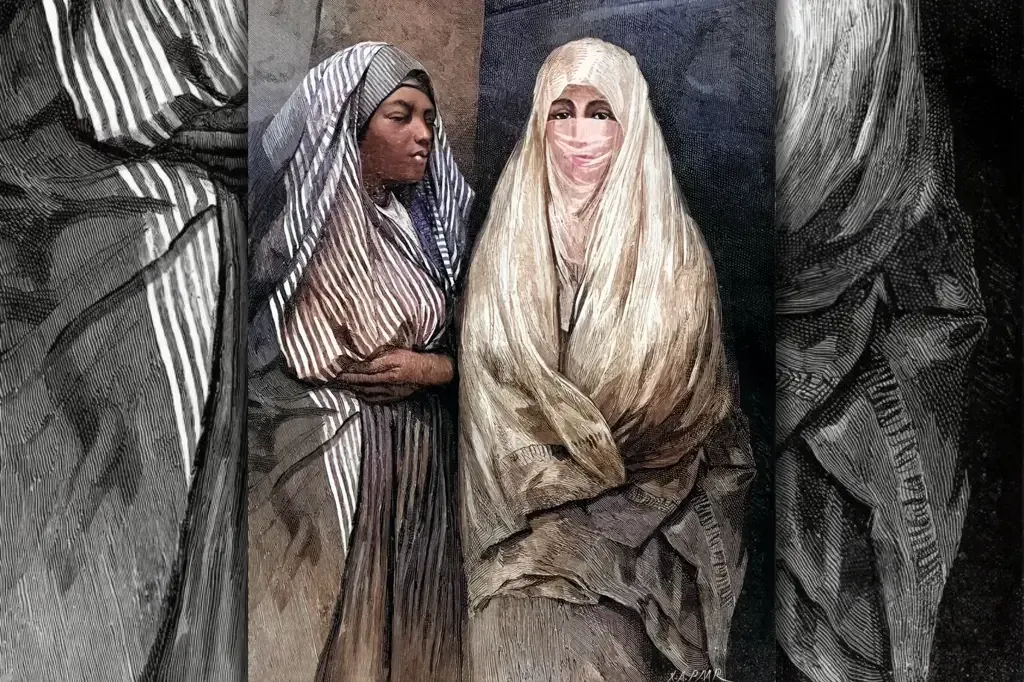
Maghrebi summer also stages another fracture, this one about clothing. On the same beach, the burkini, the one-piece and the bikini all coexist. Women's media has long handled this spectrum by picking a side, celebrating either the liberation of the body or its modesty. Both stances judge. Neither describes. Clothing, here as in the history of traditional Tunisian fashion, actually tells a far richer story than a side to be picked.
The veil and modest dress are, first and foremost, a choice, and fieldwork bears this out. Tunisian sociologist Maryam Ben Salem, drawing on interviews conducted in Tunisia, concludes that for these women wearing the veil is above all an individual choice, not an act of submission (Revue des mondes musulmans et de la Méditerranée, 2010). A 2022 survey by the Moroccan institute Sunergia, conducted among more than a thousand people, measured opinion on the obligation, not the practice: 65% of respondents were in favour, including 67% of the women surveyed — a reminder to be wary of conflating stated support with actual practice. The nuance matters, because it rules out shortcuts in either direction.
At the other end of the same choice, the freedom to uncover deserves the same respect. A Pew Research Center study, based on a survey by the University of Michigan's Institute for Social Research, found that in Tunisia 56% of respondents believed a woman should be able to decide her own dress herself — the highest proportion among the countries surveyed (2014). The same social body can, without contradiction, value modesty and defend free choice. Tunisian sociologist Hédi Cherif observes this coexistence on the beaches of Hammamet, where “the beach is a space that changes one's relationship to the norm” (Le Temps, July 2025), drawing on the work of sociologist Ridha Boukraa. The beach isn't a battlefield between tradition and modernity. It's a place where the two sit side by side, often within the same family.
This coexistence sometimes owes a debt to simple innovation. The burkini, invented in 2004 by Australian designer of Lebanese descent Aheda Zanetti, has allowed women who cover to take up swimming, diving, sport. Far from being a constraint, it has widened the field of possibilities. The question was never whether a woman should cover or uncover, but whether she's given, either way, the space and the garment to exist on the beach — a continuity also told by the Tunisian sartorial heritage of the chéchia and the sefseri.
The real body against the single body
That leaves body shape, the blind spot of summer magazines. The “summer body” they promote is slim, young, smooth, and it ignores the history of local norms. A systematic review by the Research Institute for Development, covering twenty-one African countries including Tunisia and Morocco, found that 74% of the women surveyed associated a fuller figure with dignity and health (Holdsworth and Cohen, Public Health Nutrition, 2021). That valuation is declining most sharply among young urban women, under the influence of an imported thinness ideal. Pressure toward a slim body, then, is no universal given. It's a recent norm, erasing an older one that was, for a long time, the majority view.
What the numbers say
- Tunisian cosmetics sector: about 1.77 billion dinars in 2024, nearly 1.6% of GDP (Chroniques.tn, 2025).
- Share of local products in Tunisia: from about 24% in 2015 to 15% today (L'Économiste Maghrébin, 2025).
- Fuller figure associated with dignity: 74% of women surveyed (IRD, 2021).
- Women in favour of free choice of dress in Tunisia: 56% (Pew, 2014).
Women's media, this one included
It would be dishonest to point the finger at the cosmetics industry without questioning the press that amplifies it, La Sultane included. Women's magazines don't just reflect beauty norms, they manufacture them. By choosing which faces illustrate summer, which body shapes embody the desirable, which skin tones deserve an advert, they draw a line between women who are representable and those who aren't. This editorial responsibility is real, and it's rarely owned up to — it's corrected by giving space to portraits of real Tunisian women rather than interchangeable silhouettes.
A few signs show that the norm can shift when the pressure becomes collective. In June 2020, in the wake of anti-racist mobilisations, L'Oréal announced it would remove the words “white, whitening, fair, lightening” from all its skin-evening products, and Unilever renamed its “Fair & Lovely” range “Glow & Lovely.” These decisions, taken under pressure from public opinion more than from spontaneous conviction, remain largely semantic. Even so, they prove that a representation once considered untouchable can be revised.
The modest fashion market confirms it in its own way: Muslim consumer spending on clothing reached $327 billion in 2023, according to the State of the Global Islamic Economy report (DinarStandard, 2024). Demand of that scale is no longer a niche that can be ignored.
A matter of gaze
Finally seeing real women in summer pages wouldn't be an editorial act of generosity. It would simply be ceasing to lie about who makes up the readership. Dark skin, the woman who covers and the one who uncovers, the body shapes that recent norms have rendered invisible — all of it already exists, outside the magazines. The difficulty isn't individual: no single reader will fix, through good products and good will alone, a shortfall in supply, marketing and imagery.
It's structural, and it calls for answers of the same kind: a more accessible local industry, adverts that look like their customers, a press that owns what it shows. Recognising the economic constraints of Maghrebi readers means admitting that the beauty being discussed shouldn't cost the price of a sacrifice. The rest is a matter of gaze, and the gaze can be corrected.