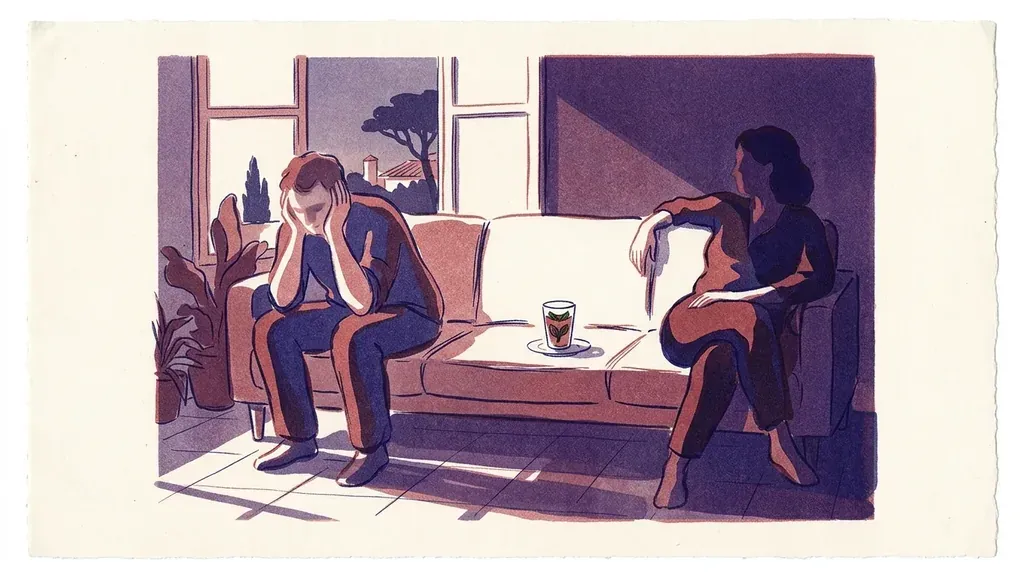
Infidelity is sadly not rare, and the experience is far from trivial. It is, in fact, deeply marking, even shattering. And for good reason: it fractures one of the very foundations on which a couple is built — trust. Infidelity is an ordeal whose outcome is hard to predict. A couple may just as easily part ways painfully as reinvent itself and explore new horizons.
In the beginning, there is a couple
Since the life of a couple is never a straight line, infidelity strikes like a storm bearing down on both partners, with no way to foresee the scale of the damage that will follow. Infidelity can be felt all the more harshly when it occurs in an already fragile context: disappointment, grief, job loss, disillusionment. It is experienced as a betrayal that locks the person into obsessive thoughts: “What does she have that I don’t? Am I no longer desirable? Am I not beautiful/intelligent/loving enough? How does she satisfy him more than I do?” Infidelity often opens a narcissistic wound that undermines self-esteem. It leads one to question one’s power to seduce, to wonder about one’s own worth, and so on.
There are two kinds of couples:
- Those for whom infidelity risks being destructive, because the partners see every act as a proof of love or of the loss of it.
- Those who constantly readjust their relationship and keep checking the attachment they feel for each other. These can turn the problem to their advantage.
What drives a partner to be unfaithful?
Before the affair
- Your partner has a need. Too busy being a good parent, a good employee and so on, your loved one pays no attention to that need. In truth, your partner is not listening to their own need.
- Because they pay no attention to that need, it is impossible to meet it properly. Impossible to communicate it to you.
- And yet the need is there. As long as your husband/wife has not listened to their need, it echoes ever louder through such signs as attraction to someone else, and so on.
BUT the tendency to turn to another person does not mean that this other person is the solution to their need.
During the affair
- Your partner thinks they are meeting their need. Naturally, they are convinced their need is being fulfilled, since their urges and/or emotional needs are being satisfied.
- But your partner soon understands that this satisfaction is fleeting. They are satisfied for the length of a night, for the length of the escapade. Your partner quickly realizes their mistake. Sleeping with someone else… that was not what they needed.
- They rushed toward a lover without really questioning their true needs. Your partner regrets it, and begins to suffer from guilt.
Suppose your partner does not stop at a single act of infidelity. Suppose your partner shows little sign of guilt. Your husband/wife remains, without realizing it, dependent on a need they do not grasp. They remain the victim of a need to which they respond in the wrong way.
A one-night affair or a steady mistress?
In the case of an extramarital relationship born of falling out of love, the couple ends up, sooner or later, falling apart. In the case of a lasting parallel relationship, if it is discovered, the same holds true. Those who settle into a compensatory relationship need the third party in order to bear their life as a couple. They are happy in their family life, but not in their marriage.
So, when the infidelity comes fully to light, the cheating partner often chooses their lover or mistress, unable to give up what that other relationship gives them. Naturally, if the other has led a double life for years, it is hard to forgive, especially since the cheater has trouble giving up their second life. The good scenario assumes that dialogue is possible, and that each acknowledges their share of responsibility — adultery involves the couple as a whole.
However, if it is a one-night fling, there is a greater chance that the couple will come through it best. Most couples who have weathered this crisis are left fragile for a while, but they overcome it through communication — provided, of course, that they can talk about it!
Rescue operation!
Communication therefore plays a major part in saving the couple. Talking about what happened, expressing one’s feelings and sharing the solutions one proposes in order to get through this ordeal are all foundations to put in place so that the couple can be saved.
Do not make hasty decisions. Let a little time pass, regain your calm, then reflect on what happened. Accept your feelings of hatred, uncertainty, agitation, fear, suffering, sadness, and so on. There is no point in ruining your life over it. It is important to take care of yourself, and to avoid as much as you can doing anything foolish. What is done is done, so do not make the situation worse.
Find ways to free yourself from the stress that is gnawing at you, so that you can look at things more clearly. In this way you will find balance. That's the secret to successfully overcoming an act of infidelity. Do not be afraid of your tears, for crying will allow you to release the tension and hatred built up within you. Unburden yourself of this weight. Communicate with your partner, dare to talk about what happened, and be sure to set things straight. Even if they do not seem open to dialogue out of shame, at least show them that you are trying to understand and that you are willing to make things right. Consult a psychologist if necessary; the problem is not infidelity in itself, but everything it implies and everything that lies behind it. An act of infidelity can generate very serious conflicts, which bring deeper problems to light.
Accept that, because of the infidelity, the relationship changes. Live through this change as a mourning, as though you had just lost a loved one. Life goes on, and you must learn to live without this thing you no longer have… which does not mean that your relationship cannot survive this ordeal. It will survive, but will come out of it different.
Infidelity… a way to know yourself better?
Infidelity is, in the end, an opportunity. The opportunity to live through the most profound of human experiences. In the wake of infidelity, we try to do everything to avoid a repeat. And so we FINALLY grow familiar with communication. We take an interest, at last, in the needs of both sexes.
Infidelity is often the disruptive element that pushes us to demystify our needs. It is often the disruptive element that pushes us to question our needs, to question who we are. It may be that, during your marriage, you missed the most beautiful proof of love: knowing and supporting the other’s needs. To divorce or not after infidelity? The choice is yours. You can choose to press on toward a more authentic, more fulfilling relationship, more attuned to each other — thanks to communication, of course!