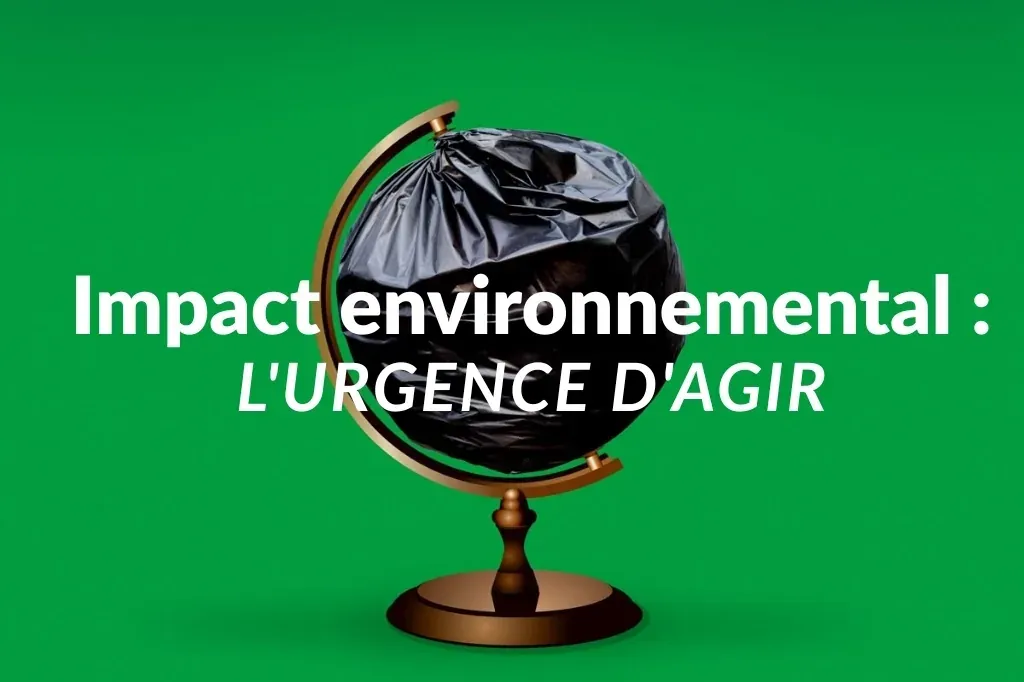
In a world where 40% of the food produced ends up in the bin while 828 million people go hungry, according to the World Food Programme, a technological and social revolution is under way. Discover how the fight against food waste is becoming one of the defining levers of impact for our time.
The figures that give pause
Food waste now accounts for nearly 40% of global production, according to the FAO (the United Nations Food and Agriculture Organization) — the equivalent of the third-largest emitter of CO₂ after China and the United States. Each year, it costs the United States between 1.3% and 1.4% of GDP, according to estimates from the EPA (the US Environmental Protection Agency, 2024). More striking still: this colossal economic value simply evaporates into food that is grown, transported and then thrown away without ever feeding anyone.
This reality calls our collective priorities into question. How can we accept that so many resources are squandered while families struggle to feed their children?
Technological solutions that are proving their worth
The anti-waste movement is enjoying a remarkable boom thanks to mobile apps. Too Good To Go, the European leader with more than 15 million users according to its 2023 figures, lets you pick up discounted "surprise bags" of unsold food. The app claims to have saved more than 55 million meals since its launch. Phenix, which reports revenue of 18 million euros, has for its part saved more than 70 million meals since 2014.
Other platforms round out this ecosystem: Karma offers a streamlined interface for urban restaurateurs and claims to have saved more than 1,000 tonnes of food, while OptiMiam and Save Eat provide compelling local alternatives. These apps are turning the reduction of food waste into a tangible economic opportunity.
The world's major retailers are not to be outdone. Walmart, the largest retailer on the planet, cut its food waste in the United States by 23% between 2016 and 2023 thanks to its predictive algorithms. Tesco redistributes 66,000 tonnes of unsold food a year through its "Community Food Connection" programme across 2,800 stores.
| Solution | Measured result |
|---|---|
| Too Good To Go | 15M+ users (2023), 55M+ meals saved |
| Phenix | 70M+ meals saved since 2014, 18M€ in revenue |
| Karma | 1,000+ tonnes of food saved |
| Walmart | -23% waste between 2016 and 2023 |
| Tesco | 66,000 tonnes redistributed/year, 2,800 stores |
Tunisia is developing solutions of its own
In Tunisia, the stakes are considerable, with 572 million dinars wasted each year by households according to the National Consumer Institute (2021), while 500,000 people in the country suffer from malnutrition.
Several initiatives are emerging to meet this challenge. Monoprix Tunisia is betting on technological innovation through its partnership with Smartway, rolled out since September 2024 across its 85 stores. This artificial-intelligence solution automatically identifies products nearing the end of their shelf life and calculates the optimal markdowns based on the weather, the day of the week and past sales. The goal: to cut in-store food losses by 50% and reduce teams' management time fourfold.
In parallel, the municipalities of Tunis and La Goulette have carried out a 350,000-dollar FAO project, run through to January 2025, to develop "pilot actions for the prevention, reduction and management of food loss and waste." The Racines et Développement Durable association, through the SwitchMed programme, is also raising awareness of the sector's challenges.
In 2023, the Tunisian government launched a national plan to reduce waste, with a target of -25% by 2030, including awareness campaigns in schools and the creation of a "National Day Against Food Waste" every 29 September.
Technological innovation in the service of people
The answer lies in an innovative logistics approach. Reducing food waste does not require producing more, but optimising the distribution that already exists. Emerging technologies are revolutionising this process by instantly connecting surplus supply with social demand.
A revolutionary way of working
Partner businesses list their food surpluses through intuitive interfaces. With a single click, they flag their excess stock: ten chicken breasts, twenty loaves, fifteen salads. The algorithm automatically calculates the approximate weight and tax value of these donations.
This technology turns food-waste management into a smooth, transparent process. Charities receive the food like an ordinary parcel, sign electronically, and the donor instantly obtains a tax receipt accompanied by a photo of the delivery.
Artificial intelligence can now predict surpluses with 85% accuracy, according to a 2024 MIT study. IoT (Internet of Things) sensors installed on the shelves automatically detect products nearing the end of their shelf life.
The measurable environmental impact
Beyond its social dimension, this approach generates quantifiable environmental benefits. Each partner has access to a detailed dashboard showing the tonnes kept out of landfill and the reduction in its carbon footprint. Every tonne of food saved avoids the emission of 3.3 tonnes of CO₂.
This transparency allows companies to give real substance to their CSR commitments. Rather than mere statements of intent, they have precise data on their contribution to the circular food economy.
A sustainable business model
Unlike traditional charitable approaches, these systems rest on durable business models. Companies were already paying to dispose of their food waste through firms such as Veolia, at an average cost of 150 euros per tonne. The alternative solutions, slightly more expensive, deliver an incomparable return on investment: tax deductions, an enhanced brand image, and measurable CSR impact.
This economic logic guarantees long-term viability and the potential to scale the model. Rather than depending on unpredictable subsidies, these social enterprises fund themselves through their services.
Concrete results on the ground
The impact can be measured on an international scale. In Europe, the anti-waste app sector helped save more than 100 million meals in 2023, avoiding the emission of 330,000 tonnes of CO₂. The global ecosystem directly employs more than 3,500 people, according to a 2024 Boston Consulting Group report.
These initiatives also create new jobs. The indirect economy (couriers, developers, community managers) generates more than 25,000 full-time-equivalent jobs worldwide. In the United States, Feeding America increased its distributions by 34% thanks to partnerships with digital platforms.
Fighting food waste effectively demands that we rethink our distribution channels entirely. This approach proves that technological innovation and social impact can converge toward sustainable solutions.
The future of social responsibility
These success stories are a perfect illustration of how social entrepreneurship can solve complex problems. By turning a cost (waste disposal) into added value (social and environmental impact), they are redefining the standards of corporate responsibility.
More ambitious initiatives are emerging: in Belgium, Cycle Up turns unsold bread into craft beer. In the United States, Imperfect Foods has made "imperfect" vegetables a 500-million-dollar market. In India, Crofarm connects small producers directly with consumers, cutting losses by 40%.
The challenge now is to multiply these initiatives and inspire other sectors. For if we can revolutionise food management, why not apply the same logic to other fields?
The message is clear: reducing food waste is no longer a utopian dream but a matter of the will to act. The tools exist, the results are convincing; all that is missing is the collective determination to make these virtuous practices the norm.