From Casablanca to Nairobi, from Tunis to Addis Ababa, Chinese cranes are reshaping the African landscape. But behind these titanic building sites, a battle is being fought for the technological soul of the continent. An investigation into the Chinese BRI initiative that is upending world geopolitics and placing Africa at the heart of crucial strategic stakes.
Eight years after its launch, the BRI initiative (Belt and Road Initiative) has surpassed every development project in modern history. Far more than a simple infrastructure strategy, it is profoundly redrawing the economy, the technology and even the culture of three continents. For Africa, the stakes are immense: a historic development opportunity, or a new colonialism in disguise?
In Tunis, the new terminal at Tunis-Carthage airport, partly financed by Chinese capital, now handles a growing number of routes to China. In Radès, the modernised port, fitted out with infrastructure imported from Beijing, sees ever more "Made in China" goods pass through. Without any media fanfare, Tunisia is gradually being drawn into the ecosystem of China's "New Silk Road".
Decoding the Acronyms
| Acronym | Definition |
|---|---|
| BRI (Belt and Road Initiative) | "New Silk Roads", a Chinese initiative launched in 2013 |
| OBOR | The former name of the BRI (One Belt, One Road) until 2016 |
| DSR | Digital Silk Road, the technological arm of the BRI |
| Global Gateway | The European answer to the BRI (300 billion euros by 2027) |
| PGII | The competing American initiative (a 600 billion dollar target) |
The Legacy of Silk: When History Inspires Geopolitics
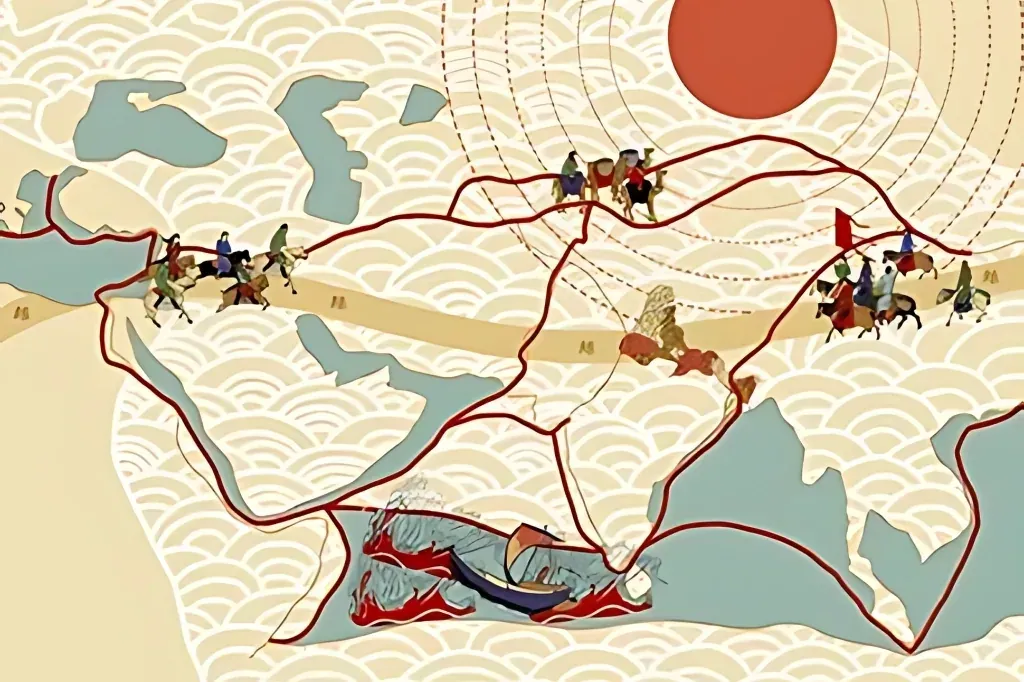
Two millennia ago, caravans laden with spices and silks already linked Chang'an to Rome. This first globalisation died out in the 15th century, a casualty of the wars between empires.
In September 2013, at a university in Nur-Sultan, Kazakhstan, Xi Jinping revived that thousand-year-old dream. The Chinese president spoke of a rebirth of the "Silk Roads" to connect Eurasia, Africa and Oceania. The announcement seemed ambitious at the time; today, it is redefining the world order.
China-Europe: The Route Broken by War
The Ghost Train of the War in Ukraine
January 2017: the first direct China-London freight train covered 12,000 km in 18 days. A logistical feat that seemed to herald a new era of Eurasian trade. But the war in Ukraine shattered that dream.
The rail route crossing Russia and Belarus, which carried close to 90% of China-Europe freight, closed abruptly. DHL and Maersk halted their Russian operations. Rail traffic fell by more than a third, forcing China to redirect its flows onto less efficient itineraries through Central Asia and Iran.
A Forced Pivot Towards the South
Paradoxically, this geopolitical disruption has strengthened the importance of the Mediterranean and of Africa in Chinese strategy. Unable to rely on the European route alone, China is rediscovering the virtues of the maritime route through Suez and the ports of the Maghreb.
For Tunisia, this is a historic opportunity to become once again what it was in antiquity: a major trading crossroads between East and West.
Africa in the Eye of the Technological Storm
The Silent Smartphone Revolution
In the souks of Tunis as in the streets of Lagos, Chinese smartphones are gaining ground. Transsion, with its Tecno and Infinix brands, adapts to local markets: phones optimised for black skin tones in sub-Saharan Africa, sand-resistant models in the Maghreb, and unbeatable prices everywhere.
In Tunisia, Huawei already supplies part of Tunisie Télécom's 4G network. Young Tunisians discover TikTok on their Xiaomi smartphones, unaware that their data passes through Chinese servers.
But this technological penetration conceals a more troubling reality: these devices collect data on a massive scale, outside the strict protection frameworks imposed by European regulations. Africa is thus becoming a development ground for Chinese artificial intelligence.
When Beijing Watches Africa
The Agreement That Unsettles
March 2018: Zimbabwe signed a shock agreement with CloudWalk, a Chinese AI start-up. In exchange for surveillance technologies, Harare agreed to share the biometric data of millions of citizens with China.
China's objective: to improve its facial recognition algorithms on non-Asian populations. Africa offers this unprecedented training ground.
The Worrying "Safe Cities"
Huawei has rolled out its "smart city" systems in 16 African countries. In Nairobi, thousands of HD cameras scan the traffic. In Uganda, facial recognition helped bring about at least 836 arrests of political opponents, documented by Amnesty International (2022) and Access Now (2023).
In the Maghreb, the advance is more discreet but no less real. Morocco has signed agreements with Huawei to modernise its digital infrastructure. Algeria is exploring Chinese "smart cities". Tunisia, for its part, is navigating cautiously between technological opportunities and the preservation of its post-revolution democratic gains.
FOCUS: Hambantota, the Story of a Contested "Trap"
In 2010, Sri Lanka inaugurated the port of Hambantota, financed by China. Seven years later, unable to repay, Colombo handed the port over to Beijing for 99 years.
The Western narrative: a perfect example of the Chinese "debt trap".
The reality: more complex. This was a 1.12 billion dollar lease, which made it possible to rescue Sri Lanka's finances. The Chinese debt remained owed separately.
The Western Response: Global Gateway Against the Silk Road
Europe Counter-Attacks
2021: Ursula von der Leyen launched the "Global Gateway", a European plan worth 300 billion euros over six years. The major difference: where China favours commercial loans, the EU is betting on a mix of grants and concessional financing.
The United States Awakens
Washington launched the "Partnership for Global Infrastructure", with a target of 600 billion by 2027. But China's responsiveness remains unmatched.
Tunisia Faces the Silk Road Dilemma
Mediterranean hub or technological dependency? Tunisia is trying to attract investment without surrendering its autonomy. Ports, telecoms, universities: every Chinese project comes with tough negotiations.
Vigilance remains crucial: infrastructure financed by Beijing often entails technical dependency (maintenance, spare parts, software updates) that can trap a country over the long term.
African Alternatives: Between Pragmatism and Innovation
Faced with these challenges, some countries are trying other paths.
- Rwanda is betting on balanced agreements, including skills-transfer clauses and strict control of debt.
- Senegal relies on diversifying its partners, combining Chinese, European and Turkish financing to avoid excessive dependency.
- South Africa mobilises its powerful public institutions to keep infrastructure contracts in check.
These experiences show that Africa can devise differentiated strategies and refuse the role of mere spectator.
Future Scenarios: What Happens After Xi?
- Relative continuity: the BRI maintained, with adjustments.
- Internal crisis: projects suspended in the event of a power struggle within the Party.
- Systemic collapse: fragmentation of Chinese power, a brutal shock for Africa.
Impacts on Africa:
- In the short term: jobs, infrastructure delivered.
- In the long term: digital dependency, financial risks tied to the loans.
- Regionally: West Africa turned towards Europe, East Africa anchored to China, the Maghreb in fragile equilibrium.
IN FIGURES (Sources: GSMA 2024, IEA 2024, AidData 2025, Amnesty 2022)
- ≈ 1,300 billion USD: cumulative investment in the BRI since 2013
- 150 countries: committed to the initiative
- Between 68% and 72%: the share of African 4G infrastructure supplied by Chinese companies
- 85%: the share of world critical-mineral processing capacity controlled by China
- At least 836: arrests in Uganda facilitated by Huawei surveillance technologies
Conclusion
In the streets of Tunis as in Addis Ababa, China is settling into the heart of everyday African life. Roads, ports, smartphones and satellites: everything converges towards increased dependency.
The real urgency is to know whether Africa – through initiatives such as the African Continental Free Trade Area (AfCFTA) and the growing role of the African Union – will manage to chart its own course before the choice slips out of its hands.