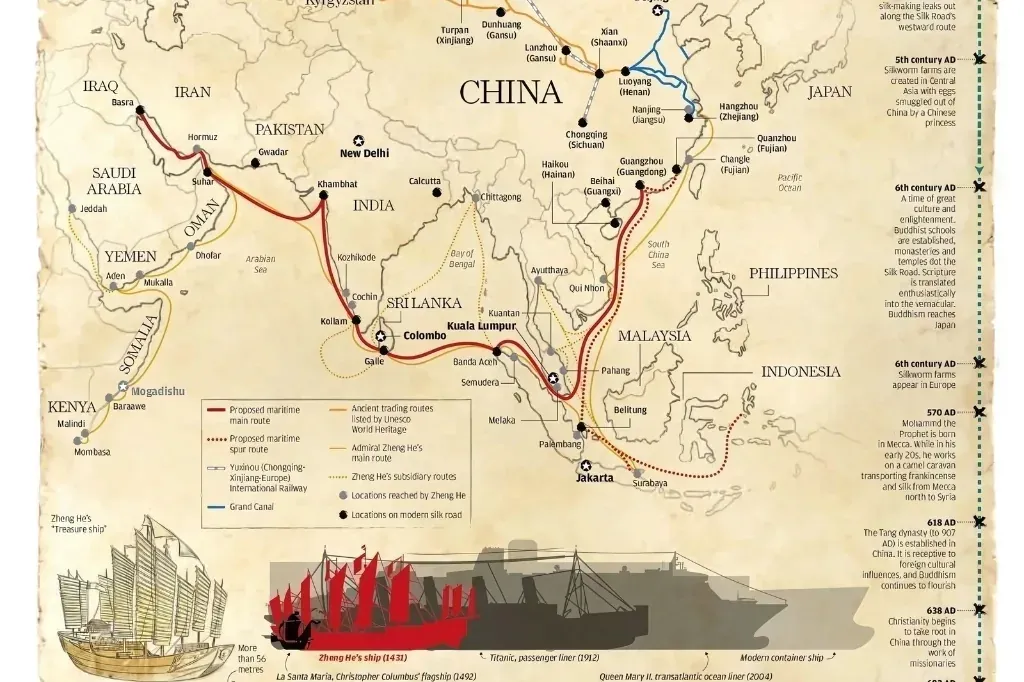
The OBOR initiative (One Belt, One Road), or the "New Silk Roads", is the most ambitious geo-economic project of the twenty-first century. This Chinese programme aims to connect Eurasia, Africa, and Oceania along two major axes: one overland, one maritime.
Caught between promises of development and fears of economic domination, the initiative is redrawing the global balance of power and placing Africa at the heart of the strategic stakes.
Back to the historical sources
The ancient Silk Road: the first globalised exchanges
Two thousand years ago, the world already knew a form of globalisation. Mutual curiosity between the Chinese Empire and the Roman Empire gave rise to trade on a grand scale: fabrics, precious stones, spices, and weapons all travelled along what would become the legendary "Silk Road".
These exchanges continued until the fifteenth century, when repeated wars between Byzantium and the Ottoman Empire made these vast territories too dangerous to cross.
The modern revival of a thousand-year-old idea
In 2013, Chinese president Xi Jinping raised for the first time the dream of reviving this trade corridor under the name Yidai yilu ("one belt, one road"), better known by the acronym OBOR. In other words: One Belt, One Road, the new silk roads!
In May 2017, at the Beijing summit, Xi Jinping set out the broad lines of this titanic project. Although he invoked a thousand years of history and "the spirit of the Silk Road" under the banners of "peace" and "cooperation", no one forgets that in the Middle Kingdom too, business is business.
The architecture of the OBOR project
One Belt: the new overland route
The aim is to link China rapidly to Europe along two main axes:
Rail network: A line starting in central China crosses Kazakhstan, Russia, Poland, Germany, France, and the United Kingdom. Most of the track already exists, particularly in Western Europe, and is waiting to be connected to the new lines.
The first freight train journey linking China to Great Britain took place in January 2017. This freight train covered 12,000 km in 18 days, proving the economic case: cheaper than air, faster than sea.
Road network: A gigantic road network completes the rail scheme, integrating the Eurasian landmass into a single unified economic zone.
One Road: the strategic maritime route
This sea route links the emerging countries of South-East and South Asia to Africa and South America. Setting out from Europe (France, Greece, the Netherlands), it runs through the Mediterranean, the Suez Canal, the Red Sea, and the Indian Ocean to Sri Lanka, drops down to Singapore, then heads back up to Shanghai.
A global port infrastructure
The acquisition and construction of port facilities extends across:
- Australia, Malaysia, Indonesia, Bangladesh
- Sri Lanka, Myanmar, Pakistan
- Kenya, Tanzania, Oman, Djibouti
These ports connect to Piraeus (Greece), the largest Greek port, bought by the Chinese group COSCO, offering direct access to European markets.
The economic dimensions of the project
Colossal figures
This pharaonic project represents more than 1,000 billion dollars of investment. It could unite 68 countries, roughly 65% of the world's population, and its economic scale could potentially exceed two thirds of global GDP.
Five areas of cooperation
The initiative officially encourages:
- Coordination of development policies
- Construction of infrastructure and public service networks
- Strengthening of trade and investment ties
- Development of financial cooperation
- Development of social and cultural exchange
China's deeper motivations
Transforming the economic model
After 30 years of receiving foreign direct investment, China is becoming a major investor abroad. This "Going Out" policy, launched in the late 1990s, serves several objectives:
- Acquiring natural resources
- Breaking into new markets
- Promoting Chinese brands
- Acquiring foreign technology
Domestic demographic challenges
The one-child policy has brought about a rapid ageing of the population. The working population is shrinking, driving wages up and productivity down.
A telling comparison: The average wage of an Ethiopian worker in Hawassa comes to 50 US dollars, against a minimum of 300 dollars for a Chinese worker in Guangdong.
This reality is pushing China to move its labour-intensive production elsewhere and to concentrate on higher value-added industries.
Geopolitical ambitions
As China is not part of the G7, OBOR would give it considerable regional weight. Faced with slowing GDP, Beijing is betting on this new trade to stimulate its growth and channel its overproduction.
The initiative also aims to strengthen the use of the yuan as an international reserve currency.
Mixed reactions around the world
Asian enthusiasm
Enthusiastic supporters:
- Pakistan and Indonesia: a very warm welcome
- Malaysia: a 162-member delegation sent to Beijing in 2015
- Sri Lanka and the countries of Central Asia: strong backing
- Russia: marked interest in the financing
Sceptics and opponents:
- Vietnam: serious doubts about the initiative
- India: outright disapproval and an active boycott
Western wariness
European reactions remain mixed. While business circles show interest, strategists stay cautious. Donald Trump did not attend the Beijing summit and, apart from Italy's Paolo Gentiloni, no G7 leader was present.
Many European countries (Germany, Hungary, Estonia) fear a loss of influence in Central Asia and refuse to sign up to Chinese communiqués, concerned at the lack of transparency in public procurement and environmental standards.
The Indo-Japanese riposte
In response to OBOR, India has joined forces with Japan to create a "freedom corridor". They hope to counterbalance Chinese influence with infrastructure projects in South-East Asia, Sri Lanka, Iran, and Africa.
Summary table: international positions on OBOR
| Country / region | Position on OBOR |
|---|---|
| Pakistan, Indonesia | A very warm welcome |
| Malaysia | A 162-member delegation sent to Beijing in 2015 |
| Sri Lanka, Central Asia | Strong backing |
| Russia | Marked interest in the financing |
| Vietnam | Serious doubts about the initiative |
| India | Outright disapproval, an active boycott, and a rival corridor with Japan |
| Europe (Germany, Hungary, Estonia) | Mixed reactions, fear of a loss of influence in Central Asia |
| G7 | Absent from the Beijing summit, apart from Italy's Paolo Gentiloni |
Africa at the heart of the strategy
Historic ties renewed
Sino-African relations date back to the fourteenth century, when the Chinese fleet frequented the continent's eastern coast. That history may explain why China has made Kenya the hub of its African initiative.
Structuring projects
Kenya: The Chinese-financed railway lines will connect Kenya and its ports (notably Mombasa) to its landlocked neighbours: Burundi, Rwanda, South Sudan, and Uganda.
Tanzania: A 7.6 billion dollar loan from the China Exim Bank in 2016 to build a railway line linking Tanzania to Uganda, Rwanda, Burundi, and the Democratic Republic of the Congo.
Bilateral partnerships
China has developed relations with South Africa, Ethiopia, Mauritius, Morocco, Nigeria, the Seychelles, Tunisia, and Zambia, accompanied by bilateral investment treaties.
Promises of development
In 2016 the China EXIM Bank signed a 1 billion dollar programme to build industrial parks and special economic zones in Africa (commodity processing, light industry).
The World Bank's former chief economist, Justin Lin, predicts that the new silk roads could become "one belt, one road, one continent".
The project's challenges and risks
Financial obstacles
Some partner countries have weak creditworthiness and may not repay their debts. Instability in the Middle East and local opposition (Sri Lanka, Myanmar) complicate implementation.
Overestimated capacity
According to Jonathan Hillman of the Center for Strategic and International Studies, China may be overestimating its capacity and could end up financing unprofitable projects.
The problem of debt
India openly criticises OBOR, accusing it of creating an "unsustainable debt burden" and of threatening the sovereignty of participating countries.
Opportunities for Africa
Beneficial competition
Chinese interest in Africa is drawing the attention of other world powers. The Indo-Japanese axis and other players are now taking an interest in the continent's development prospects.
Demographic potential
The untapped potential of less developed African economies, with a dynamic young population, appeals to many international investors.
Critical infrastructure
Africa's needs in transport, energy, and communications infrastructure offer considerable opportunities for economic development.
What is at stake for the Maghreb and African countries
Strategic opportunities
For Tunisia and the Maghreb:
- A privileged geographical position on the maritime route
- Potential as a Mediterranean logistics hub
- Easier access to European and Asian markets
For sub-Saharan Africa:
- Development of critical infrastructure
- Job creation and technology transfer
- Stronger regional integration
Necessary precautions
Economic vigilance:
- Fair negotiation of debt terms
- Transparency in public procurement
- Protection of economic sovereignty
Diversifying partners:
- Avoiding exclusive dependence on China
- Maintaining balanced relations with other powers
- Developing local negotiating capacity
Looking ahead
Lingering uncertainties
Four years after its launch, it remains impossible to say whether OBOR will be crowned with success or destined to fail. The scale of the project and its geopolitical complexity make prediction a hazardous business.
Vigilance advised
Many countries recommend greater vigilance as OBOR develops. Questions of transparency, financial sustainability, and respect for sovereignty remain central.
Africa, the potential big winner
Paradoxically, the African continent could be the great beneficiary of this competition between powers. Sino-Western rivalry for influence in Africa could accelerate the continent's development.
Conclusion: navigating the new silk roads with care
The New Silk Roads represent an initiative of unprecedented scale, one that is redrawing the world's economic geography. For African and Maghreb countries, the project offers considerable development opportunities, but calls for a cautious and strategic approach.
The challenge is to make the most of Chinese investment while safeguarding economic sovereignty and diversifying partnerships. Competition between powers for influence in Africa can benefit the continent, provided that African leaders negotiate these new geopolitical dynamics skilfully.
Xi Jinping's "Chinese dream" may well turn the African dream into reality, but only if the continent's countries know how to navigate these new roads of global geopolitics wisely.