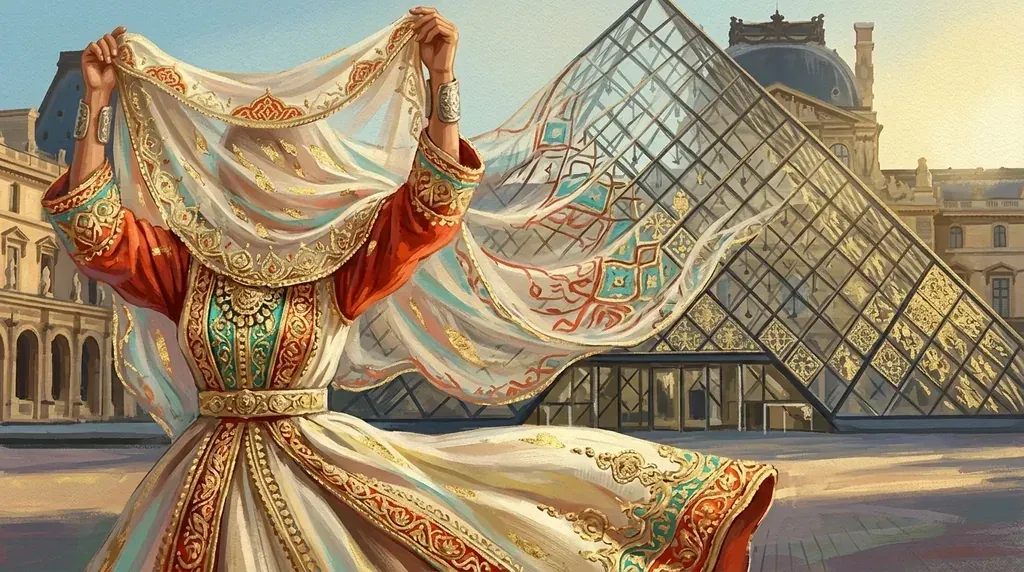
On 4 July 2026, five processions were due to set off from five towns in the Paris suburbs — Gennevilliers, Saint-Ouen, Pantin, Saint-Denis and Argenteuil — and converge on the Grand Palais: decorated cars, henna, traditional and electronic music, a great feast. The programme announces a wedding celebration. Except there are no bride and groom. Devised by artist Mohamed Bourouissa and titled Raconte-moi ton mariage (Tell Me About Your Wedding), the event celebrates no union: it stages the Maghrebi wedding itself, as an object, as a memory, as material for an exhibition.
These lines were written before the parade: they say nothing, then, about turnout or atmosphere, and stick to what was announced. But the intent was already legible, and it reaches far beyond a summer happening. When a private, intimate celebration, largely a women's affair, becomes a piece of cultural programming at the heart of Paris, something is being said about the place the Maghrebi diaspora claims for itself, and about its relationship to a heritage it no longer inhabits quite the same way.
A season, an exhibition, a parade
The context is no accident. Since 15 May 2026, the Saison Méditerranée, coordinated by the Institut français, has been rolling out more than two hundred events. Weddings hold a prominent place in it. The Institut du monde arabe is announcing, from 29 September 2026 to 31 January 2027, an exhibition titled “Mariages (Algeria-Morocco-Tunisia),” devoted to costumes, jewellery, rituals, and above all to how these rites have evolved in a context of migration. The 4 July parade is its advance echo, this time out in public space. (On another Maghrebi legacy that became an institution's heritage, read Ennajma Ezzahra: The Cultural Legacy of Rodolphe d'Erlanger.)
The stated approach is precise: wedding stories gathered from residents of these towns, turned into a procession. So this isn't a wedding faithfully reconstructed, but a contemporary creation built out of memories. The nuance is decisive. What's being shown isn't the “authentic” Maghrebi wedding. What's being shown is what remains of it in the memory of those who left it behind, or whose parents did.
Bourouissa isn't a name chosen at random for this. A French-Algerian artist born in 1978 in Blida, who arrived in France as a child, grew up in the Paris suburbs and built his entire body of work on representing the margins, seen from within. Périphérique, Temps mort, and then Horse Day, made with African-American riders from Philadelphia, all follow the same method: working with a community rather than on it. Winner of the Deutsche Börse Prize in 2020, exhibited at the Palais de Tokyo in 2024, he approaches the wedding as he has approached everything else, through collaboration and through image. No statement from the artist about this specific project was available at the time of writing, and it would be unwise to attribute intentions to him that he hasn't voiced. What remains is the announced work itself, which is enough to raise the question. (On another contemporary creation out of the Maghreb that reached screens worldwide, read “The Voice of Hind Rajab” in Cinemas: Kaouther Ben Hania Delivers Her Boldest Film Yet.)
What the diaspora does with its rites
Sociology had already grappled with this question long before a Paris institution took it up. The central reference remains Abdelmalek Sayad, the Algerian sociologist who died in 1998. In a tellingly titled 1985 article, “Le mariage: un moment de vérité de l'immigration familiale maghrébine” (Marriage: a moment of truth for Maghrebi family immigration) (Revue européenne des migrations internationales), he showed that a wedding is never simply a ceremony. It's the moment when an immigrant family reveals what it has become: what it has kept from the home country, what it has given up, what it negotiates.
Sayad is also the author of La double absence (Seuil, 1999), in which he describes the immigrant as doubly absent — from the country they left, and from the one that never fully takes them in. Staging a wedding in Paris is precisely an attempt to fill, for the space of a celebration, that double absence.
Staging a wedding in Paris is an attempt to fill, for the space of a celebration, this double absence.
The gesture becomes clearer still when set alongside a concept forged far from the Maghreb. In The Invention of Tradition (Cambridge University Press, 1983), historians Eric Hobsbawm and Terence Ranger established that many traditions presented as time-immemorial are in fact recent reconstructions, fabricated to meet a present-day need. The Grand Palais parade belongs to that same mechanism. It doesn't exhume an intact rite. It composes one, out of fragments, for an audience and a place that have nothing to do with the original wedding. This isn't a betrayal of heritage. It's heritage's way of surviving once the country of origin is no longer within reach.
Descendants of Maghrebi immigrants have, in any case, never reproduced their parents' wedding identically. Sociologist Emmanuelle Santelli (CNRS) has shown how much couple formation, among them, is negotiated between loyalty to family and individual autonomy. The wedding put on display at the Grand Palais, then, isn't the wedding of Blida or of Tunis. It's a third object, born of displacement, neither entirely here nor entirely there.
Women, keepers and heirs
One dimension remains that this kind of staging tends to aestheticise, and it needs naming for what it is. The Maghrebi wedding is, to a large extent, women's business. They are the ones who hold the knowledge of the rites, passed down from mother to daughter, from aunt to niece. The henna ceremony, on the parade's programme, is the clearest example of this: matrilineal, gestural knowledge, rarely written down, kept alive through practice and presence. Ethnologist Camille Lacoste-Dujardin, who devoted her work to Kabyle women and their rites, documented this feminine centrality long before it became an exhibition's talking point.
For the daughters of the diaspora, the stakes are twofold. They inherit this knowledge, but within a setting where it's no longer a given. They decide what they keep of the henna, the dress, the songs, and what they leave aside. Moroccan sociologist Moha Ennaji (University of Fez), who works on migration and gender, points out that women of the Maghrebi immigration are rarely mere passive custodians of a culture: they are its active negotiators, often the first to decide what gets passed on and what gets transformed. (This way of inheriting without letting oneself be defined by it comes up often in our pages: see the profile of Houda Cherif, Tunisian Woman, Woman of Substance.)
Parading the henna through the Grand Palais, then, means putting a piece of women's transmission work on display. On condition of not forgetting that a celebration, however festive, first rests on those who prepare it. There's a real tension here, one it would be dishonest to smooth over. Putting a rite on show can honour it as living heritage. It can also freeze it, detaching it from the concrete, domestic and often invisible load carried by the women who keep it alive. The same ambivalence runs through the Institut du monde arabe exhibition: displaying costumes and jewellery pays tribute to a craft, but it also risks reducing to mere objects what was, first of all, a social bond.
When heritage becomes spectacle
A parade with no bride and groom, stories turned into a procession, a rite recomposed for a museum: what the Paris cultural season offers to read is not the preservation of a heritage, it's its openly acknowledged recomposition. The Maghrebi diaspora of 2026 isn't putting its wedding in a display case to protect it from time. It's using it to say, from France, who it has become.
That is a legitimate, even necessary, use of memory. It only calls for vigilance, one just as valid from Paris to Tunis: a rite put on stage remains, behind the decor, the patient work of those who keep it alive the rest of the year. For readers in the Maghreb, this shift isn't a distant affair. It raises a question that concerns them too, wherever they live: when a heritage becomes spectacle, who decides what it keeps, and who goes on, in silence, carrying it?