In July, a Tunisian city is measured by its distance from the coast. Tunis empties out toward La Marsa and Gammarth, Sfax toward Chaffar, and everywhere, families without a house by the water arrange to spend at least a day there.
This seasonal movement looks like leisure. It's more than that. The sea, in Tunisian culture, isn't a holiday backdrop added on to summer. It's a space where the country sets down things it doesn't say elsewhere: freedom, celebration, silence, and also mourning.
The tourism industry has its own version of this sea, made of private beaches and poolside buffets. That's not the one we're talking about here. The popular sea is free, loud, contested, and it belongs to those who have nothing to pay to enter it. This is the sea that Tunisian literature has known how to look at closely, even as the ethnography of popular uses remains, itself, surprisingly undocumented.
The fishermen's sea, not the brochure's
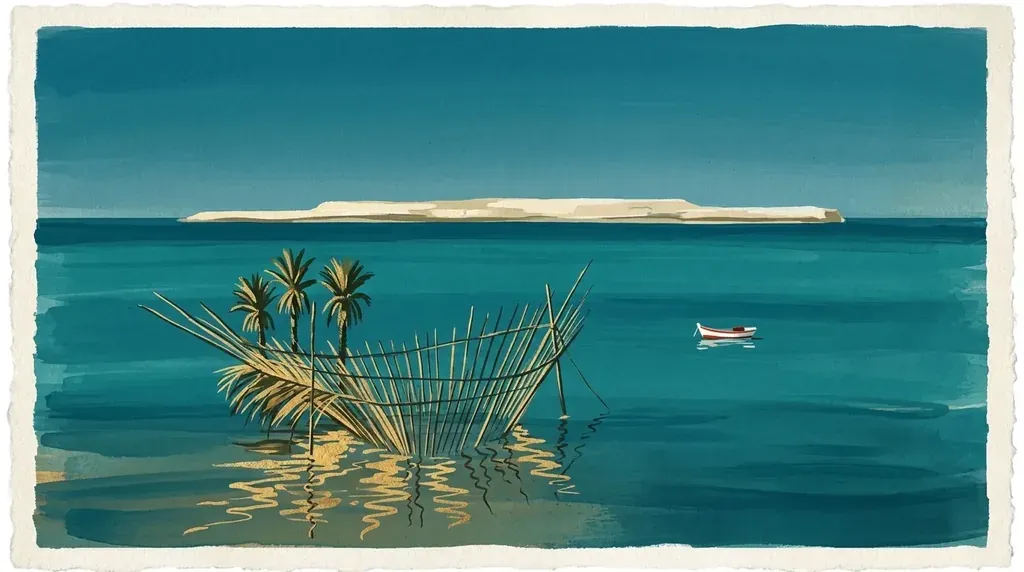
No Tunisian writer has held the sea as close to the body as Moncef Ghachem. Born July 29, 1946 in Mahdia, from a family of fishermen across four generations, he made the Mediterranean not a landscape but a substance of labour, fatigue and memory. His sea smells of fish, salt and effort, not suntan oil. His collection Cap Africa (1989), and above all L'Épervier, nouvelles de Mahdia, which won him the Prix Albert-Camus in 1994, give voice to a world of fishermen that the tourist narrative erases: those for whom the sea is, first and foremost, an uncertain livelihood.
This distinction matters. In a country that sells its coastline abroad, Ghachem's poetry reminds us that the sea was, first, a working-class space, inhabited by people who make their living from it and sometimes die by it. The Sunday beach and the fishing harbour sit side by side geographically and ignore one another socially. To read Ghachem is to refuse this erasure, and to recognise that the Tunisian sea is inhabited long before it is visited.
A space of freedom under gentle surveillance
For many Tunisians, the sea remains one of the few places where the usual codes loosen. At night, especially. In July, families settle on the sand after nightfall, once the heat has dropped and the beach turns into an open-air living room. People eat there, play music, sometimes sleep. This nighttime seaside sociability is one of the most egalitarian forms of summer leisure, because it costs nothing and welcomes everyone to the same spot — all the way to the shores of La Marsa, between sea and tradition.
This freedom isn't the same for everyone. Women's relationship to the beach remains under a social gaze that men don't face, and the female body is commented on, assessed, sometimes contested there. The sea opens up a space to let go, but it doesn't suspend the norms that weigh on the rest of the year. For some Tunisian women, seaside freedom has to be negotiated: choice of beach, of time, of dress, the presence of a group rather than a lone figure. The sea liberates and watches at the same time, and this tension is part of what it represents.
Exile always looks back to the sea
For Tunisian writers who left, the sea changes function. It's no longer a destination, but the thing that separates. Tahar Bekri, born in Gabès in 1951 and exiled to Paris since 1976, made it the very title of a collection, La brûlante rumeur de la mer. In his work, the Mediterranean doesn't soothe: it recalls the distance, the country left behind, the far-off sound of a coast no longer inhabited.
This sea-as-border also runs through the wider Tunisian imagination. Abdelwahab Meddeb, a Tunisian writer born in Tunis in 1946 and who died in 2014, turned the Mediterranean into a cultural matrix in Talismano (1979), a space where languages and memories circulate rather than a beach. Albert Memmi, born in Tunis in 1920, wrote less about the sea as element than about the city and identity in La Statue de sel (1953), but his work establishes this Mediterranean, plural Tunisia in which the coast is a threshold between worlds. In all three writers, the sea is never just water: it is the line along which the relationship to elsewhere is written.
The same sea carries mourning
We need to name what summer covers over. The Mediterranean that welcomes swimmers in July is also the route of the harga, clandestine emigration by sea. Tunisians, mostly young, set out from these same coasts toward Italy, and some don't come back.
The sea of celebration and the sea of departure are the same expanse of water, seen from the same shore.
This reality remains poorly quantified, and it would be dishonest to put forward a precise toll without solid sourcing. What is documented is the persistence of the phenomenon and the mark it leaves on entire families. The mourning, though, is unambiguous. There are mothers, sisters and wives who look at the sea knowing it has taken someone and will not return a body. Mahdia's sea cemetery, present in Ghachem's work, speaks to this old familiarity between the coast and death: the sea feeds and the sea swallows, and coastal communities have always known it.
For women, this dimension takes a particular shape. Against the figure of the one enjoying the beach stands the one waiting for a return. Waiting is an old feminine relationship to the sea, in fishing families as much as today, in those the harga has emptied of a son. The sea organises part of the lives of coastal women around a return that may never come, and this silent vigil belongs fully to the Tunisian maritime imagination, even when no survey measures it.
Silence as a final use
One less visible, equally real use remains: the sea as a place for doing nothing and saying nothing. Far from the crowded beach, many Tunisians maintain a contemplative relationship with the coast, an end of the day spent watching the water with no purpose. This silence isn't emptiness. It's a way of setting down what the year has accumulated, in a country where summer remains, for many, the only respite granted.
This is no doubt where all the functions of this sea meet. A space of controlled freedom, a place of popular celebration, a frontier of exile, a graveless grave, and finally a surface on which to lay down silence. The Tunisian sea carries all of this at once, and that is why it resists the simple narrative that tourism would like to make of it.
What the sea says about the Tunisian relationship to freedom and loss
The sea tells of an ambivalence Tunisian society knows well. It is the country's freest space and its most dangerous threshold. It offers people who have little a leisure that costs nothing, and it takes from others what they hold most dear. To think about the Tunisian sea is to hold both these faces together, without choosing the gentler one. For coastal women in particular, it remains at once the promise of release and the site of a wait, and it is this tension, more than any postcard, that tells the truth of it.