When starting a new chapter in life — a new city, a wedding — we look to create a pleasant environment: the perfect furniture, matching colors, sturdy materials. And yet, despite the time and money invested, an unease sometimes lingers: the space stays furnished without ever feeling truly alive. A simple reorganization is often enough to set everything right, following an ancestral method renowned for harmonizing homes: Feng Shui.
What is Feng Shui?
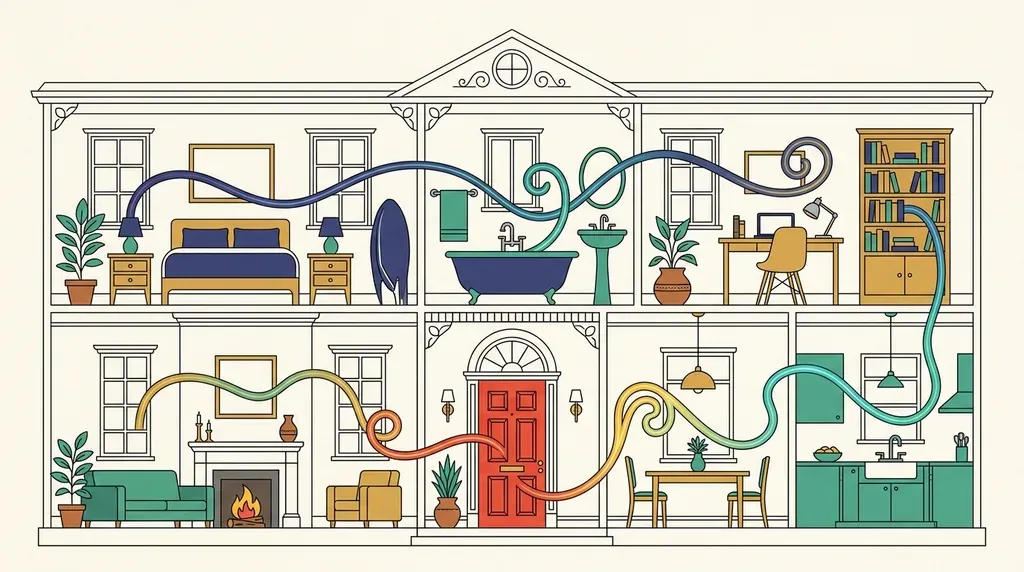
Often seen as a mere decorating trend inspired by Asian minimalism, Feng Shui is in fact a body of knowledge over 4,000 years old, as significant as traditional medicine in Chinese culture. It's a Taoist art built on balance and the smooth flow of energy stemming from water and wind — the objects within a home must respect this flow to preserve the household's health and prosperity.
What are the basic principles of Feng Shui?
| Principle | What it refers to |
|---|---|
| Chi | The environment's vital breath, gauged through the materials used, the Yin/Yang balance, and orientation according to the pa kua |
| Yin and Yang | The balance between opposites: masculine/feminine, light/shadow, full/empty, open/enclosed |
| The five transformations | The interaction between water, earth, fire, metal, and wood, following three cycles: production, control, weakening |
| The compass (luopan) | Helps organize the orientation of openings and the distribution of materials |
| The time factor | Knowledge of the yearly cycles that influence the quality of energy |
| The pa kua | An octagonal diagram used in Feng Shui analysis, with each direction carrying its own qualities |
To move from principles to practice, room by room, check out our dedicated guide: Feng Shui at Home.