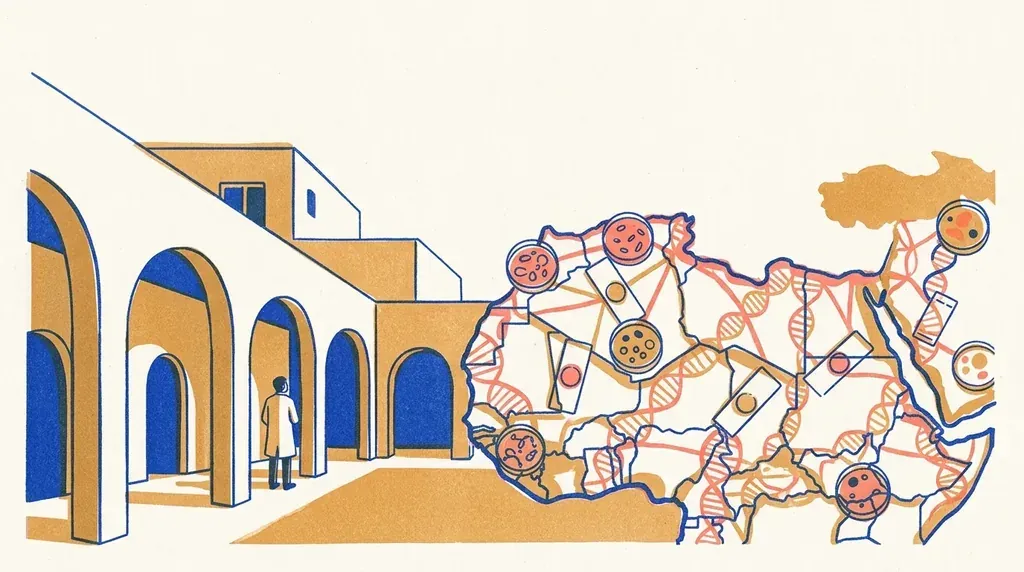
Dhia Bouktila, a professor of genetics at the University of Monastir, explains why the 2026 Nobel Prize in Physiology or Medicine owes so much to an alga: its biological mechanism, co-opted from its original setting, gave rise to optogenetics, now an essential tool in neuroscience.
Why is an alga behind a Nobel Prize?
A discovery, it would seem, is often born far from where it was expected, carried by a curiosity that refuses to confine itself to its starting point.
You may not have known it, but the 2026 Nobel Prize in Physiology or Medicine owes a great deal to an alga. According to a professor of genetics at the University of Monastir, the award recognises discoveries that made optogenetics possible, a control technique that has become indispensable in neuroscience.
Behind this feat lies a singular scientific story: that of a biological mechanism discovered in an alga, which has since become a major tool in neuroscience.
From an algal mechanism to a neuroscience tool: how did this shift happen?
It all begins far from any neuroscience lab, with an alga and a biological mechanism that, at first, had nothing to do with the human brain. Yet it is from this almost incidental observation that, through a singular chain of events, one of the major tools of brain research would emerge.
The most decisive discoveries don't always follow the path laid out for them: an algal mechanism became a major tool of neuroscience.
What’s the takeaway from this unplanned scientific detour?
At heart, this detour shows the unpredictable paths of knowledge: you never know in advance where one question will lead to another, or what it will ultimately illuminate. A discovery, it would seem, is often born far from where it was expected. It is carried by a curiosity that refuses to confine itself to its starting point.
This way of moving forward would also say something about a society preparing for its future: one that lets research cross the boundaries between disciplines gives itself the means for fruitful surprises. The alga that made optogenetics possible promised nothing of the sort at the start, and that is precisely what makes it worth remembering.
If this story moves us, it may be because it speaks to all of us about our own detours: the ones we never planned for, yet which lead us exactly where we needed to go.
More from La Sultane
After the World Cup: the FTF as a Mirror of Tunisia’s Crisis
Glam & Goodies Mini Market: the Pop-Up Shining a Light on Hammamet’s Creators
Harry Styles Crosses the Berlin Marathon Finish Line in Under Three Hours
Chery Arrizo 8: the New Premium Sedan Making Waves in Tunisia