Dar Lella Soltana
What the courtyard knew how to do, and concrete forgot
On 15 July 2026, the Tunisian Company of Electricity and Gas (Société tunisienne de l'électricité et du gaz, STEG) began cutting power…
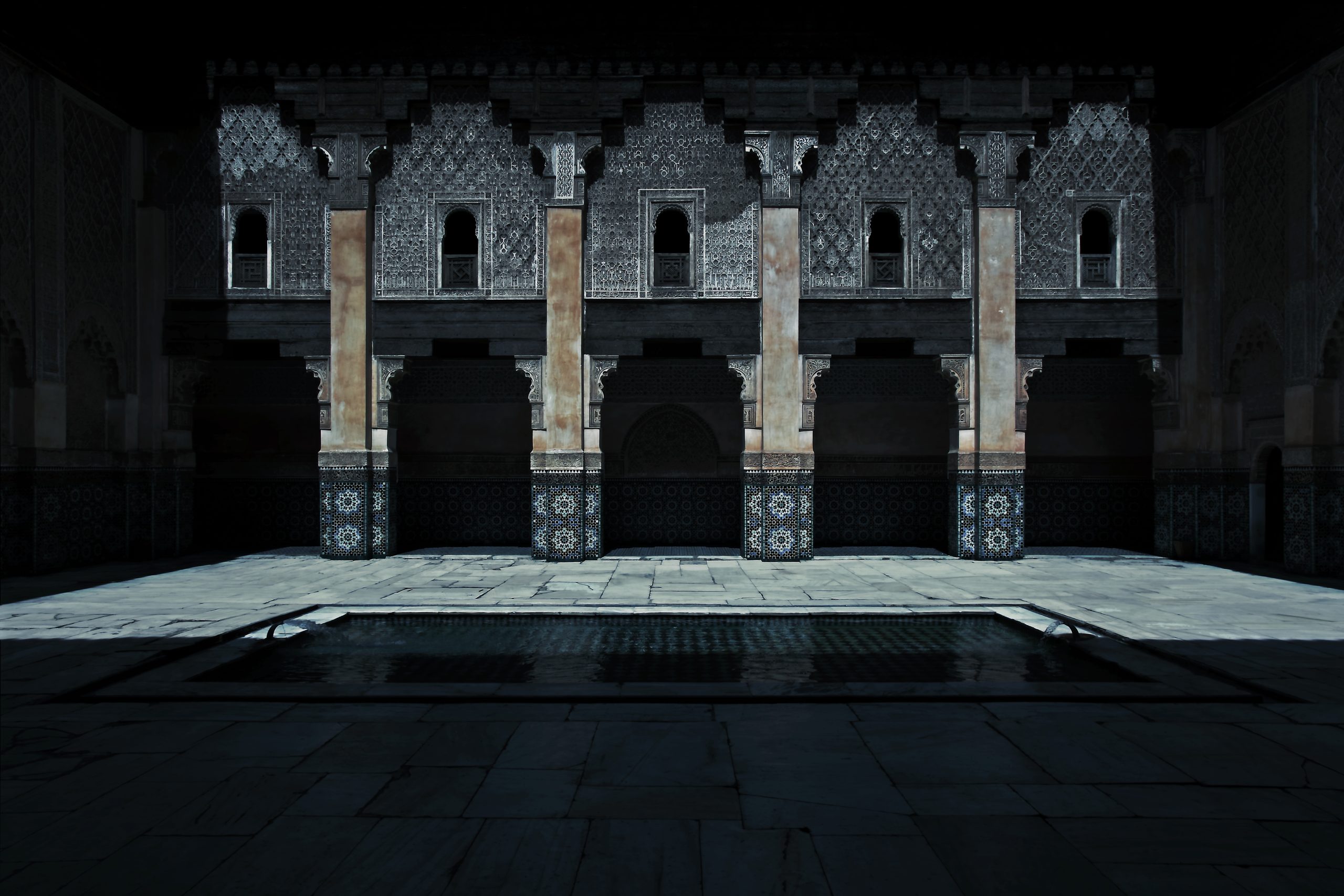
That same summer, five hundred kilometres away, houses carved into the rock at Matmata and courtyard houses in the medina of Fez, the historic walled quarter of the city, went through the heatwave without drawing a single kilowatt hour. The observation is circulating widely at the moment, usually in a nostalgic register. It deserves better than that. It deserves numbers, and it deserves an honest account of what these
buildings cannot do.
What exactly is being measured when we say thick walls cool a house ?
Two distinct things : damping and time lag. Thermal mass is the capacity of a wall to store heat before releasing it. A rammed earth wall sixty to eighty centimetres thick does not stop heat from entering. It delays it. The heat crosses the wall over eight to twelve hours and surfaces indoors in the middle of the night, at the moment when outside air, in an arid climate, has dropped by fifteen degrees. The wall creates no coolness. It moves heat through time, until it can be released.
Which is why the mechanism works in the Sahara and works far less well by the sea. It assumes a large daily temperature swing. At Ghardaïa, in the M'Zab valley of southern Algeria, daytime temperatures can reach 50 degrees with a daily swing of around 15 degrees, which gives the wall a chance to unload at night. In Tunis or Algiers in August, where nights no longer fall far enough, the nocturnal discharge is incomplete. Thermal mass then turns against the occupant, holding accumulated heat in place.
A literature review published in 2025 in the journal Energies reports the case of traditional courtyard houses in the Tunisian Sahara holding indoor temperatures of around 27 degrees while the outside reached 49. The gap is considerable, and it comes to us through a review rather than through the primary study. It rests on three elements in combination, never on one alone : substantial thermal mass, restricted openings to the outside, and a courtyard.
Why the courtyard is not ornament
The courtyard is an engine, not a decoration. The principle is the stack effect : hot air, being lighter, rises and escapes through the top of the courtyard, drawing cooler air up from the low, shaded rooms. At night the courtyard radiates towards the sky and cools faster than the surrounding air ; cold air, denser, pools there and serves as a reserve for the following morning. Rooms open onto it rather than onto the street, which explains the blank exterior facades of the medinas of Tunis, Fez and Algiers.
An engine has to be operated. This one was operated daily for centuries, very largely by the women who ran domestic space. Open at first light,
The M'Zab and Fez as study sites rather than postcards
close before ten, wet the courtyard floor to obtain evaporative cooling, move the family's life from one room to another according to the hour and the orientation : the Tunisian wast ed-dar, the central courtyard of the house, works because somebody is working it. That knowledge was never written into an engineer's manual. It passed between generations of women. Its disappearance is a technical fact as much as a cultural one, because a bioclimatic house used badly loses a large share of its performance.
Recent work confirms the mechanism and draws its limits in the same breath. A study published in 2025 in the journal Energies on multilevel courtyards measures a temperature reduction of around 2.15 degrees for optimised configurations. Two degrees is not trivial in a hot climate. Neither is it the miracle the nostalgic account implies.
The M'Zab valley in Algeria is probably the most studied vernacular site in the Maghreb in building physics terms. Its five ksour, the fortified villages of the region, listed as UNESCO World Heritage, are exercises in compactness : narrow lanes, party walls, very little wall surface exposed to the sun. A study published in 2025 in the journal Sustainability examined the effect of the size of compact urban fabric on thermal comfort in Ghardaïa, confirming that performance is not settled at the scale of the single house but at the scale of the district. Drop a Mozabite house alone in the middle of a suburban plot and it would lose part of its advantage. It is calculated to be pressed tight against its neighbours.
In Fez, a bioclimatic assessment of the traditional riads of the medina, the inward facing courtyard houses of the old city, published in 2025, combined calculation of thermal transmittance coefficients for rammed earth walls, Mahoney tables, the Givoni diagram and the PMV and PPD comfort indices, testing the results against Moroccan thermal regulation. The authors conclude that the passive strategies of the courtyard house and the thermal mass of local materials significantly improve indoor comfort. The same study notes that Fez has cold winters, which immediately shifts the question : architecture optimised against heat is not automatically efficient in the cold season.
In southern Tunisia, the troglodyte dwellings of Matmata push the logic of thermal mass to its conclusion. They do away with the wall altogether in favour of the rock itself, arranged around a central open air houch that is the only source of light. The Tunisian press reported in January 2026 that families still live there, with some of the houses having shifted to tourist use, museums or galleries, which brings in an income. The detail is telling. The survival of the built fabric now runs through an economy that is no longer the economy of living in it.
What vernacular architecture cannot do
This is the part most often skipped. A literature review published in 2023 in the journal Buildings on the challenges facing vernacular architecture identifies high maintenance costs and restrictive heritage regulations among the reasons pushing residents out of traditional houses and into modern ones. It also underlines the loss of maintenance knowledge : an earth render needs regular reworking, and the skill disappears faster than the building.
The geography of validity is narrow. The same review warns against applying vernacular strategies directly in humid or mixed climates, where comfort depends more on ventilation and humidity control than on mass. Then comes the number that should end the romance. A 2025 study published in Scientific Reports, by Mohammed A. Aloshan (Imam Mohammad Ibn Saud Islamic University, Riyadh) and Kareem M. Aldali (Horus University, Egypt), drawing on nearly 29,000 parametric simulations, finds that courtyard geometry accounts for less than 3 percent of the variance in performance, far behind glazing ratio and envelope composition. In hot and humid climates, energy optimised
A disappearance that is first of all an economic trade-off
configurations still produced several hundred hours of discomfort per year. The courtyard is a tool, not a guarantee.
One last limit, and the past could not have seen it coming. A study published in 2026 in the journal Buildings on morphological discontinuity shows that climate projections tip several regions from a cold desert regime into a hot desert one, which weakens the very hypothesis thermal mass rests on : nocturnal discharge. Warming is stripping thick walls of part of their physical rationale. Our grandmothers' houses were calculated for a climate that no longer entirely exists.
The courtyard house did not recede because people forgot it. It receded because it stopped adding up in the land market. A courtyard consumes footprint without producing sellable floor area. Work published in 2025 on reactivating courtyard logic in contemporary Indian architecture identifies exactly these obstacles : land cost, absence of financial incentives, and the priority given to marketable surface over communal or climatic space. The courtyard then ends up reduced to an ornamental atrium, losing both its environmental performance and its social meaning.
History holds a precedent that should temper any enthusiasm. The village of New Gourna in Egypt, built between 1946 and 1952 by the architect Hassan Fathy in mud brick, was meant to rehouse a community settled on the necropolis of Thebes. The residents refused to move in. Fathy abandoned the site after three years. UNESCO launched a safeguarding project in 2009, by which time the village was heavily degraded and partly demolished. The harshest criticism came from Egypt itself : the architecture blog Cairobserver noted in 2013 that the Fathy style is now built for a wealthy urban clientele, not for those it was intended for. Architecture can be thermally correct and socially misplaced.
That precedent does not condemn the technique. It condemns one way of imposing it. Women practitioners in the region work with raw earth differently today, starting from what already stands rather than from new villages. The Moroccan architect and anthropologist Salima Naji, who holds a doctorate from the École des hautes études en sciences sociales in Paris, has been building and restoring in stone and mud brick since 2004 : the collective granaries of southern Morocco known as igoudar, ksour, the kasbah of Agadir Oufella delivered in 2023, an archive centre in Tiznit. She received the Philippe Rotthier European Prize for Architecture in 2024, then the Global Award for Sustainable Architecture in 2025. In Algeria, the architect Yasmine Terki has directed the Algerian Centre for Earthen Built Heritage (Centre algérien du patrimoine culturel bâti en terre, CAPTERRE) in Timimoun since 2012, training craftspeople and architects in adobe, rammed earth and compressed earth block, and running the Archi'terre festival.
Their work runs into the same economic resistance all the same. After the earthquake of 8 September 2023, which hit the provinces of Al Haouz and Taroudant hardest, two rural areas of the High Atlas where building in earth and stone is the norm, raw earth was blamed for the collapse of the houses. Moroccan specialists corrected the diagnosis within weeks : the material was not at fault. The age of the buildings, their structure and the quality of the work were. Building in earth can meet seismic standards, provided it carries ring beams. The debate did not stop reconstruction from happening largely in cement. Knowing how to build in earth is not enough when the concrete block arrives faster and is easier to finance.
Maghrebi states took another route : regulation. Morocco adopted its thermal building regulation (Règlement thermique de construction au Maroc, RTCM), in force since October 2014, drawn up with the national energy efficiency agency and the national meteorological directorate, dividing the country into six climate zones represented by Agadir, Tangier, Fez, Ifrane, Marrakech and Errachidia, on the basis of readings from 37 weather stations. Expected savings range from around 25 kilowatt hours per square metre per year in Agadir to 116 in Ifrane, in a country where buildings absorb more than 30 percent of national energy. Algeria has had a thermal technical regulatory document since the 1990s, and Tunisia made thermal requirements mandatory for tertiary buildings and then for collective housing at the end of the 2000s. So the text exists in all three countries. Whether it is enforced is an entirely different question, and that is where the substance lies.
The Sultane view
There is a lazy way of loving old houses : photograph them, feel moved, go home to an air conditioned flat. There is another, more demanding, which keeps the principle rather than the form. Nobody is going to rebuild medinas. But the orientation of a home, the depth of a balcony, the solar protection of a window, the thickness of a wall, the possibility of cross ventilation at night : these are trade-offs that come up when buying, renting or renovating, and they weigh every summer on a bill and on a body.
The subject is not a heritage one. It is budgetary and political. As long as a developer earns more by selling square metres than by leaving room for a courtyard, and as long as a thermal regulation remains a document without serious enforcement, air conditioning will keep paying architecture's bill. Our grandmothers did not go without air conditioning because they were virtuous. They lived in houses that worked for them.
Kahla B.O