The gourmet moment
Four hours and forty six minutes : the kitchen as an inhabited room
On 20 April 2026, Morocco's High Commission for Planning (Haut-Commissariat au Plan, HCP) sent its surveyors out to more than 14,000 households for the country's third…
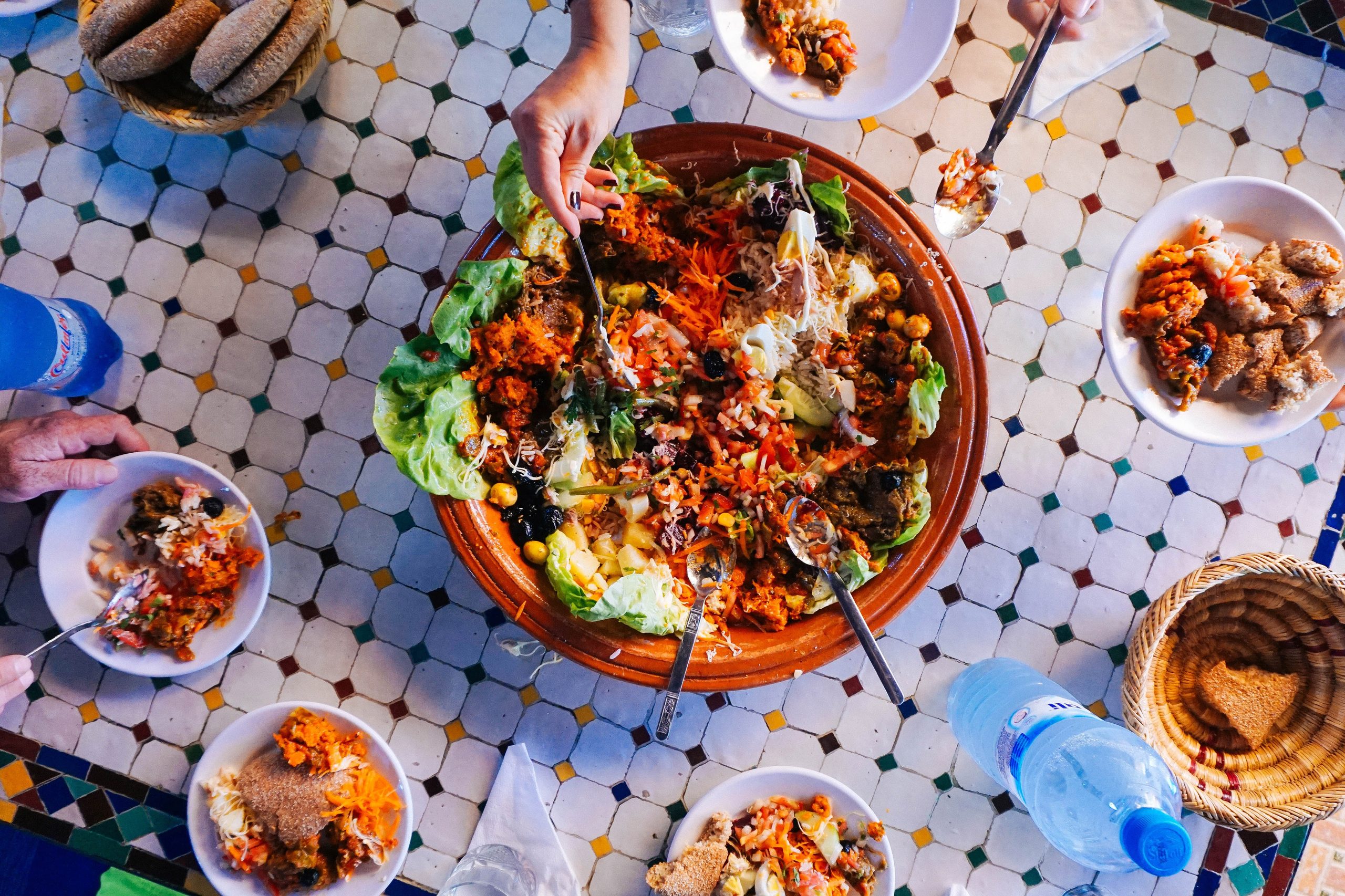
That room is the kitchen, and it is the room everyone says they love. It is also, statistically, where the unpaid work most systematically assigned to women collects, in the Maghreb as everywhere else. Both things are true at the same time. Holding them together, without flattening the kitchen into servitude or dressing it up as a sanctuary, is probably the only honest way to talk about it.
Why was the kitchen pushed to the edge of the house before it came back ?
The kitchen has not always been a separate room, and its position in the floor plan tracked the position of the people who worked in it. In nineteenth century European bourgeois housing, it was banished as far as possible from the drawing room and the dining room. The work was real. It simply had to stay out of sight. That was an architectural decision, not a technical constraint.
The architect Catherine Clarisse, in her work on the history of the kitchen in housing, shows that the twentieth century produced two opposing models. On one side, the Frankfurt kitchen, designed in 1927 by the Austrian architect Margarete Schütte-Lihotzky for a social housing programme : compact, rationalised, engineered to cut down the number of steps. On the other, the kitchen of Le Corbusier's Unité d'habitation in Marseille, in the early 1950s, so narrow that only one person fits inside. Clarisse calls it a corset kitchen. Technical progress and confinement advanced arm in arm.
Only from the 1980s and 1990s, once extractor hoods and household appliances made it possible to contain noise and smells, did the kitchen open onto the living room. It became the site of domestic sociability, often at the expense of the dining room. The hidden room turned into the display room.
What does the choice between open and closed kitchens say about women's work ?
Opening up the kitchen makes domestic work visible. Visible is not the same as shared. That is the nuance the decorating debate keeps losing.
The feminist argument for the open kitchen is solid. As long as the person cooking is physically cut off from the rest of the household, she is absent from the conversation, from the children's games, from the evening itself. Opening the room ends that exile. But Catherine Clarisse also observes that residents have often preferred closed kitchens when given the choice, and that the central island, sold as a space of freedom, in fact freezes circulation and installs a hierarchy of sightlines that a table does not impose.
An open kitchen brings a new demand with it : permanent tidiness. The room is exposed, so mess becomes public. What opening up made visible is not always the workload. Sometimes it is only the result.
In the Maghreb, the question arises in its own terms. The traditional courtyard house organises rooms around a central space, and the kitchen there is a place of collective work among the women of the household, not an isolated cell. Urbanisation and the shift to apartments individualised that arrangement. The modern kitchen is better equipped, and often occupied by one person alone. The equipment was gained. What was shared was lost.
How much time do Maghrebi women actually spend cooking ?
The available data agree on the scale of the gap and disagree on its exact size, for want of recent and harmonised surveys.
Domestic work figures across the Maghreb
• Morocco : 4 hours and 46 minutes a day for women against 27 minutes for men, including 4 hours and 33 minutes of strictly household tasks, cooking included (High Commission for Planning, National Time Use Survey 2012) • Algeria : around 85 % of women aged 12 and over prepare meals against 4.7 % of men, for roughly 3 hours and 15 minutes a day devoted to that single task (National Statistics Office, National Time Use Survey 2012, 9,015 households) • Tunisia : between 8 and 12 hours a day of unpaid care work for women against around 45 minutes for men (Oxfam and the Tunisian Women's Association for Research on Development, "Et s'il y avait une grève dans les foyers ?", 2021, method and sample not published)
The distance between the Tunisian estimate and the other two is not a contradiction. It is an effect of definition. The Oxfam and AFTURD study counts the whole of care work, childcare and support for elderly relatives included, whereas the Moroccan and Algerian time use surveys isolate narrower categories. Read these figures as three angles on the same reality, not as a ranking.
The Algerian figure is the one that speaks most directly about the kitchen : 85 % against 4.7 %. That is not a gap in duration. It is a gap in existence. An overwhelming majority of women prepare meals. An overwhelming majority of men prepare none.
The Tunisian economist Souad Triki documented the mechanics of that invisibility as far back as her work on rural Tunisia. Censuses do not count unpaid activity as work, which artificially pushes the activity rate of rural women below 20 % even though they carry out most of the productive labour. In those households, preparing bread in the tabouna oven alone took up some forty minutes a day.
One point deserves flagging. Tunisia has run no national time use survey since 2005. Morocco has only just restarted its own. Algeria has published no update to its 2012 survey. On a subject this structural, Maghrebi public statistics move slowly, and the delay is not neutral : what is not measured never becomes a public problem.
The neighbourhood oven, a kitchen outside the walls
The neighbourhood oven long shifted part of the cooking work outside the home, and with it part of women's sociability. In the medinas, most houses had no individual oven, for reasons of space and safety. The Moroccan ferran, like its Algerian and Tunisian equivalents, was part of a neighbourhood's basic equipment, alongside the fountain, the hammam and the Quranic school.
Families kneaded the dough at home, pressed a distinctive mark into it, then carried it to the oven. The baker knew each loaf by its shape or its place on the board. One oven in Sidi Bernoussi, in Casablanca, still bakes several hundred loaves a day and keeps Fridays for couscous. The terrah who works there describes his establishment as a place that animates neighbourhood life.
The system receded with the arrival of industrial bakeries and gas ovens from the 1970s and 1980s onwards. In Sidi Bernoussi, about ten ovens have closed. Nostalgia should be resisted here : the neighbourhood oven also rested on very hard working conditions for the men who ran it, with no social protection and no day off. But its decline produced a measurable effect on women's lives. A task that had been a reason to go out, to run into neighbours, to
What culinary transmission actually produces
keep information moving, became a solitary task at home again, or a purchase.
Maghrebi culinary transmission is now recognised as heritage, which changes its social status without changing how it is shared between women and men.
In December 2020, UNESCO inscribed the knowledge, know-how and practices linked to the production and consumption of couscous on the Representative List of the Intangible Cultural Heritage of Humanity, following a joint nomination by Algeria, Morocco, Tunisia and Mauritania. The official file describes a whole that runs from cereal cultivation to earthenware and wooden utensils, and explicitly associates couscous with solidarity, conviviality and living together. In 2022, Tunisia separately obtained the inscription of harissa under the heading "knowledge, know-how and culinary and social practices".
The couscous file states that transmission long happened informally, through observation and reproduction in the domestic setting, and that it is now moving out of the family circle and through structured educational arrangements. That is the interesting point. As long as the knowledge passes only in the family kitchen, it stays attached to the women who work there. Once it passes through schools, cooperatives or vocational training, it becomes knowledge anyone can acquire, boys included.
Recognising the value of that heritage requires no indulgence. A grandmother teaching a granddaughter to roll semolina between her palms passes on a real skill, a relationship to time, a family memory. Transmission is not the problem. The problem is that it happens only between women.
Eating together : a real benefit, poorly measured
Shared meals produce positive social effects, and the state of the research is less solid than public discourse suggests. Work conducted at the University of Oxford by the team of the psychologist Robin Dunbar established a correlation between how often people eat together and feelings of satisfaction, trust and community integration. These are correlations, not demonstrated causal relationships.
Social scientists also point out that the shared meal carries a cost that is rarely counted : the emotional and logistical work of whoever organises it. The conviviality of the table is produced by someone. In the Maghreb, the Friday meal, the family couscous, the festive tables that bring three generations around the same dish are powerful social institutions. They also rest on several hours of preparation carried out, in the vast majority of cases, by women.
The Sultane view
The kitchen is neither a trap nor a refuge. It is a room, and a room gets shared out. The imbalance measured in Morocco, Algeria and Tunisia will not be corrected by a better layout, nor by a gentler discourse on our mothers' recipes. It will be corrected the day preparing a meal stops being, for half the population, a skill nobody ever offered to teach them. The next Moroccan time use survey will deliver its results in 2027. It will be worth seeing whether fourteen years have moved the 27 minutes.
3. THE RECIPES
Four Maghrebi dishes that sit at the centre of the table and get shared. Quantities are given for family gatherings.
1. Ajlouk of courgettes (Tunisia), cold starter
Ajlouk, a spiced vegetable purée served cold, is a classic of the Tunisian kemia, the spread of small dishes set out before a meal.
Serves 6. Preparation : 20 minutes. Cooking : 20 minutes.
Ingredients
- 5 courgettes
- 1 small red pepper
- 4 garlic cloves
- 1 teaspoon paprika
- 1/2 teaspoon ground caraway
- 1 tablespoon ground coriander
- 1 tablespoon harissa
- 1 lemon
- 4 tablespoons olive oil
- Salt
Method
- Peel the courgettes, leaving every other strip of skin on, then cut them in half lengthways.
- Cook them covered in a large quantity of boiling salted water, about 20 minutes over medium high heat.
- Halfway through cooking, add 2 garlic cloves cut in half and the whole red pepper.
- Drain thoroughly in a colander and leave them to give up their water.
- Slip the skin off the pepper.
- Press the vegetables lightly by hand to squeeze out the excess water, then crush them with a fork or a potato masher together with the cooked garlic. The texture should stay coarse.
- Add the 2 remaining garlic cloves, crushed raw.
- Stir in the lemon juice, salt, harissa, paprika, caraway, coriander and olive oil.
- Taste and adjust the seasoning.
- Serve cold or at room temperature, with bread.
Note. Ajlouk is also made with aubergines (the original version), with carrots or with pumpkin. It keeps for 3 days in the refrigerator, and the texture improves the next day.
2. Djaj mqualli with dried fruit (Morocco), main course
Djaj mqualli, a chicken tagine simmered with saffron, prunes and dried apricots.
Serves 6. Preparation : 20 minutes. Cooking : 1 hr 10.
Ingredients
- 900 g chicken pieces
- 2 large grated onions
- 140 g pitted prunes
- 140 g dried apricots
- 150 g whole blanched almonds
- 1 teaspoon black pepper
- 1/2 teaspoon saffron threads, diluted in 2 teaspoons hot water
- 1 cinnamon stick
- 2 tablespoons honey
- 1 tablespoon orange blossom water
- 1 teaspoon ground ginger
- Vegetable oil
- Salt
Method
- Heat 3 tablespoons of oil in a large casserole over medium high heat. Add the grated onions, salt, pepper, diluted saffron, ginger, cinnamon stick and chicken.
- Fry uncovered for 10 minutes, stirring.
- Add 4 tablespoons of water, cover and leave to simmer 30 to 40 minutes, until the chicken is tender.
- Lift out the chicken and keep it warm.
- Add the prunes and apricots to the casserole and cook 10 minutes over medium heat.
- Stir in the orange blossom water and the honey, then let it reduce over low heat until the sauce coats.
- Return the chicken to the casserole to reheat it in the sauce.
- Fry the almonds in a little oil for 2 to 3 minutes, until golden. Drain on kitchen paper.
- Arrange the chicken on a large dish, coat it with sauce, spread the dried fruit over it and scatter the almonds on top.
Note. Mqualli refers to cooking in a casserole on the hob, as opposed to m'hammer, which is oven baked. The proportions of prunes and apricots vary from one family to another, and some use prunes only.
3. Mesfouf, buttered couscous (Algeria), dish to share
Mesfouf, steamed buttered semolina served with a vegetable broth and fermented milk on the side. A speciality associated with Constantine.
Serves 4. Preparation : 10 minutes. Cooking : 1 hour.
Ingredients
- 450 g precooked couscous semolina
- 5 tablespoons vegetable oil
- 70 cl cold water
- 1 onion
- 450 g broad beans (fresh or frozen)
- 450 g artichoke hearts (fresh or frozen)
- 1 bunch coriander
- 50 cl milk
- 115 g unsalted butter
- Salt
- Sugar and raisins (optional)
- 1 litre fermented milk (leben or kefir) to serve
Method
- Bring a large quantity of water to the boil in the bottom of the couscoussier.
- In a large deep dish, work the semolina by hand with the salt and the oil.
- Add 25 cl of water in four goes, stirring constantly so no lumps form.
- Leave to rest 5 minutes, then pour the semolina into the top of the couscoussier.
- Steam for 20 minutes, hollowing out a well in the centre so the steam circulates.
- Meanwhile, fry the sliced onion in the oil until it turns translucent.
- Add the chopped coriander and stir for a few minutes over medium heat.
- Add the broad beans, artichoke hearts and salt, then cover with 1.5 litres of water.
- Bring to the boil, then leave to simmer 20 minutes over low heat.
- Lower the heat, add the milk and hold it at a bare simmer until serving.
- Pour the semolina into a large dish and moisten it gradually with the remaining water, separating the grains with a fork.
- Return it to the steam for 15 minutes.
- Serve the semolina very hot, with the melted butter worked through it.
- Present the broth, the vegetables, the fermented milk, and if you like the sugar and raisins, separately.
Note. Mesfouf comes in many variants : sweet with raisins and dates, or savoury with vegetables as here. It is traditionally associated with the sahur meal during Ramadan. In high summer, broad beans and artichokes are commonly replaced by peas or by a sweet version with dried fruit.
4. Samsa with almonds (Tunisia), sweet
Samsa, triangles of brick pastry filled with almonds, fried then dipped in a syrup scented with orange blossom.
Makes about 30 pieces. Preparation : 1 hr 30. Cooking : 45 minutes.
Ingredients, filling
- 400 g blanched almonds
- 120 g icing sugar
- 2 tablespoons sugar
- 1/2 teaspoon vanilla extract
- 4 tablespoons orange blossom water
- 1 pinch ground clove
- 1/4 teaspoon ground cinnamon
- 4 tablespoons melted butter
- 20 sheets of brick pastry
- Vegetable oil for frying
Ingredients, syrup
- 300 g sugar
- The juice of one lemon
- 2 tablespoons orange blossom water
- 3 tablespoons runny honey
Decoration
- 70 g toasted sesame seeds or crushed pistachios
Method, syrup
- Pour the sugar into a saucepan and cover it barely with water.
- Add the lemon juice and the orange blossom water.
- Heat over low heat and stir only once, with a wooden spoon, at the moment it boils.
- Leave to reduce 20 to 30 minutes, until it reaches 105 °C.
- At around 90 °C, stir in the honey.
Method, filling
- Toast the almonds lightly, then grind them finely.
- Mix the ground almonds with the clove, cinnamon, sugar and vanilla.
- Sift the icing sugar over the top and mix.
- Add the orange blossom water and the melted butter, then knead until the paste is smooth.
- Shape into small, even balls.
Folding and cooking
- Cut each sheet of brick pastry into two equal parts.
- Fold the half sheet lengthways, then fold it back on itself.
- Set a ball of filling in the bottom left corner.
- Fold the bottom right corner over to the left, then fold the resulting triangle to the right.
- Fold the top right corner down and tuck the point under the fold, like an envelope.
- Heat the oil over medium heat in a deep saucepan.
- Fry the samsas, turning them, until golden.
- Drain on kitchen paper.
- Dip them in the syrup while still hot, but not scalding.
- Lay them on oiled baking paper and sprinkle with toasted sesame or crushed pistachios.
Note. Samsa is claimed as an origin by both Tunisia and Algeria. There is a version known as samsa bel jeljlen, with peanut and toasted sesame, and modern versions with pistachio or hazelnut. Leave to cool completely before storing in a metal or glass tin, in a cool place.
Kahla B.O