Hanoune
A home at child height : what the adult order quietly takes away
Count the people in an ordinary urban Moroccan flat, then count the…
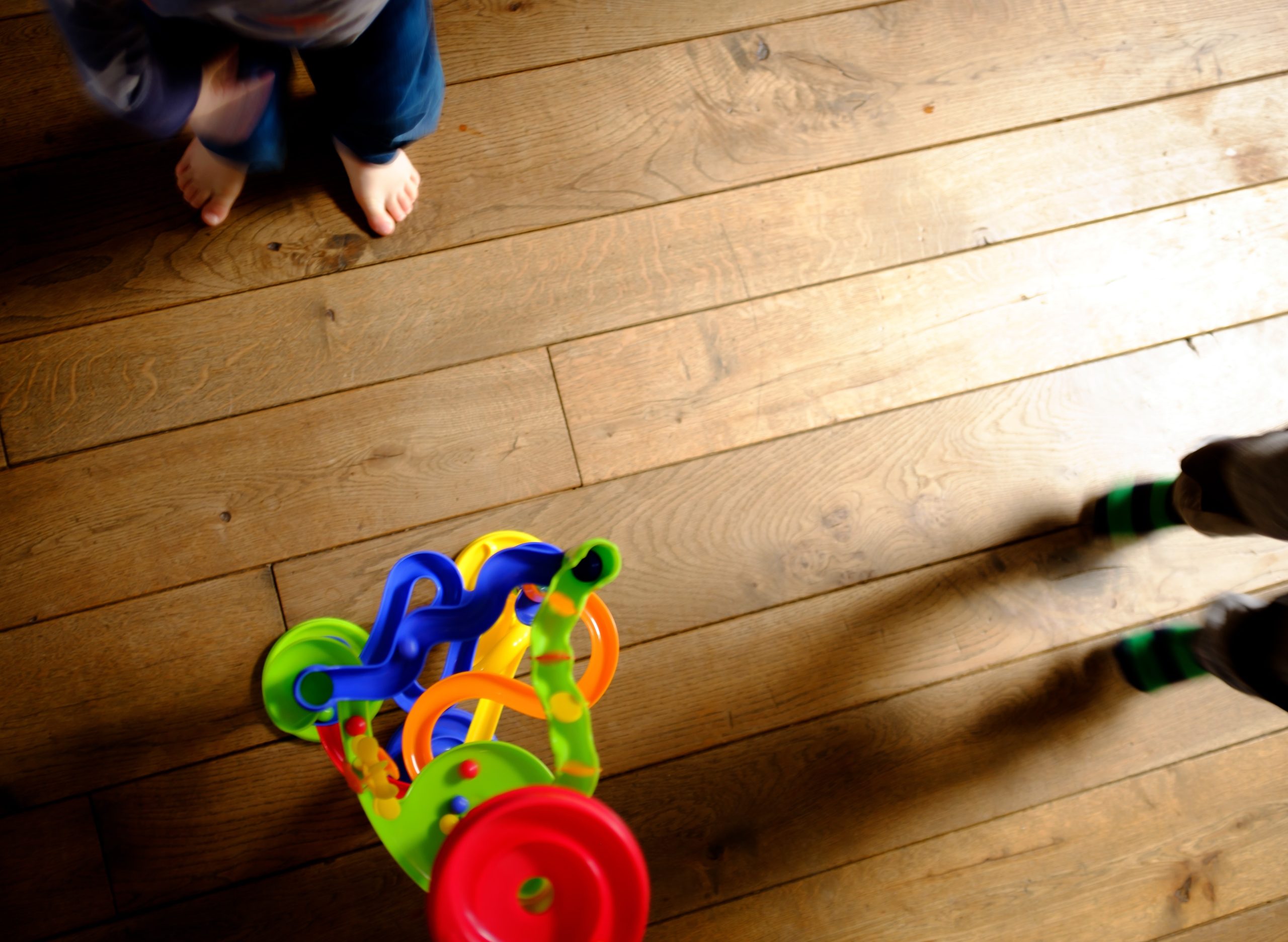
Two conversations open at that point, and they get mixed up almost every time. One is a research question : what does it do to a growing child to have, or not have, a space of her own ? The other is domestic, far more ordinary, and repeated daily : who decides how a house runs, and on what grounds ? A mother can live in a comfortable four-room flat and still leave her children exactly no say in how the place works. Shortage of room and dispossession are two different problems.
What does the research actually say about space and child development ?
Housing overcrowding is associated with cognitive and behavioural difficulties in children. The effect, though, is more modest and more indirect than common sense expects. The most cited synthesis remains the international review by Kimberly Ferguson, Rochelle Cassells, Jack MacAllister and Gary Evans, published in 2013 in the International Journal of Psychology. We cite it despite its age for two reasons : no review of comparable scope has replaced it since, and it pools data from Egypt, India, Thailand, South Africa and Jamaica rather than from the Western world alone.
Its central finding runs against the intuition. Overcrowding works on the adults before it works on the child. Parents living in dense housing speak less to their children, with a poorer vocabulary, and answer less readily when asked. Family tension and physical punishment are more frequent. The child, for her part, develops a coping strategy the literature documents well : withdrawal. She shuts out the noise, the demands, the presences. The skill protects her and it costs her, because the same wall that keeps the noise out keeps out the family and friends around her.
Then the size of the effect, where caution is required. A study published in 2024 in the journal Psychology, Health and Medicine, conducted by researchers from the Department of Child and Adolescent Health at the University of the West Indies in Kingston, Jamaica, followed 1,311 four-year-olds assessed across six developmental domains. Overcrowding told on two of them : motor development, and personal and social development. Language, coordination and practical reasoning showed no significant effect. The authors note that evidence for an overall effect of household size on development remains thin. Established ground, then, as to the direction of the effect. Contested ground as to its intensity.
Sleep, the best documented tipping point
If one mechanism deserves a mother's attention, it is sleep, because sleep is where spatial constraint becomes measurable. A systematic review published in 2025, drawing together work published between 2019 and 2024 on children aged 6 to 12, finds consistent associations between sleep quality and cognitive performance, emotional balance and reduced behavioural problems. Sleep is not a question of comfort. It is the channel through which the physical environment reaches development.
And dense housing goes for that channel first. A child who shares a room with adults goes to bed at adult hours. A study published in January 2025 on a cohort of middle-aged women establishes a link between housing density and reduced sleep duration. The limit has to be said honestly : those data concern adults, not children, and cannot be transposed mechanically. They mark a lead, not a proof.
Which moves the question sideways. The trouble is not the shared bedroom as such. It is the forced synchronisation of rhythms. Five people in three rooms who protect a sleep window for the youngest do not produce the effects of four people in four rooms with the television running until midnight.
Is the shared bedroom a Maghrebi handicap ?
No. And the question, framed that way, carries a bias worth naming. One bedroom per child is a recent norm, historically situated, and a minority arrangement worldwide. It is not where progress ends up.
Housing figures across the Maghreb
• Morocco : 1.3 people per room in urban areas, against 1.6 in 2014 (High Commission for Planning, 2024 census) • Morocco : 372,000 urban dwellings occupied by two households or more, that is 6.3 % of the occupied stock (High Commission for Planning, 2024) • Tunisia : three-room dwellings make up 46.6 % of the stock, average household size 3.45 people (National Institute of Statistics, 2024 census) • Algeria : occupancy rate of 4.25 people per dwelling at the end of 2023, against 5.5 in 2000 (Ministry of Housing data relayed by the Algerian business press) These figures trace a trajectory, not a misery. Tunisian single-room dwellings are down to 2.8 % of the stock, against 40.9 % in 1975. Average household size there fell from 5.5 people in 1975 to 3.45 in 2024. One generation, and the grip has loosened that far.
That leaves intergenerational cohabitation, which still shapes part of Maghrebi housing. The costs to a child are real : less space, more noise, a domestic hierarchy in which she comes last, and a mother whose educational authority is sometimes diluted among several adults. The resources are real too, and Western models do not know how to manufacture them : several attachment figures, adults available at almost any hour, learning early to negotiate and to read other people. Research on overcrowding measures the costs above all, because it was built in societies where density is an accident rather than an organisation. That is a limit of the literature, not a truth about Maghrebi families.
The adult order : what a layout takes away without saying so
The real lever, and it works in a small home, is accessibility. A child who can reach neither her clothes, nor her toys, nor a glass of water depends on an adult for every gesture she makes. That is not a shortage of space. That is the height of a cupboard.
This is the central intuition of Montessori pedagogy, which deserves judging on the evidence rather than on its reputation. The most rigorous systematic review to date, by Justus Randolph and published in 2023 in Campbell Systematic Reviews, retained 32 comparative studies. It finds positive and consistent effects : 0.24 standard deviations on academic outcomes, 0.33 on non-academic outcomes, 0.36 on executive functions, meaning the capacity to plan, to hold back an impulse and to keep attention going.
Real, then, and modest, and the authors flag the limits themselves. Eighteen of the thirty-two studies come from the United States. The search stops at English-language publications appearing up to February 2020. The Montessori label covers implementations of wildly uneven seriousness, from the full system down to an occasional add-on. Not one included study concerns the Maghreb. So the honest conclusion runs like this : the approach works, a little, in well resourced Western school settings. Nothing proves that low furniture transforms a child.
What crosses over to the home is the principle, not the equipment. The environment matters, and it matters measurably. The reference study on school architecture, led by Peter Barrett at the University of Salford in the United Kingdom, followed 3,766 pupils in 153 classrooms across 27 primary schools. It attributes 16 % of the variation in learning progress to the physical characteristics of the room : natural light, temperature, air quality, and above all the pupil's ability to personalise her space. That work dates from 2015 and has never been replicated at that scale since, which argues for reading it as an order of magnitude rather than as a law.
A right, not a luxury
A child's space is not an educational preference. It is a recognised obligation. Article 31 of the Convention on the Rights of the Child guarantees the right to rest, leisure and play. The United Nations Committee on the Rights of the Child, in its general comment number 17, states that public investment too often concentrates on organised activities, when what children need is time and spaces for spontaneous play. The text names urban planning, parks and green spaces explicitly.
In the Maghreb that dimension decides a great deal, because the question is not settled in the living room. When housing is small, a child's space is outside : the street, the courtyard, the square, the vacant lot. Mothers know it. They also know that this outside is neither safe nor equally open to girls and boys. The spatial restriction imposed on girls in adolescence then adds itself to the constraint of the home. International research on overcrowding, centred on the interior of the dwelling, almost never captures that.
The Sultane view
The room of one's own will not arrive. Not in a housing stock where the three-room dwelling is the norm, and not in the budgets that follow either. What is within reach is smaller and closer to hand : a drawer whose contents the child alone decides, a bedtime that belongs to her, a wall where she can put up what she likes. Autonomy is not measured in square metres. It is measured in the number of decisions a child can make without asking.
NJM