At Zeryeb
A history of inhabiting : what our houses say about us
The United Nations has made 2026 the International Year of Rangelands…
It makes a good starting point for a question that looks simple and is not : since when, and why, have humans lived in one place ? The schoolbook account runs smoothly. Humanity was nomadic, then invented agriculture, then settled, then built cities, each stage an improvement on the last. The archaeology of the past ten years has taken that sequence apart, methodically. And the Maghreb, long filed as a margin of the story, has turned into one of its most interesting grounds.
A note on method, since this article is the only one in the issue to allow itself older sources : when the subject is archaeology or the
history of ideas, a fourteenth century text or an ethnographic study from 2017 remains a valid reference. What has been dated does not expire. Wherever the current condition of a heritage site is concerned, however, the figures cited are from 2025 or 2026.
Was sedentary life born out of agriculture ?
No, not systematically, and this is the most important revision in a century of archaeology. The classic model made agriculture the cause and settlement the consequence. Several sites have reversed or blurred that relationship.
The clearest case comes from Japan. The Jomon culture, present in the Japanese archipelago from around 14,000 BCE, produced lasting villages, pottery and semi-sunken houses without agriculture forming the basis of subsistence. The site of Sannai Maruyama, in Aomori prefecture, housed several hundred people, large pit dwellings, monumental timber structures and long-distance exchange networks. Japanese researchers speak of a sedentary revolution for this period, distinct from the agricultural revolution. People chose to stay, for millennia, because the sea and the forest allowed it. They never ploughed a field.
A review published in 2025 in the Journal of World Prehistory asks head on whether the concept of the Neolithic holds up as a unified category at all. The move towards settlement and social complexity sometimes precedes the domestication of plants and animals, sometimes follows it, and the case of the Americas refuses to fit the mould built for the Near East. We are in the register of open scientific debate here, not settled fact.
What ancient DNA changed in the Maghrebi account
A great deal, and in a direction that contradicts an old assumption. The neolithisation of North Africa was long told as an import : farmers from elsewhere brought their seeds, their animals and their villages to passive local populations. The palaeogenomes say otherwise. Above all, they say the answer changes from one end of the Maghreb to the other.
A study published in Nature in 2025, presented by the archaeologist Giulio Lucarini (National Research Council, Italy), analysed the genomes of nine individuals who lived in the eastern Maghreb, present-day Tunisia and eastern Algeria, between 15,000 and 6,000 years before present. The result : ancestry linked to farmers arriving from the Mediterranean accounts for less than 20 % per individual. The bulk of the genetic heritage stays anchored in the local hunter-gatherer inheritance. Signatures linked to the Levant appear around 6,800 years before present, associated with the arrival of pastoralism and domestic animals.
The contrast with the western Maghreb is striking. At the site of Kaf Taht el-Ghar, near Tetouan in Morocco, the proportion of ancestry linked to European farmers reaches around 80 %. A few hundred kilometres away, at Ifri n'Amr ou Moussa, in Khemisset province, individuals of entirely local ancestry were buried with pottery and with practices tied to agriculture. Same moment, same territory : some groups adopted the techniques without any change of population, while others saw their demographic composition transformed.
The same phenomenon has been documented elsewhere. A study published in Science in June 2025, led notably by Dilek Koptekin with the Middle East Technical University in Ankara, Hacettepe University and the University of Lausanne, established 7,000 years of genetic continuity in western Anatolia despite major cultural transformations. The authors conclude that change came sometimes through migration and sometimes through the circulation of ideas, depending on region and period.
The lesson holds beyond archaeology. A way of inhabiting can travel without bodies travelling.
Ibn Khaldoun asked the question before anyone else
In the fourteenth century, a jurist and historian born in Tunis built the first systematic theory of the opposition between nomadic and urban dwelling. The Muqaddima of Ibn Khaldoun distinguishes badawa, the life of the encampment and the tribe, from hadara, urban and settled life. This is not a picturesque classification. It is a political model.
For him, badawa is defined by the absence of a state, of taxation, of a standing army and of the city, and by the existence of a very strong group solidarity, assabiya, which binds individuals into families, families into clans, clans into tribes. Hadara is defined by the reverse : a central power strong enough to levy tax, which is what makes the city possible. His central thesis is that the city, by producing comfort and specialisation, gradually dissolves the assabiya that founded it, until a more tightly bound peripheral group takes over.
This source is more than six centuries old. It is cited here because it forms the theoretical foundation from which a large part of the urban sociology of the Arab world proceeds, and because it formulates an intuition that contemporary archaeology partly confirms : the way people inhabit is not a backdrop to social life, it is one of its structuring variables. Ibn Khaldoun's cyclical model can be argued with, and historians do argue with it. He cannot be treated as a regional curiosity.
The tent is an architecture, and it is made by women
The point is rarely put this way, and it deserves to be. In the pastoral societies of the Maghreb and the Sahara, the tent is not a makeshift shelter while waiting for the real house. It is a complete technical system, and its production belongs to women.
The anthropologist Ahmed Skounti, of the National Institute of Archaeological Sciences and Heritage in Rabat, devoted a study to the question, published in the journal Hespéris-Tamuda in 2017 under the explicit title of mobile architecture. A reference predating 2020, retained because it is descriptive ethnography of a long-established craft, and because it comes from a Moroccan researcher working on his own ground.
The khayma is made of woven strips, the flij, joined by stitching, and of a wooden frame with central poles and pegs. The women spin the fibres themselves, goat hair most often, weave the strips in teams and maintain the whole. Producing a few metres of flij demands considerable patience and dexterity. The shape, the density of the weave and the quality of the hair vary by region and by the skill of the weavers.
The result is a dwelling that can be taken down, transported and is thermally adapted, and whose design and manufacture are in female hands. In a history of architecture that has long recorded the names of palace builders, this deserves to be noted without emphasis : a significant share of the region's housing stock, for centuries, was produced by women.
Matmata and the ksour : technical answers, not scenery
The troglodyte dwellings of southern Tunisia are usually presented to travellers as astonishing remains. They are first of all engineering solutions.
At Matmata, some forty kilometres from Gabes and at around 600 metres of altitude, dwellings cut into the rock provide natural thermal insulation in an environment where summer temperatures are hostile. The principle is the one bioclimatic construction pursues today, fifteen centuries early and at zero energy consumption. Families still live there.
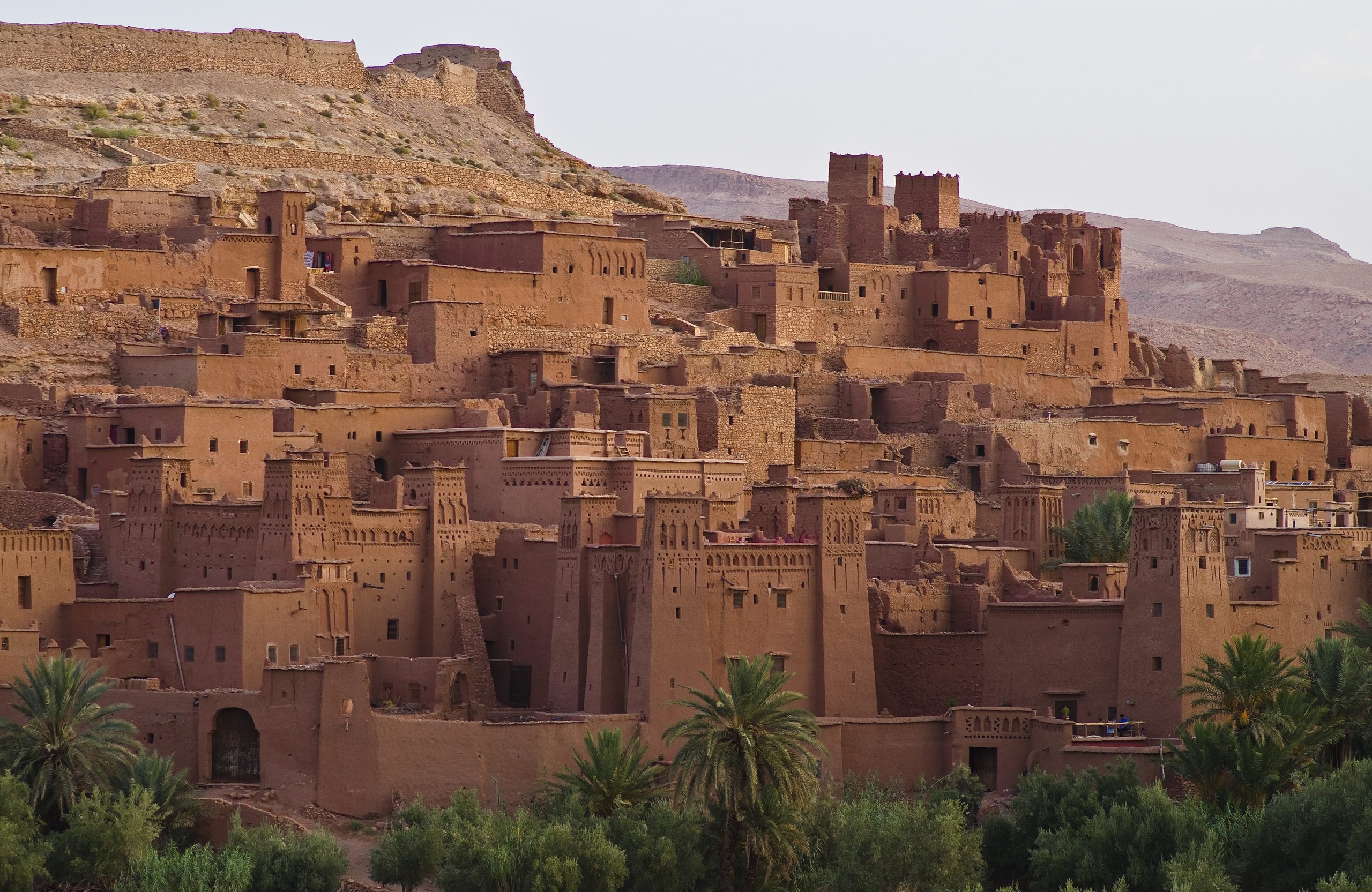
The ksour follow another logic, a collective one. These fortified granaries, around ninety of them recorded between the governorates of Medenine and Tataouine, held the reserves of one or several tribes through long droughts. Each storage cell, the ghorfa, belonged to a family. Ksar el-Ferch, northwest of Tataouine, holds around 280 of them. This is not decorative architecture. It is a mutualised food insurance scheme, doubled as a defensive system.
In January 2020 Tunisia submitted to the UNESCO World Heritage tentative list a serial property entitled Troglodyte habitat and the world of the ksour of southern Tunisia. The dossier argues precisely along these lines : forms of human settlement representative of the interaction between indigenous communities and an unfavourable natural environment. On 14 April 2025, Ksar Ouled Soltane, near Tataouine, was inaugurated after restoration under the RINOVA project, co-financed by the Italian Agency for Development Cooperation and carried out with Tunisia's National Heritage Institute. Several of the site's spaces have been converted into outlets for local products and into workshops run by women from an agricultural development group.
Is the medina still standing ?
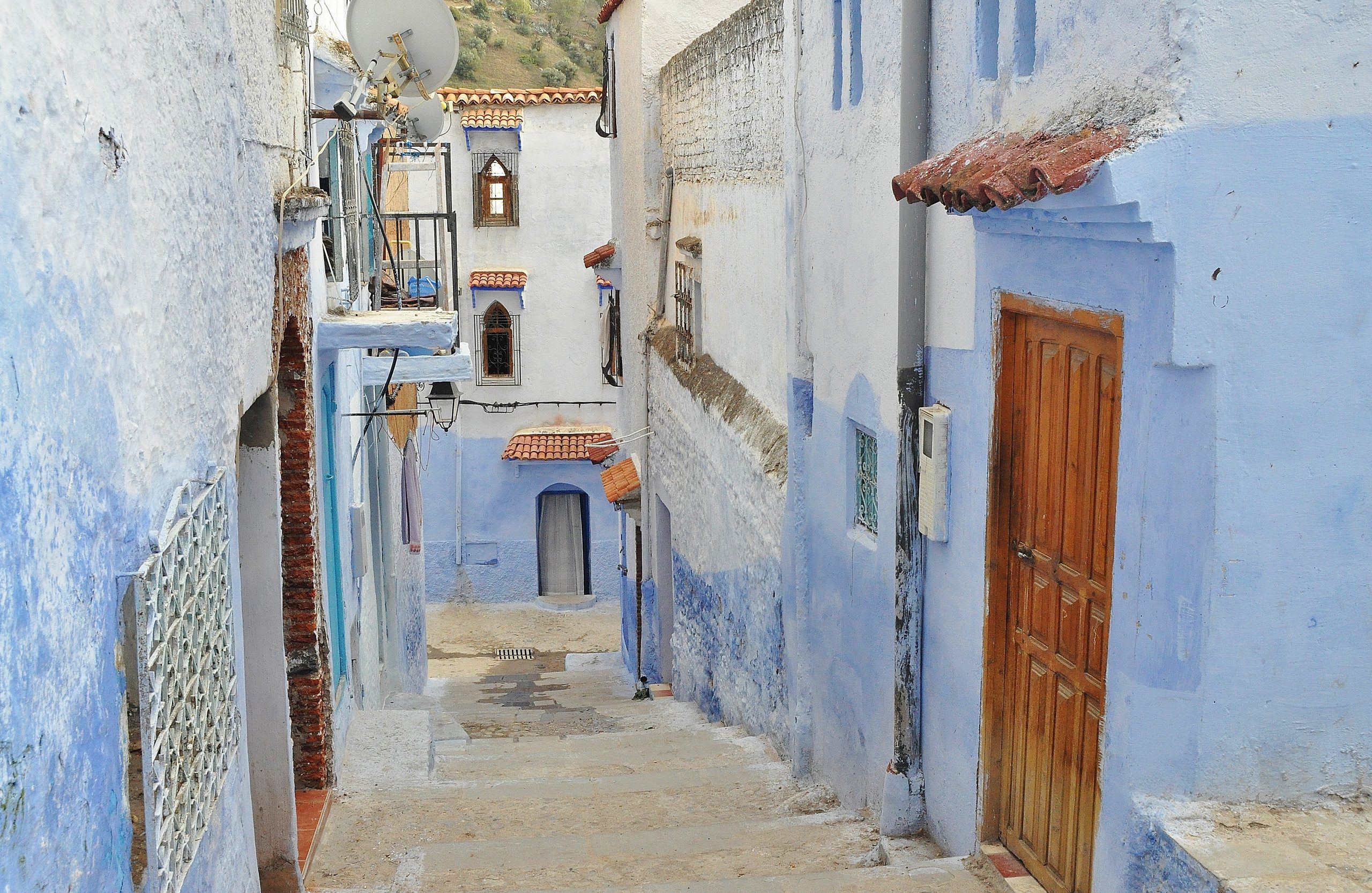
Partly, and at considerable cost. The medina is not an old neighbourhood, it is a coherent urban system : a hierarchy of streets running from public to private, and a house organised around a central patio, the wast ed-dar in Tunisian, which regulates temperature and concentrates domestic life. Historically this arrangement gave women an outdoor space inside the house itself, at a time when the street was largely male territory. The patio was not an ornament. It was an air conditioner and a private public square.
The current condition of this heritage can be read in official reports, and it is mixed. In Algiers, the 2025 state of conservation report of the UNESCO World Heritage Centre on the Casbah records 143 buildings already rehabilitated, emergency measures planned for 25 severely degraded buildings and around thirty others reported to the wilaya services. The report confirms a positive dynamic since 2023 while pointing to the absence of an independent governance structure.
In Morocco, the wali of Fes-Meknes Mouaad Jamai presented on 16 April 2025 the assessment of fifteen years of rehabilitation of the medina of Fes : three billion dirhams invested between 2010 and 2025, 399 projects, 4,671 buildings at risk of collapse treated, around 20,000 beneficiaries. In Tunisia, the Association for the Safeguarding of the Medina of Tunis launched at the end of 2025 a twelve-month study on the legal, architectural and urban preservation of historic heritage, with the National Heritage Institute, UN-Habitat and the National School of Architecture and Urbanism.
Meanwhile the underlying movement continues. The report Africa's Urbanisation Dynamics 2025, co-produced by the OECD, the African Development Bank, UCLG Africa and Cities Alliance, projects a doubling of Africa's urban population, from 700 million to 1.4 billion inhabitants by 2050. In Morocco, the urban share would rise from 68 % in 2020 to 81 % in 2050. In Tunisia, from 72 % to 77 %. The Maghrebi way of inhabiting tomorrow is being decided less in restored medinas than in the peripheries growing around them.
The Sultane view
What this long history teaches is not that the ancients were right. It is that ways of inhabiting cannot be ranked on a scale running from primitive to modern. A tent woven by women, a house cut into rock, a fortified collective granary and a flat on the edge of Tunis each answer precise constraints, with the means available.
That observation has a practical consequence. When a medina or a ksar is restored, what is preserved is not a memory. It is a library of tested technical solutions to heat, water scarcity and food insecurity. Those are precisely the constraints coming back. The air conditioners running today in Tunis, Algiers and Casablanca are doing work the patio did for free.
The question is therefore not whether we should go back to living in a patio house. It is why we stopped counting this knowledge as engineering, and at what point we began to look at it as folklore.
Houda Chouk